
[论文解读] Categorical Symmetry of the Standard Model from Gravitational Anomaly
本文表明,在重力背景下,由于标准模型中的混合 U(1)–重力和 Z4/重力异常,非可逆的、范畴性的 B-L 对称性仍然存在,并通过异常注入和拓扑量子场论构建了相应的拓扑缺陷算符。
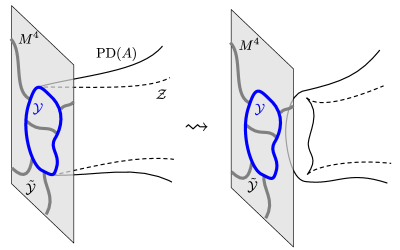
In the Standard Model, some combination of the baryon $\bf B$ and lepton $\bf L$ number symmetry is free of mixed anomalies with strong and electroweak $su(3) imes su(2) imes u(1)_{ ilde Y}$ gauge forces. However, it can still suffer from a mixed gravitational anomaly, hypothetically pertinent to leptogenesis in the very early universe. This happens when the total "sterile right-handed" neutrino number $n_{ν_R}$ is not equal to the family number $N_f$. Thus the invertible $\bf B - L$ symmetry current conservation can be violated quantum mechanically by gravitational backgrounds such as gravitational instantons. In specific, we show that a noninvertible categorical $\bf B - L$ generalized symmetry still survives in gravitational backgrounds. In general, we propose a construction of noninvertible symmetry charge operators as topological defects derived from invertible anomalous symmetries that suffer from mixed gravitational anomalies. Examples include the perturbative local and nonperturbative global anomalies classified by $\mathbb{Z}$ and $\mathbb{Z}_{16}$ respectively. For this construction, we utilize the anomaly inflow bulk-boundary correspondence, the 4d Pontryagin class and the gravitational Chern-Simons 3-form, the 3d Witten-Reshetikhin-Turaev-type topological quantum field theory corresponding to a 2d rational conformal field theory with an appropriate rational chiral central charge, and the 4d $\mathbb{Z}_4^{ m TF}$-time-reversal symmetric topological superconductor with 3d boundary topological order.
研究动机与目标
- 澄清混合引力异常如何影响标准模型中的 B-L 及相关的 U(1) 对称性。
- 证明在弯曲时空背景下,非可逆(范畴性)B-L 对称性带的电荷仍然存在。
- 利用体–边界注入和 TQFT 技术,从带异常的 U(1) 与 Z4-重力异常出发,建立非可逆对称算符的构造。
- 将扰动性和全局异常(Z 与 Z16 分类)与标准模型框架中的非可逆范畴对称性联系起来。
提出的方法
- 通过 Atiyah–Singer 指数定理推导的 6d 异常多项式来表达 4d SM 的异常结构。
- 将混合 U(1)–gravity 与纯 U(1) 异常表示为 Z^2 与 Z16 的元素,并与 cobordism 分类相关联。
- 通过在缺陷世界体上附着与块体引力/U(1) 背景耦合的 3d TQFT 来构造非可逆对称拓扑缺陷。
- 利用异常注入将 6d 多项数据关联到 5d 可逆相与 4d 边界现象,从而产生非可逆电荷。
- 讨论 framing、Atiyah 的 2-framing,以及引力 Chern–Simons 项在定义拓扑缺陷中的作用。
实验结果
研究问题
- RQ1混合 U(1)–重力与纯 U(1) 异常如何影响标准模型中 B-L 的守恒?
- RQ2由引力背景引起的不可守恒是否可以重新表述为不可逆(范畴性)对称性?
- RQ3利用 3d TQFT 与体–边界注入,非可逆 B-L 对称算符的明确构造是什么?
- RQ4Z4 与 Z16 全局异常分类如何在标准模型情境中体现为不可逆范畴对称性?
- RQ5流形同伦和异常注入框架如何统一扰动性与全局异常数据,以生成不可逆对称性?
主要发现
- 当 n_{νR} ≠ Nf 时,非可逆的 B-L 广义对称性在引力背景下存活,用非可逆电荷取代守恒电流。
- 混合 U(1)–重力异常和全局 Z4,X 重力异常可以编码为附属于缺陷世界体的 3d TQFTs 推导出的拓扑缺陷。
- 异常数据组织成一个 6d 多项式,其注入到 5d iTFT 与 4d 边界理论中,产生一致的非可逆对称结构。
- 处理两类异常:由 Z^2 分类的扰动局部异常和由 Z16 分类的全局异常,两者都可实现为不可逆对称。
- 该框架使用异常注入、4d Pontryagin 类、引力 Chern–Simons 项,以及具有 framing 异常的 3d RT 型 TQFT 来定义范畴对称算符。
- 该方法与基于 cobordism 的异常分类相连,提出在 leptogenesis/baryogenesis 情景中整合 BSM 部分或相互作用的 TQFT/CFT 部分的途径。
更好的研究,从现在开始
从阅读论文到最终审阅,大幅缩短您的研究时间。
无需绑定信用卡
本解读由 AI 生成,并经人工编辑审核。