
[论文解读] Cross-cap defects and fault-tolerant logical gates in the surface code and the honeycomb Floquet code
本文通过在实射影平面($\mathbb{RP}^2$)和克莱因瓶等非可定向曲面上嵌入拓扑量子码——特别是 $\mathbb{Z}_2$ 晶格码和蜂窝 Floquet 码——引入了容错逻辑门。研究表明,扭结(cross-caps)可诱导出涌现对称性,从而实现常深度、局域酉变换的逻辑门(如 Hadamard 门和 Clifford 门),有效抑制错误传播,并避免了以往折叠表面码中的距离减半问题。
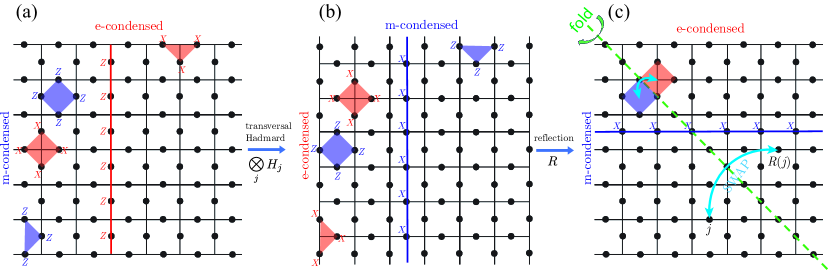
We consider the $\mathbb{Z}_2$ toric code, surface code and Floquet code defined on a non-orientable surface, which can be considered as families of codes extending Shor's 9-qubit code. We investigate the fault-tolerant logical gates of the $\mathbb{Z}_2$ toric code in this setup, which corresponds to $e\leftrightarrow m$ exchanging symmetry of the underlying $\mathbb{Z}_2$ gauge theory. We find that non-orientable geometry provides a new way the emergent symmetry acts on the code space, and discover the new realization of the fault-tolerant Hadamard gate of 2d $\mathbb{Z}_2$ toric code on a surface with a single cross-cap, dubbed a non-orientable toric code. This Hadamard gate can be realized by a constant-depth local unitary circuit modulo non-locality caused by a cross-cap. Via folding, the non-orientable surface code can be turned into a bilayer local quantum code, where the folded cross-cap is equivalent to a bi-layer twist terminated on a gapped boundary and the logical Hadamard only contains local gates with intra-layer couplings. We further obtain the complete logical Clifford gate set for a stack of non-orientable surface codes. We then construct the honeycomb Floquet code in the presence of a single cross-cap, and find that the period of the sequential Pauli measurements acts as a $HZ$ logical gate on the single logical qubit, where the cross-cap enriches the dynamics compared with the orientable case. We find that the dynamics of the honeycomb Floquet code is precisely described by a condensation operator of the $\mathbb{Z}_2$ gauge theory, and illustrate the exotic dynamics of our code in terms of a condensation operator supported at a non-orientable surface.
研究动机与目标
- 开发在非可定向流形上的拓扑稳定子码与 Floquet 码的容错逻辑门。
- 通过使用扭结实现常深度逻辑门,克服折叠表面码中的距离减半问题。
- 通过在 $\mathbb{RP}^2$ 码上使用稳定子泵动电路实现逻辑 Hadamard 门,该电路具有非局域连通性。
- 将构造方法扩展至在 $\mathbb{RP}^2$ 和克莱因瓶码上生成完整的逻辑 Clifford 门集合。
- 证明在非可定向几何下,蜂窝 Floquet 码中连续 Pauli 测量的周期表现为 $HZ$ 逻辑门,这是由于任意任何子的凝聚效应。
提出的方法
- 将 $\mathbb{RP}^2$ 码构建为在对边之间通过单个扭结连接的表面码非可定向变体。
- 通过稳定子泵动电路实现逻辑 Hadamard 门,该电路在扭结引起的非局域性下保持常深度。
- 将 $\mathbb{RP}^2$ 码折叠为双层系统,利用扭结处的层交换缺陷实现门操作的局域化。
- 将带有扭结的蜂窝 Floquet 码的动力学映射为 $\mathbb{Z}_2$ gauge 理论的凝聚算符,该算符表现为 $HZ$ 门。
- 使用 Arf-Brown-Kervaire 不变量计算凝聚算符在希尔伯特空间上的作用,得到 $\mathbb{RP}^2$ 上的矩阵 $\mathrm{diag}(e^{2\pi i/8}, e^{-2\pi i/8})$,对应于 $\mathbb{Z}_8$ 分类。
- 推导出在非可定向曲面上,蜂窝 Floquet 码的丰富动力学源于费米子对偶与拓扑不变量。
实验结果
研究问题
- RQ1如何在 $\mathbb{RP}^2$ 等非可定向曲面的拓扑码上实现容错逻辑门?
- RQ2能否在不引起距离减半的情况下,通过常深度电路在非可定向曲面码上实现 Hadamard 门?
- RQ3扭结在改变 $\mathbb{Z}_2$ 晶格码的涌现对称性与动力学方面起什么作用?
- RQ4蜂窝 Floquet 码的测量周期在非可定向曲面上如何表现为逻辑门?
- RQ5在带有扭结的蜂窝 Floquet 码中,增强对称性与周期的场论解释是什么?
主要发现
- 在 $\mathbb{RP}^2$ 码上,逻辑 Hadamard 门通过稳定子泵动电路实现,该电路在扭结引起的非局域性下保持常深度,避免了折叠表面码中常见的因子二距离减半问题。
- 折叠后的 $\mathbb{RP}^2$ 码仅通过扭结以外的层内耦合实现逻辑 Hadamard 门,而无需像折叠表面码那样依赖层间耦合。
- 利用单个扭结,成功在 $\mathbb{RP}^2$ 码和克莱因瓶码上构建了完整的逻辑 Clifford 门集合,包括 CNOT 和 $S$ 门。
- 带有单个扭结的蜂窝 Floquet 码表现出周期为 4 的动力学,而非周期 2,其作用为代码空间上的 $HZ$ 逻辑门,矩阵表示为 $\mathrm{diag}(e^{2\pi i/8}, e^{-2\pi i/8})$。
- 在非可定向曲面上,蜂窝 Floquet 码的动力学由 $\mathbb{Z}_2$ gauge 理论的凝聚算符描述,该算符计算了在 Pin$^{-}$-结构上 Kitaev 链的路径积分,产生单位根的八次单位根相位。
- 凝聚算符作为非可定向曲面上费米子可逆相 $\mathbb{Z}_8$ 分类的生成元,解释了周期延长与对称性增强现象。

更好的研究,从现在开始
从阅读论文到最终审阅,大幅缩短您的研究时间。
无需绑定信用卡
本解读由 AI 生成,并经人工编辑审核。