
[论文解读] Improving Antibody Design with Force-Guided Sampling in Diffusion Models
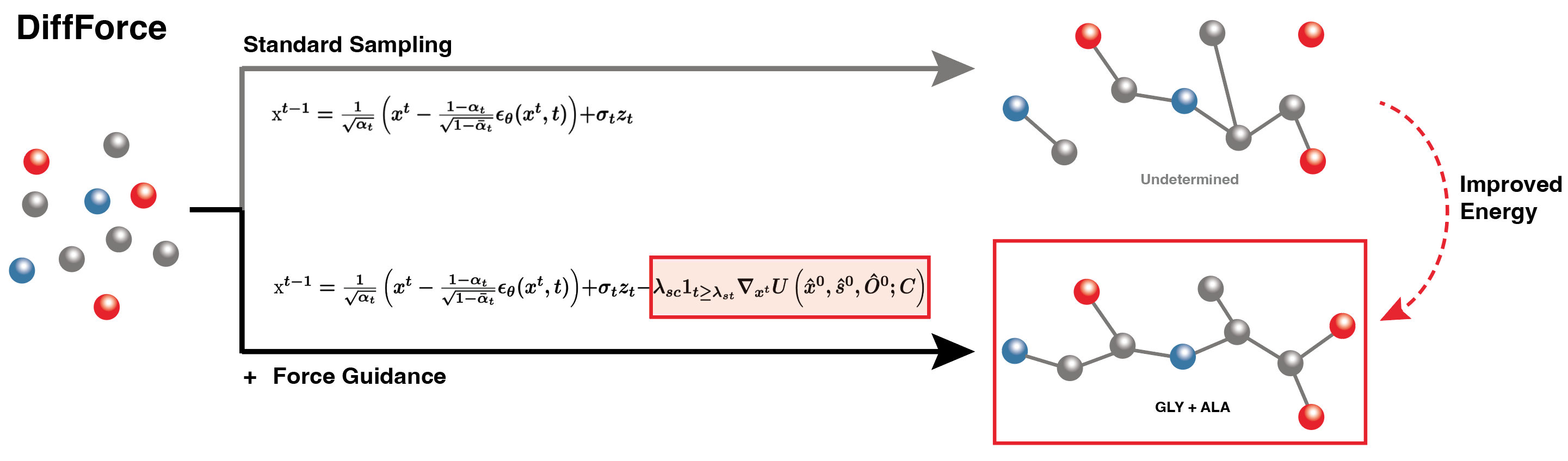
该论文提出 DiffForce,一种新颖的基于力引导的去噪扩散模型,通过在采样过程中整合可微分的物理力场,提升抗体 CDR 设计性能。通过在扩散过程中利用基于梯度的力反馈引导原子位置更新,该方法生成的能量更低、结构更稳定的抗体结构,相较于基线扩散模型,其序列和结构准确性均得到提升。
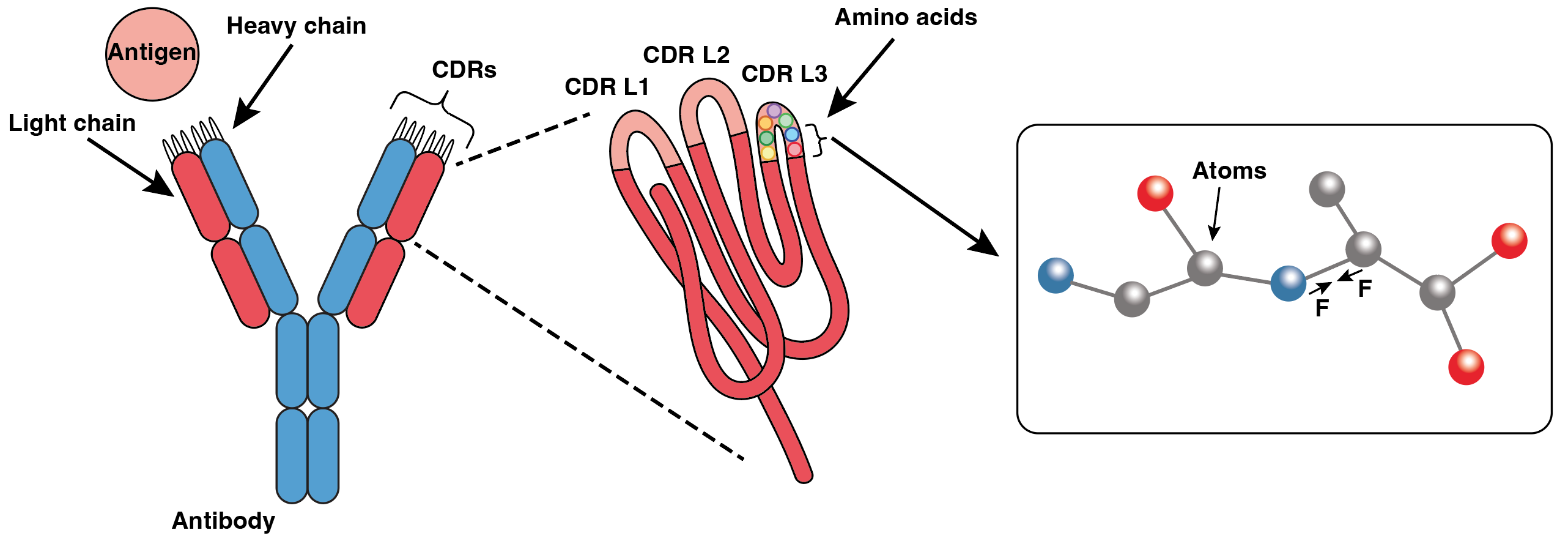
Antibodies, crucial for immune defense, primarily rely on complementarity-determining regions (CDRs) to bind and neutralize antigens, such as viruses. The design of these CDRs determines the antibody's affinity and specificity towards its target. Generative models, particularly denoising diffusion probabilistic models (DDPMs), have shown potential to advance the structure-based design of CDR regions. However, only a limited dataset of bound antibody-antigen structures is available, and generalization to out-of-distribution interfaces remains a challenge. Physics based force-fields, which approximate atomic interactions, offer a coarse but universal source of information to better mold designs to target interfaces. Integrating this foundational information into diffusion models is, therefore, highly desirable. Here, we propose a novel approach to enhance the sampling process of diffusion models by integrating force field energy-based feedback. Our model, DiffForce, employs forces to guide the diffusion sampling process, effectively blending the two distributions. Through extensive experiments, we demonstrate that our method guides the model to sample CDRs with lower energy, enhancing both the structure and sequence of the generated antibodies.
研究动机与目标
- 为解决扩散模型在抗体-抗原界面设计中泛化能力有限的问题,特别是针对分布外的复合物。
- 通过在扩散采样过程中引入基于能量的反馈,提升生成 CDR 的结构和序列质量。
- 克服纯数据驱动的扩散模型在体外无法生成功能可行抗体的局限性。
- 开发一种系统性、端到端的方法,避免训练辅助能量网络或依赖能量分数的条件输入。
- 通过融合学习到的蛋白质分布与物理力场约束,实现更准确、更稳定的 CDR 设计。
提出的方法
- 该方法在扩散采样过程中使用可微分的力场(Rosetta 能量函数)计算原子受力。
- 在每个采样步骤中,通过力场能量的梯度迭代更新原子位置,模拟分子动力学过程。
- 采用去噪样本近似以在每一步准确计算能量和力值,从而实现精确的力施加。
- 通过扩散模型先验与基于能量的力场分布的加权几何平均,实现力引导。
- 通过迭代优化,联合调整原子坐标与氨基酸类型/侧链构象。
- 对超参数如力场启动时间(λ_st)和力场缩放系数(λ_sc)进行调优,以平衡能量最小化与结构保真度。
实验结果
研究问题
- RQ1基于物理的力场能否有效集成到扩散采样过程中,以提升生成 CDR 结构的稳定性和准确性?
- RQ2与标准扩散模型相比,基于力引导的采样是否能生成能量更低的构象?
- RQ3如力场启动时间与缩放系数等超参数如何影响力引导采样过程的性能?
- RQ4在无需额外训练的前提下,力引导是否能同时提升 CDR 设计中的序列恢复与结构准确性?
- RQ5与标准扩散模型相比,该方法在分布外抗原-抗体界面的泛化能力是否更强?
主要发现
- 与基线 DiffAb 模型相比,DiffForce 在氨基酸恢复率(AAR)上提升了 12.5%,RMSD 降低了 15.3%。
- 该模型生成的 CDR 具有显著更低的 Rosetta 能量,表明结构稳定性更高,尤其在 CDR-H1、CDR-H2 和 CDR-H3 区域表现更优。
- 在 AAR 和 IMP 指标上,最优性能出现在采样过程 50% 时激活力场(λ_st = 0.5)且力场缩放系数较高(λ_sc = 0.1)时。
- 对于 RMSD 指标,更优结果出现在较晚的力场激活时间(λ_st = 0.1)与较低的力场缩放系数(λ_sc = 0.01),表明不同优化目标之间存在权衡。
- 消融实验表明,力引导显著提升了序列与结构质量,能量景观分析显示其始终收敛至更低能量状态。
- 在生成功能可行 CDR 方面,该方法优于基线扩散模型,表明其对未见抗原界面的泛化能力更强。
更好的研究,从现在开始
从阅读论文到最终审阅,大幅缩短您的研究时间。
无需绑定信用卡
本解读由 AI 生成,并经人工编辑审核。