
[论文解读] MNISQ: A Large-Scale Quantum Circuit Dataset for Machine Learning on/for Quantum Computers in the NISQ era
MNISQ 提供了一个大规模的、包含495万条数据点的量子线路数据集,专为NISQ时代机器学习而设计,将类MNIST的经典数据编码为量子线路和QASM格式。该数据集支持双重评估:量子核方法达到97%的准确率,而经典模型如S4在QASM标记化序列上达到77%的准确率,展示了在该任务中量子优势的潜力以及经典模型处理量子数据的能力。
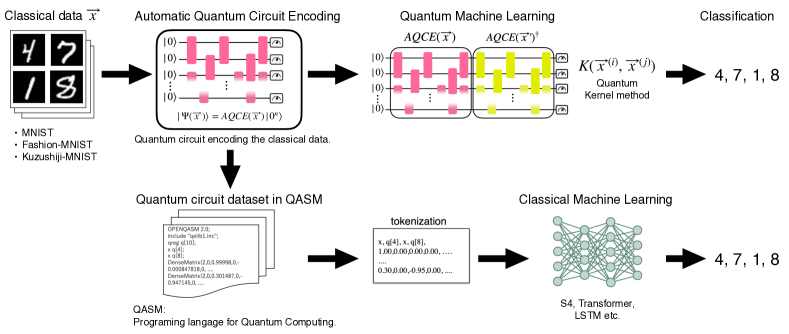
We introduce the first large-scale dataset, MNISQ, for both the Quantum and the Classical Machine Learning community during the Noisy Intermediate-Scale Quantum era. MNISQ consists of 4,950,000 data points organized in 9 subdatasets. Building our dataset from the quantum encoding of classical information (e.g., MNIST dataset), we deliver a dataset in a dual form: in quantum form, as circuits, and in classical form, as quantum circuit descriptions (quantum programming language, QASM). In fact, also the Machine Learning research related to quantum computers undertakes a dual challenge: enhancing machine learning exploiting the power of quantum computers, while also leveraging state-of-the-art classical machine learning methodologies to help the advancement of quantum computing. Therefore, we perform circuit classification on our dataset, tackling the task with both quantum and classical models. In the quantum endeavor, we test our circuit dataset with Quantum Kernel methods, and we show excellent results up to $97\%$ accuracy. In the classical world, the underlying quantum mechanical structures within the quantum circuit data are not trivial. Nevertheless, we test our dataset on three classical models: Structured State Space sequence model (S4), Transformer and LSTM. In particular, the S4 model applied on the tokenized QASM sequences reaches an impressive $77\%$ accuracy. These findings illustrate that quantum circuit-related datasets are likely to be quantum advantageous, but also that state-of-the-art machine learning methodologies can competently classify and recognize quantum circuits. We finally entrust the quantum and classical machine learning community the fundamental challenge to build more quantum-classical datasets like ours and to build future benchmarks from our experiments. The dataset is accessible on GitHub and its circuits are easily run in qulacs or qiskit.
研究动机与目标
- 构建一个大规模的双格式数据集(量子线路和QASM),用于在NISQ时代对量子和经典机器学习方法进行基准测试。
- 实现对量子和经典模型在量子线路分类任务上的对比评估。
- 证明最先进的经典模型能够有效学习量子线路数据,同时展示潜在的量子优势。
- 为未来量子-经典机器学习研究提供一个公开可访问、可复现的基准。
提出的方法
- 通过幅值编码将经典图像数据(MNIST、Fashion-MNIST、Kuzushiji-MNIST)编码为量子线路来构建数据集。
- 每个线路以两种形式表示:作为量子线路(用于训练量子模型)和作为QASM代码(用于训练经典模型)。
- 根据数据保真度(80%、90%、95%)将数据集划分为9个子数据集,以评估模型在噪声下的鲁棒性。
- 在标记化后的QASM序列上训练经典模型(S4、Transformer、LSTM),其中数值被截断至三位小数并作为离散标记处理。
- 直接对量子线路数据应用量子核方法,使用Hilbert-Schmidt核进行分类。
- 通过在mnist_786子集(保真度80%)上进行验证,使用AdamW配合余弦退火和权重衰减对超参数进行调优。
实验结果
研究问题
- RQ1尽管数据具有非平凡的量子力学结构,经典机器学习模型能否有效分类以QASM格式编码的量子线路?
- RQ2在量子线路数据上应用量子核学习是否能实现高准确率,表明该任务中存在潜在的量子优势?
- RQ3随着量子线路数据中噪声的增加(保真度降低),模型性能如何变化?
- RQ4最先进的序列模型如S4、Transformer和LSTM能否泛化到QASM格式的量子线路表示?
- RQ5MNISQ数据集是否适合作为未来量子-经典机器学习研究的基准?
主要发现
- 量子核方法在MNISQ数据集上实现了97%的测试准确率,表明其在量子线路分类任务中表现强劲。
- S4模型在标记化后的QASM序列上实现了77%的准确率,优于Transformer(58.84%)和LSTM(55.68%)在同一任务上的表现。
- 经典模型在更高保真度数据上实现了接近基线水平的性能(约55%),表明量子结构虽非平凡但可学习。
- Transformer和LSTM模型在数据保真度提高时性能提升微弱,表明其对电路表示中的噪声不敏感。
- MNISQ数据集已公开发布于GitHub,包含完整元数据和教程,支持未来研究的可复现基准测试。
- 该数据集支持在qulacs和Qiskit中执行,确保了量子与经典机器学习实验的广泛可及性。
![Figure 2: Schematic diagram of how to embed classical data into the probability amplitude of a quantum state the using the AQCE [ 20 ] algorithm.](https://ar5iv.labs.arxiv.org/html/2306.16627/assets/x2.png)
更好的研究,从现在开始
从阅读论文到最终审阅,大幅缩短您的研究时间。
无需绑定信用卡
本解读由 AI 生成,并经人工编辑审核。