
[论文解读] NANOGrav signal from axion inflation
本文表明,具有 Chern-Simons 耦合到质量 U(1) 规范场的伪标量膨胀子可以产生一个奇偶性违背、蓝色倾斜的引力波谱,可能解释 NANOGrav 的纳诺赫信号,同时与宇宙学约束相容。
Several pulsar timing arrays including NANOGrav, EPTA, PPTA, and CPTA have recently reported the observation of a stochastic background of gravitational wave spectrum in the nano-Hz frequencies. An inflationary interpretation of this observation is challenging from various aspects. We report that such a signal can arise from the Chern-Simons coupling in axion inflation, where a pseudoscalar inflaton couples to a (massive) $U(1)$ gauge field, leading to efficient production of a transverse gauge mode. Such tachyonic particle production during inflation exponentially enhances the primordial perturbations and leads to a unique parity-violating gravitational wave spectrum, that remains flat near the CMB scales but becomes blue-tilted at smaller scales. We identify the parameter space consistent with various cosmological constraints and show that the resultant gravitational wave signals can provide extra contribution on top of the standard astrophysical contribution from inspiraling supermassive black hole binaries towards explaining the observed excess at NANOGrav. The parity-violating nature of the signal can be probed in future interferometers, distinguishing it from most other new physics signals attempting to explain the NANOGrav result.
研究动机与目标
- 以 NANOGrav 的 SGWB 作为来自早期宇宙物理的新信号的潜在动机,超越超大黑洞二合体。
- 研究带有 Chern-Simons 耦合到(质量的)U(1)规范场的轴子膨胀作为引力波来源。
- 识别与宇宙学与观测约束相符合的参数空间。
- 证明所得引力波信号可以增补 SMBHB 的贡献以解释 NANOGrav 数据。
- 突出独特的奇偶性违背引力波签名,作为可测试的预测。
提出的方法
- 在准的迪塞特时空中,构建一个类似轴子的膨胀子,与 U(1) 规范场的 Chern-Simons 耦合。
- 推导规范场模方程;识别 A+ 极化态的 tachyonic 产生(Eq. 2.6)。
- 计算包含规范场后扰动的标量和张量扰动;固定 CMB 尺度谱并约束非高斯性与 r(方程 2.3–2.4、2.8、2.13–2.15)。
- 使用 N 作为时间变量在超出 CMB 尺度的尺度上演化系统,以捕捉后效应(方程 3.1–3.2)。
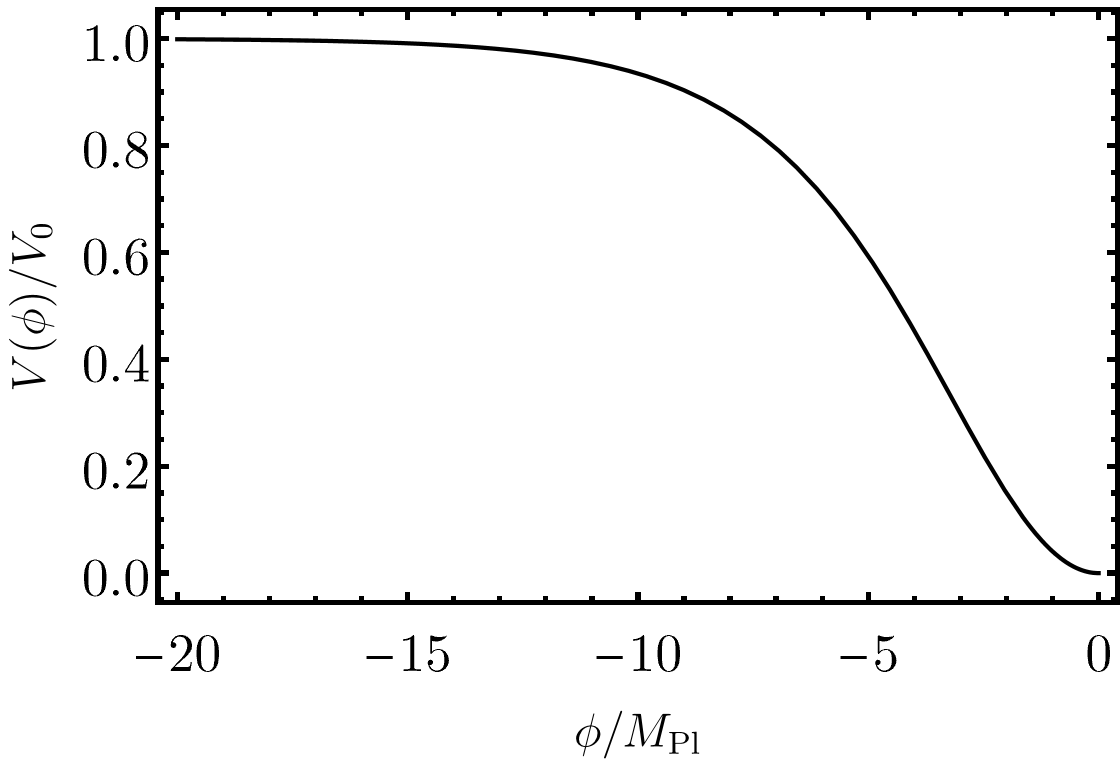
- 采用 T-model 势 V(phi)=V0 tanh^2(phi/√(6αT) Mpl),并为基准点计算 ξ(N) 与 mA/H(N)(Eq. 3.3)。
- 预测今天的 GW 谱 ΩGW(f),包括奇偶性违背分量,并与 NANOGrav 与 LVK 约束比较(Eq. 4.1、4.2、4.3)。
![Figure 1 : Shaded regions denote exclusion of the gauge boson’s parameter space from various constraints. Tensor-to-scalar ratio bound is drawn for $H/M_{\rm Pl}=10^{-5}$ . For $f_{\rm NL}^{\rm eq}<-25\pm 47$ [ 156 ] , the left (right) part corresponds to the positive (negative) bound.](https://ar5iv.labs.arxiv.org/html/2307.01192/assets/Allconstraints.png)
实验结果
研究问题
- RQ1带有 phi F tilde F 耦合的轴子膨胀是否能在 NanoHz 频率产生与 NANOGrav 兼容的随机引力波背景?
- RQ2哪些参数空间区域(ξ、mA/H)在产生在 PTA 尺度上可观测的 GW 信号的同时满足 CMB 约束、非高斯性和 LVK 界?
- RQ3该模型是否预测一个可被未来探测器测试的奇偶性违背的 GW 谱?
- RQ4所选的膨胀子势(T-model)如何影响 ξ 的演化、后效应及由此产生的 GW 信号?
- RQ5来自 GW 背景的额外 ΔNeff 是否在 BBN/CMB 界限之内?
主要发现
- 轴子膨胀过程中的规范场产生产生奇偶性违背的 GW 谱,在 CMB 尺度处为平坦,但在较小尺度处为蓝色倾斜。
- 来自规范场的后效应控制增长,使其在避免 LVK 边界的同时在 nano-Hz 频率产生可检测的 PW 信号。
- 在 T-model 势下,三个基准点产生的 GW 信号可以比 SMBHB 背景更好地拟合 NANOGrav 数据。
- 预测的 ΩGW(f) 在 LVK 尺度下仍然次主导,原因是后效应;奇偶性违背签名提供了一个独特的实验手段。
- 来自 GW 背景的额外 ΔNeff 很小(约 0.013),并且在 BBN/CMB 的限制之内。
- 该模型意味着一个可测试的奇偶性违背信号,适用于未来的探测器,如 ET-CE 与 LISA-Taiji 网络。
更好的研究,从现在开始
从论文设计到论文写作,大幅缩短您的研究时间。
无需绑定信用卡
本解读由 AI 生成,并经人工编辑审核。