
[论文解读] Observations of a PT-like phase transition and limit cycle oscillations in non-reciprocally coupled optomechanical oscillators levitated in vacuum
本研究通过使用相对反向传播的激光束在真空中悬浮的一对非互惠耦合光机械振子中,展示了类似PT对称性的相变以及极限环振荡。通过调节光束的相对功率、相位和偏振,系统表现出类似于宇称-时间(PT)对称性相变的非厄米动力学,当耗散减小时,通过霍普夫分岔产生集体振荡,为异常点传感和拓扑光机械学提供了一个平台。
Nanoparticles levitated in an optical trap provide a versatile platform to study mechanical oscillators in a controlled environment with tuneable parameters. Recently, it has become possible to couple two of these optomechanical oscillators. Here, we demonstrate the collective non-Hermitian dynamics of such a pair of non-conservatively coupled oscillators. We take advantage of the tunability of the optical interactions between the particles in our system and set the optical interaction between the particles to be purely non-reciprocal. By continuously varying the relative power of the trapping beams, we take the system through a transition, similar to a parity-time phase transition. A Hopf bifurcation at a critical point results in the formation of collective limit cycle oscillations, resembling those observed in phonon lasers. These coupled levitated oscillators provide a platform for exceptional point optomechanical sensing and can be extended to multi-particle systems, paving the way for the development of topological optomechanical media.
研究动机与目标
- 探索两个光学悬浮纳米颗粒组成的系统中非厄米集体动力学的行为。
- 研究在无真正PT对称性的经典开放系统中,类似PT行为的出现机制。
- 通过连续调节激光功率失谐,展示类似于宇称-时间(PT)相变的转变过程。
- 在耗散减小的条件下,通过霍普夫分岔观测到集体极限环振荡的形成。
- 建立一个可调的多粒子平台,用于异常点光机械传感和拓扑介质研究。
提出的方法
- 使用两对平行的反向传播激光束在真空中实现二氧化硅纳米颗粒的光学悬浮。
- 通过调节捕获光束的相对相位、偏振和间距,实现非互惠耦合。
- 通过连续调节两束光之间的功率失谐(η)来调控系统的非厄米特性。
- 利用数字微镜器件(DMD)对激光光束图案进行整形和动态控制,实现精确捕获。
- 同时使用四象限光电二极管(QPD)和高速CMOS成像(400 kHz采样)检测粒子位置。
- 通过与高速视频追踪对比校准QPD信号,确保位置测量的准确性。
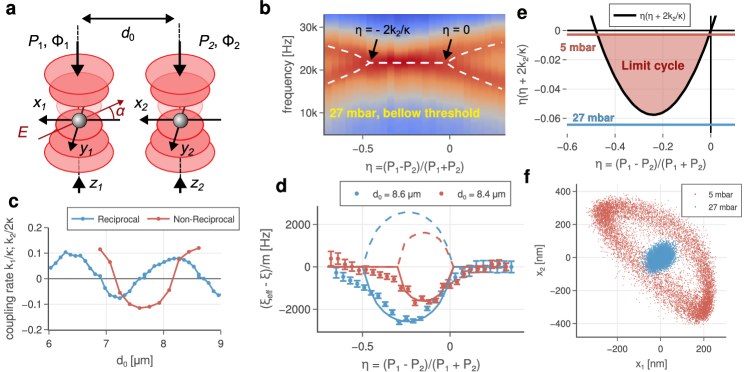
实验结果
研究问题
- RQ1在真空中,非互惠耦合的光机械系统是否能表现出类似于PT相变的动力学?
- RQ2非互惠光学力在双粒子系统中诱导集体极限环振荡的作用机制是什么?
- RQ3调节相对激光功率失谐(η)如何影响耦合振子的稳定性和光谱特性?
- RQ4所观测到的动力学在多大程度上类似于声子激光器或其他非厄米系统的行为?
- RQ5该系统是否可作为异常点传感和拓扑光机械现象的可调平台?
主要发现
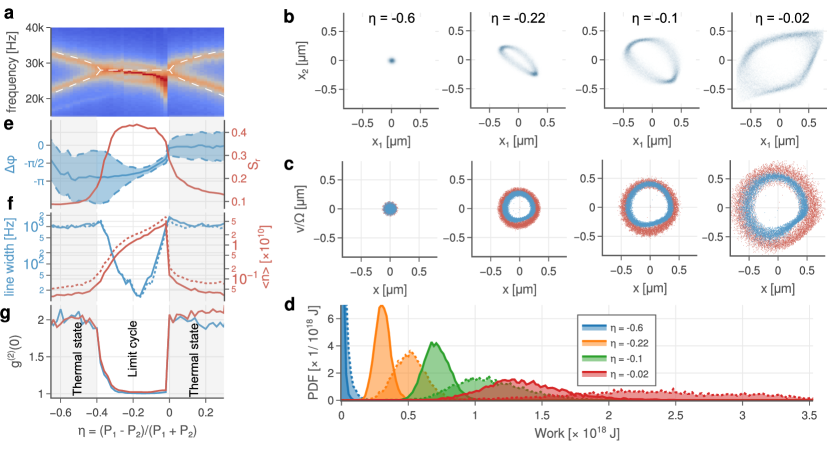
- 通过连续调节功率失谐η,系统表现出类似PT相变的动力学,从稳定平衡态转变为具有复特征值的非平衡态。
- 当耗散减小时,发生霍普夫分岔,导致耦合纳米颗粒中出现集体极限环振荡。
- 光学束缚相互作用强度约为库仑相互作用的10^4倍,证实光学力主导了耦合机制。
- 测得的耦合速率b/Ω₀ < 10⁻⁴,表明库仑相互作用可忽略不计,验证了工程化非互惠光学力的主导作用。
- 由于D形边缘反光镜的分离,系统实现了稳定、长时间的轨迹(长达100,000帧),且粒子信号间串扰极小。
- 尽管系统中不存在真正的PT对称性,但所观测到的动力学与非厄米物理一致,包括类似异常点的行为。
更好的研究,从现在开始
从阅读论文到最终审阅,大幅缩短您的研究时间。
无需绑定信用卡
本解读由 AI 生成,并经人工编辑审核。