
[论文解读] Quasicrystalline structure of the Smith monotile tilings
本文表明,尽管帽形单体镶嵌是非周期性的,但其表现出具有六重(C6)对称性的准晶序,并且与黄金分割率锁定的不可公度比值相关。通过将六维超立方体格点的一个子集投影到二维平面上,作者展示了该镶嵌的衍射图样由波矢与不可公度基矢的整数线性组合成比例的密集布拉格峰组成,从而确认其尽管缺乏周期性,仍具有准晶态特征。
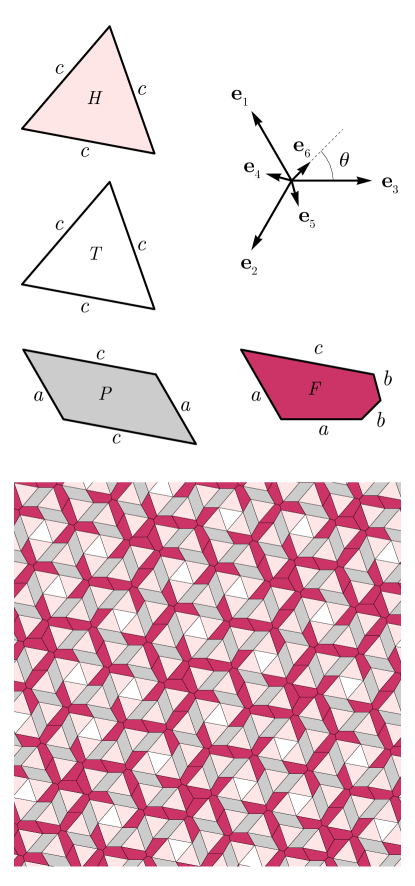
Tiling models can reveal unexpected ways in which local constraints give rise to exotic long-range spatial structure. The recently discovered Hat monotile (and its mirror image) has been shown to be aperiodic~[Smith et al., arXiv:2303.10798 (2023)]; it can tile the plane with no holes or overlaps, but cannot do so periodically. We show that the structure enforced by the local space-filling constraints is quasiperiodic with hexagonal (C6) rotational symmetry. Although this symmetry is compatible with periodicity, the incommensurate ratio characterizing the quasiperiodicity stays locked to the golden mean as the tile parameters are continuously varied. We analyze a modification of the metatiles introduced by Smith et al. that yields a set of ``Key tiles'' that can be constructed as projections of a subset of six-dimensional hypercubic lattice points onto the two-dimensional tiling plane. We analytically compute the diffraction pattern of a set of unit masses placed at the tiling vertices, establishing the quasiperiodic nature of the tiling. We point out several unusual features of the family of Key tilings and associated Hat tilings, including the tile rearrangements associated with the phason degree of freedom associated with incommensurate density waves, which exhibit novel features that may influence the elastic properties of a material in which atoms or larger particles spontaneously exhibit the symmetries of the Hat tiling.
研究动机与目标
- 表征帽形单体镶嵌中的长程序,其为非周期但非周期性。
- 确定该镶嵌是否表现出准晶特性,例如具有不可公度衍射峰的长程序。
- 通过引入源自6D超立方体格点投影的“关键镶嵌块”,扩展镶嵌框架。
- 分析在连续的镶嵌参数族中,替换(膨胀/收缩)动力学的行为。
- 研究黄金分割率是否在具有2个参数的镶嵌族中作为固定不可公度比值出现,尽管六重对称性并未强制该比值。
提出的方法
- 作者通过将6D超立方体格点的一个有界子集投影到二维镶嵌平面上,定义了一组“关键镶嵌块”,其中投影窗在垂直于镶嵌平面的4D子空间中定义。
- 他们建立关键镶嵌块上的膨胀与收缩操作在6D空间中对应线性变换,从而实现更大或更小镶嵌的递归构造。
- 通过在镶嵌顶点处放置单位质量,并将6D倒易格点投影到二维物理空间,解析计算衍射图样。
- 结果表明,衍射图样由波矢为(n + mφ)k₀形式的布拉格峰组成,其中φ为黄金分割率,n、m为整数,从而证实其准周期性。
- 黄金关键镶嵌被识别为唯一在无限收缩下保持镶嵌块形状的案例,对应Smith等人元镶嵌的极限形状。
- 作者将该结构与彭罗斯镶嵌进行比较,并指出差异,例如缺乏10重对称性,以及在六重系统中出现φ锁定。
实验结果
研究问题
- RQ1帽形单体镶嵌是否表现出准晶序,其衍射图样中是否存在不可公度波矢的密集布拉格峰作为证据?
- RQ2该镶嵌是否可理解为高维格点的投影?若是,该格点的维度与结构为何?
- RQ3为何黄金分割率φ在此六重系统中被锁定为不可公度比值,尽管对称性并未强制该比值?
- RQ4在连续的“关键镶嵌”族中,膨胀与收缩操作如何演变?黄金关键镶嵌与其他镶嵌有何区别?
- RQ5是否存在适用于关键镶嵌族的替代镶嵌块装饰方式,以减少镶嵌块类型数量?这些装饰是否保持与帽形镶嵌的组合等价性?
主要发现
- 帽形镶嵌具有准晶态,其衍射图样由波矢为(n + mφ)k₀的密集布拉格峰组成,其中φ为黄金分割率,n、m为整数。
- 该镶嵌源于将6D超立方体格点的一个子集投影到二维平面,投影窗在垂直于镶嵌平面的4D子空间中受限。
- 黄金关键镶嵌是唯一在无限收缩下保持镶嵌块形状的案例,其顶点集表现出镜像对称性。
- 当镶嵌参数连续变化时,不可公度比值φ保持固定,表明存在一种非由对称性强制的“锁定”机制,与具有可变比值的不可公度密度波相区别。
- 关键镶嵌族中存在某些情况,反复收缩后镶嵌边界会自相交,且部分成员无法通过两片镜像对称的帽形镶嵌块进行装饰。
- 该投影方法使标准准晶分析工具(如集团结构与相位缺陷分析)可应用于帽形镶嵌,从而确认其与彭罗斯镶嵌在深层结构上的相似性,尽管对称性不同。
更好的研究,从现在开始
从阅读论文到最终审阅,大幅缩短您的研究时间。
无需绑定信用卡
本解读由 AI 生成,并经人工编辑审核。