
[论文解读] Structural Chirality and Electronic Chirality in Quantum Materials
本文建立了一个统一框架,将量子材料中的结构手性与电子手性通过轨道角动量锁定联系起来,展示了原子尺度的手性如何诱导自旋极化(CISS)、二极管样输运(EMCA)以及异常圆偏振光发射(ACPLE)。其核心贡献在于识别出轨道角动量锁定是这些手性现象的中心机制,对自旋电子学、光电子学以及拓扑量子材料具有重要意义。
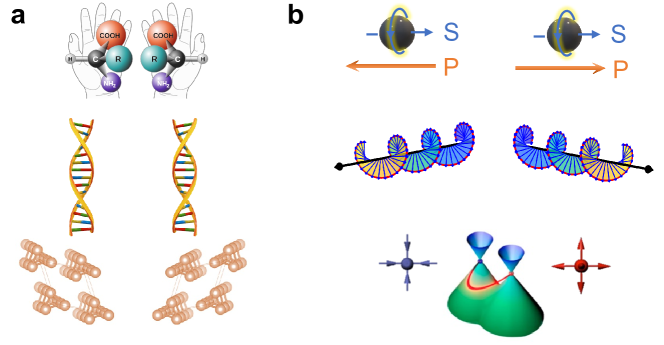
In chemistry and biochemistry, chirality represents the structural asymmetry characterized by non-superimposable mirror images for a material like DNA. In physics, however, chirality commonly refers to the spin-momentum locking of a particle or quasiparticle in the momentum space. While seemingly disconnected, structural chirality in molecules and crystals can drive electronic chirality through orbital-momentum locking, i.e. chirality can be transferred from the atomic geometry to electronic orbitals. Electronic chirality provides an insightful understanding of the chirality-induced spin selectivity (CISS), in which electrons exhibit salient spin polarization after going through a chiral material, and electric magnetochiral anisotropy (EMCA), which is characterized by the diode-like transport. It further gives rise to new phenomena, such as anomalous circularly polarized light emission (ACPLE), in which the light handedness relies on the emission direction. These chirality-driven effects will generate broad impacts in fundamental science and technology applications in spintronics, optoelectronics, and biochemistry.
研究动机与目标
- 建立原子尺度结构手性与量子材料中涌现电子手性之间的微观联系。
- 通过轨道角动量锁定与自旋-轨道耦合,解释手性诱导自旋选择性(CISS)的起源。
- 通过将两者与相同的轨道角动量锁定机制联系起来,统一理解EMCA与CISS。
- 通过光学贝里相位解释手性有机半导体中异常圆偏振光发射(ACPLE)的物理起源。
- 提出一个通用的理论框架,用于预测和设计多样化材料(包括杂化钙钛矿和扭曲2D异质结构)中的手性量子现象。
提出的方法
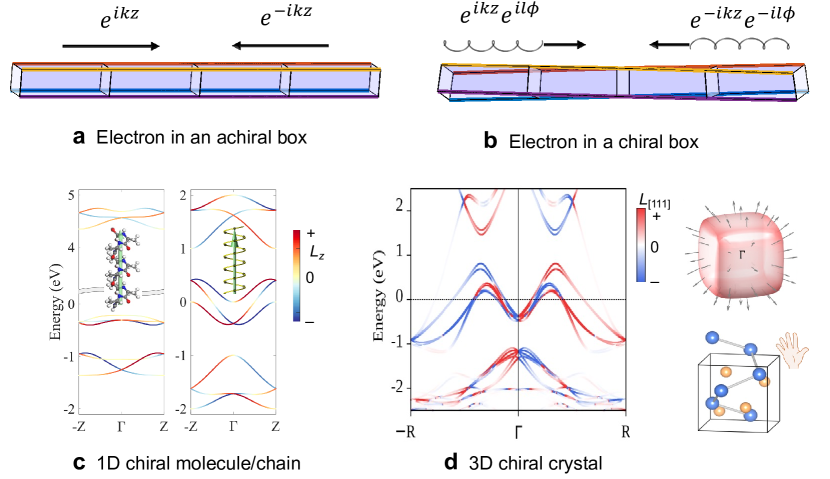
- 使用扭曲三维盒子的简化模型,说明手性几何如何在电子波函数中诱导轨道角动量(OAM),进而导致轨道角动量锁定。
- 将轨道角动量锁定的概念应用于手性分子中的波函数结构推导,表明 $k$ 与 $l$ 在符号和大小上均被锁定。
- 引入金属接触中的自旋-轨道耦合(SOC)作用,将轨道极化转化为自旋极化,从而实现CISS效应。
- 应用昂萨格倒易关系,将EMCA与CISS联系起来,表明二者均源于手性电子结构导致的时间反演对称性破缺。
- 通过光学贝里相位分析ACPLE,表明电流诱导的轨道极化导致发射方向依赖的圆偏振光发射。
- 通过光学贝里曲度偶极子将ACPLE推广至固体体系,将其与非中心对称材料中的本征能带结构特性联系起来。
实验结果
研究问题
- RQ1材料中的结构手性如何通过轨道角动量锁定诱导本征电子手性?
- RQ2手性分子中手性诱导自旋选择性(CISS)效应的微观机制是什么?
- RQ3EMCA与CISS之间有何关联?二者共同的物理起源是什么?
- RQ4光学贝里相位在手性有机半导体中实现异常圆偏振光发射(ACPLE)的过程中起什么作用?
- RQ5非中心对称固体中的光学贝里曲度偶极子能否用于预测和设计新型材料中的ACPLE?
主要发现
- 手性分子与晶体中的结构手性通过轨道角动量锁定诱导电子手性,其中电子的轨道角动量(OAM)与动量锁定。
- 轨道角动量锁定机制解释了CISS中观测到的自旋极化,其自旋滤波效应由金属接触中的自旋-轨道耦合实现。
- EMCA与CISS被证明是同一基本物理机制的两种表现形式——即由于手性电子结构导致的时间反演对称性破缺,二者通过昂萨格倒易关系相联系。
- 异常圆偏振光发射(ACPLE)源于电流诱导的轨道极化,其中发射方向决定了所发射圆偏振光的手性。
- ACPLE与电子-空穴复合过程中的光学贝里相位相关联,由于载流子向光子的角动量转移,正向与反向发射均表现出相同手性。
- 光学贝里曲度偶极子为预测固体中手性材料的ACPLE提供了通用框架,将该现象从有机半导体扩展至钙钛矿和2D异质结构。
更好的研究,从现在开始
从阅读论文到最终审阅,大幅缩短您的研究时间。
无需绑定信用卡
本解读由 AI 生成,并经人工编辑审核。