
[论文解读] Trading T gates for dirty qubits in state preparation and unitary synthesis
该论文提出了一种量子算法,在合成任意量子态和酉算符时,通过使用脏辅助量子比特(dirty ancillary qubits)来减少T门的数量,实现了接近最优的T门计数权衡。通过利用$Λ$个脏量子比特,其T门成本降低至$Θ(N/\lambda + \lambda \log^2(N/\epsilon))$,在最佳情况下相比以往无需辅助量子比特的方法实现了二次改进,且证明了其最优性(仅在对数因子范围内)。
Efficient synthesis of arbitrary quantum states and unitaries from a universal fault-tolerant gate-set e.g. Clifford+T is a key subroutine in quantum computation. As large quantum algorithms feature many qubits that encode coherent quantum information but remain idle for parts of the computation, these should be used if it minimizes overall gate counts, especially that of the expensive T-gates. We present a quantum algorithm for preparing any dimension-$N$ pure quantum state specified by a list of $N$ classical numbers, that realizes a trade-off between space and T-gates. Our scheme uses $\mathcal{O}(\log{(N/ε)})$ clean qubits and a tunable number of $\sim(λ\log{(\frac{\log{N}}ε)})$ dirty qubits, to reduce the T-gate cost to $\mathcal{O}(\frac{N}λ+λ\log{\frac{N}ε}\log{\frac{\log{N}}ε})$. This trade-off is optimal up to logarithmic factors, proven through an unconditional gate counting lower bound, and is, in the best case, a quadratic improvement in T-count over prior ancillary-free approaches. We prove similar statements for unitary synthesis by reduction to state preparation. Underlying our constructions is a T-efficient circuit implementation of a quantum oracle for arbitrary classical data.
研究动机与目标
- 最小化在容错量子计算中为主要成本因素的T门计数,用于量子态制备与酉算符合成。
- 利用可调数量的脏辅助量子比特(即初始化为混合态或未知态的量子比特),而非要求使用干净的辅助量子比特。
- 建立T门计数与辅助量子比特使用量之间的权衡关系,该关系在对数因子范围内为最优。
- 通过将酉算符合成问题约化为态制备问题,将该方法扩展至酉算符合成,同时保持较低的T门计数。
- 证明一个门计数的下界,以确认所提出的权衡关系在对数因子范围内为最优。
提出的方法
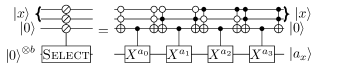
- 该方法通过受控相位旋转的分层分解实现态制备,其中每个相位旋转通过傅里叶态和受控加法电路实现。
- 利用准备误差为$\epsilon$的傅里叶态$|\mathcal{F}\rangle$来近似目标相位$ a_x / 2^b $,从而减少对直接使用T门密集型相位旋转的需求。
- 受控加法电路的代价为$\mathcal{O}(b)$个T门,通过与傅里叶态纠缠实现相位旋转$e^{i2\pi x / 2^b}$。
- 总误差被限制在$\delta \leq \frac{2\pi n}{2^b} + \epsilon$,其中$ b = \Theta(\log(N/\delta)) $,从而可精确控制近似误差。
- T门代价被分解为$\mathcal{O}(N/\lambda + \lambda \log^2(N/\epsilon))$,其中$\lambda$控制所用脏量子比特的数量。
- 通过将问题约化为酉算符列的态制备,将该方法扩展至酉算符合成,同时保持相同的T门计数权衡。
实验结果
研究问题
- RQ1能否通过使用脏辅助量子比特而非干净辅助量子比特来减少任意量子态制备中的T门计数?
- RQ2在态与酉算符合成中,T门计数与辅助量子比特数量(包括脏量子比特)之间的最优权衡是什么?
- RQ3所提出的T门计数权衡是否在对数因子范围内为最优?能否通过无条件门计数下界证明这一点?
- RQ4与直接相位旋转合成相比,使用傅里叶态与受控加法电路在T门代价上表现如何?
- RQ5该权衡关系能否扩展至酉算符合成?其对应的T门计数缩放关系如何?
主要发现
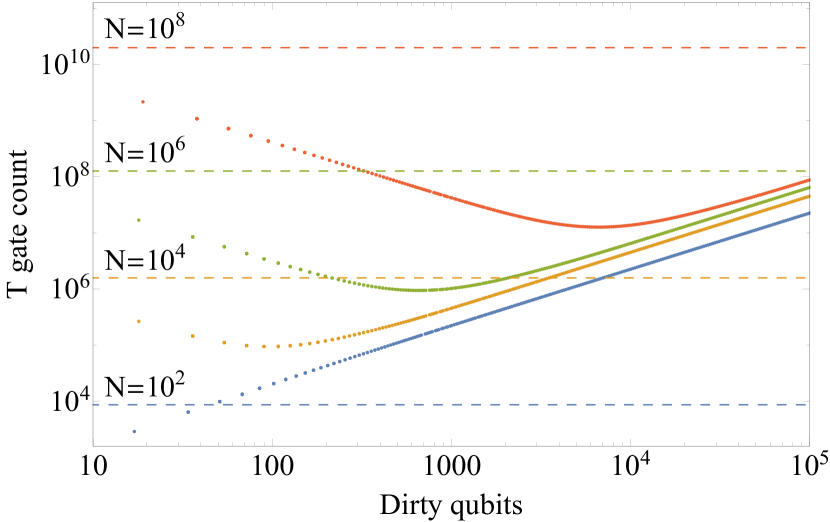
- 所提出的方法在使用$\lambda$个脏量子比特的情况下,实现了制备$N$维量子态的T门代价为$\mathcal{O}(N/\lambda + \lambda \log^2(N/\epsilon))$。
- 在最佳情况下,该方法相比无辅助量子比特的方法实现了T门计数的二次改进,当$\lambda = \mathcal{O}(\sqrt{N})$时,T门计数从$\mathcal{O}(N \log(N/\epsilon))$降低至$\tilde{\mathcal{O}}(\sqrt{N})$。
- 通过无条件门计数下界,证明了T门计数与辅助量子比特使用量之间的权衡在对数因子范围内为最优。
- 对于具有$K$个完全指定列的$N \times N$矩阵酉算符合成,T门代价缩放为$\mathcal{O}(KN/\lambda + \lambda K \log^2(N/\epsilon))$,保持了相同的权衡关系。
- 使用傅里叶态与受控加法电路可减少对直接T门密集型相位旋转的需求,从而实现高效近似,误差满足$\delta \leq \frac{2\pi n}{2^b} + \epsilon$。
- 即使考虑制备$|\textsc{T}\rangle$魔术态的成本,当$\lambda = \mathcal{O}(\sqrt{N})$时,该方法仍优于朴素的辅助量子比特使用方式。
更好的研究,从现在开始
从论文设计到论文写作,大幅缩短您的研究时间。
无需绑定信用卡
本解读由 AI 生成,并经人工编辑审核。