
[論文レビュー] A hybrid discrete-continuum modelling approach for the interactions of the immune system with oncolytic viral infections
本研究では、免疫細胞、感染したがん細胞および未感染のがん細胞の確率的エージェントベースのダイナミクスと、キモアトラクトント駆動の免疫細胞動員を記述する連続体PDEを組み合わせたハイブリッド離散的・連続的モデルを提示する。モデルは、過剰に速い免疫活性化ががん細胞破壊ウイルス療法の有効性を損なう可能性があることを示し、腫瘍および患者特異的要因に応じた免疫応答の調整の必要性を強調している。
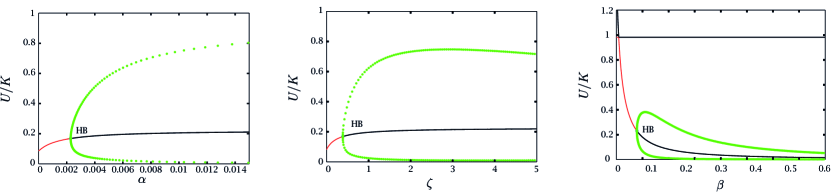
Oncolytic virotherapy, utilizing genetically modified viruses to combat cancer and trigger anti-cancer immune responses, has garnered significant attention in recent years. In our previous work arXiv:2305.12386, we developed a stochastic agent-based model elucidating the spatial dynamics of infected and uninfected cells within solid tumours. Building upon this foundation, we present a novel stochastic agent-based model to describe the intricate interplay between the virus and the immune system; the agents' dynamics are coupled with a balance equation for the concentration of the chemoattractant that guides the movement of immune cells. We formally derive the continuum limit of the model and carry out a systematic quantitative comparison between this system of PDEs and the individual-based model in two spatial dimensions. Furthermore, we describe the traveling waves of the three populations, with the uninfected proliferative cells trying to escape from the infected cells while immune cells infiltrate the tumour. Simulations show a good agreement between agent-based approaches and numerical results for the continuum model. Some parameter ranges give rise to oscillations of cell number in both models, in line with the behaviour of the corresponding nonspatial model, which presents Hopf bifurcations. Nevertheless, in some situations the behaviours of the two models may differ significantly, suggesting that stochasticity plays a key role in the dynamics. Our results highlight that a too rapid immune response, before the infection is well-established, appears to decrease the efficacy of the therapy and thus some care is needed when oncolytic virotherapy is combined with immunotherapy. This further suggests the importance of clinically improving the modulation of the immune response according to the tumour's characteristics and to the immune capabilities of the patients.
研究の動機と目的
- がん細胞破壊ウイルス、がん細胞、および免疫細胞の間の空間的かつ確率的相互作用を捉えるハイブリッドモデリングフレームワークの開発。
- キモアトラクトントによる免疫細胞動員が、実体腫瘍におけるがん細胞破壊ウイルス療法の結果に与える影響の調査。
- エージェントベースのシミュレーションとその連続体PDE極限との比較を通じて、モデルの挙動を検証し、確率的要因に起因する乖離を同定。
- 特に併用ウイルス療法および免疫療法の文脈において、免疫応答のタイミングと強度が治療効果に与える影響の探求。
- 免疫活性化がウイルスによるがん細胞破壊を促進するか、あるいは妨げる条件を特定することで、最適な治療スケジューリングの支援。
提案手法
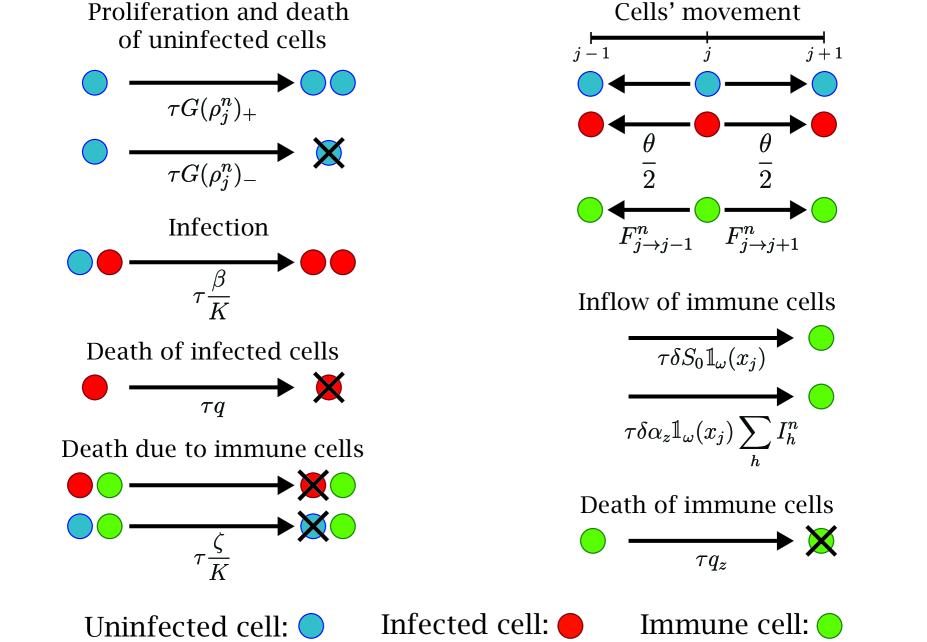
- 確率的エージェントベースのモデルは、個々の免疫細胞、感染したがん細胞および未感染のがん細胞の移動、増殖、死滅、感染、キモアトラクトント産生をシミュレートする。
- 免疫細胞の走化性は、ノイマン境界条件を伴うPDEに基づくキモアトラクトント場によって駆動され、安定性を確保するための上流差分スキームが用いられる。
- エージェントベースモデルの連続体極限を形式的に導出すると、細胞密度およびキモアトラクトント濃度の連立PDE系が得られる。
- 数値シミュレーションでは、明示的有限差分法を用い、急激な免疫細胞波を解像するための小さな時間刻み(Δt = 10⁻⁴ h)および空間分解能(Δx = 0.01 mm)が使用される。
- パラメータ値は、免疫細胞の速度(χ = 0.165 mm²/h)、流入速度(S₀ = 5.00×10⁻² cells/(mm²·h))、および免疫細胞による殺傷速度(ζ = 0.50 または 5.00 h⁻¹)を含む、実験データを用いてキャリブレーションされる。
- モデルの妥当性は、複数回のシミュレーション実行および空間的構成において、エージェントベースモデルと連続体モデルの出力の直接比較によって検証される。
実験結果
リサーチクエスチョン
- RQ1キモアトラクトントによって駆動される免疫細胞浸潤の空間的ダイナミクスは、実体腫瘍におけるがん細胞破壊ウイルス療法の結果にどのように影響を与えるか?
- RQ2エージェントベースモデルと連続体モデルが乖離するパラメータ範囲は何か? これは、免疫応答ダイナミクスにおける確率的要因の役割に何を示唆するか?
- RQ3免疫応答のタイミングと強度は、がん細胞破壊ウイルスの拡散および腫瘍制御の成功にどのように影響を与えるか?
- RQ4腫瘍微小環境において、未感染細胞、感染細胞、および免疫細胞の進行波が出現する条件は何か?
- RQ5高い空間的不均一性が存在する中で、連続体極限は個々の免疫細胞および感染細胞の確率的挙動を正確に再現できるか?
主な発見
- ほとんどのパラメータ範囲において、エージェントベースモデルと連続体モデルは強い定量的整合性を示し、大規模なダイナミクスにおけるPDE近似の妥当性が裏付けられた。
- 特に高い免疫殺傷速度(ζ = 5.00 h⁻¹)の範囲では、非空間的モデルで観察されたホップ分岐と整合する、振動的ダイナミクスが両モデルで示された。
- ウイルス感染が十分に確立される前における、あまりに速い免疫応答は、治療効果を顕著に低下させることが示され、有害なタイミング効果がある可能性を示唆した。
- 現実的な条件下(χ = 0.165 mm²/h)では、免疫細胞の速度は約0.06 mm/hと推定され、腫瘍微小環境内の物理的障壁と整合的であった。
- モデルは、感染によって免疫細胞の流入が促進されること(α_z = 3.75×10⁻⁵ (mm²·h)⁻¹)を予測しており、これは腫瘍部への免疫細胞の動員を助ける。
- 波フロント解析により、未感染細胞が感染領域を避ける試みを示した一方、免疫細胞は周囲から浸潤し、明確に分離された進行波パターンを形成した。
より良い研究を、今すぐ始めましょう
論文の読解から最終レビューまで、研究時間を劇的に削減しましょう。
クレジットカード登録不要
このレビューはAIが作成し、人間の編集者が確認しました。