
[論文レビュー] ATLASGAL: 3-mm class I methanol masers in high-mass star formation regions
本研究では、IRAM 30m望遠鏡を用いて408個のATLASGALクラスターの3-mmスペクトルラインサーベイを実施し、84、95、104.3 GHzにおけるクラスIメタノールメーザーを検出する。それぞれ54件、100件、4件の新しいメーザー検出が得られ、95 GHzメーザーが84 GHzメーザーよりも強度が高く、メーザーはSiO衝撃トレーサーおよびボリオメトリック光度やH₂質量密度といったクラスター特性と強く相関しており、これは高質量星形成の初期段階における衝撃を示す指標であることを示している。
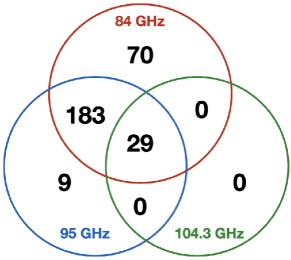
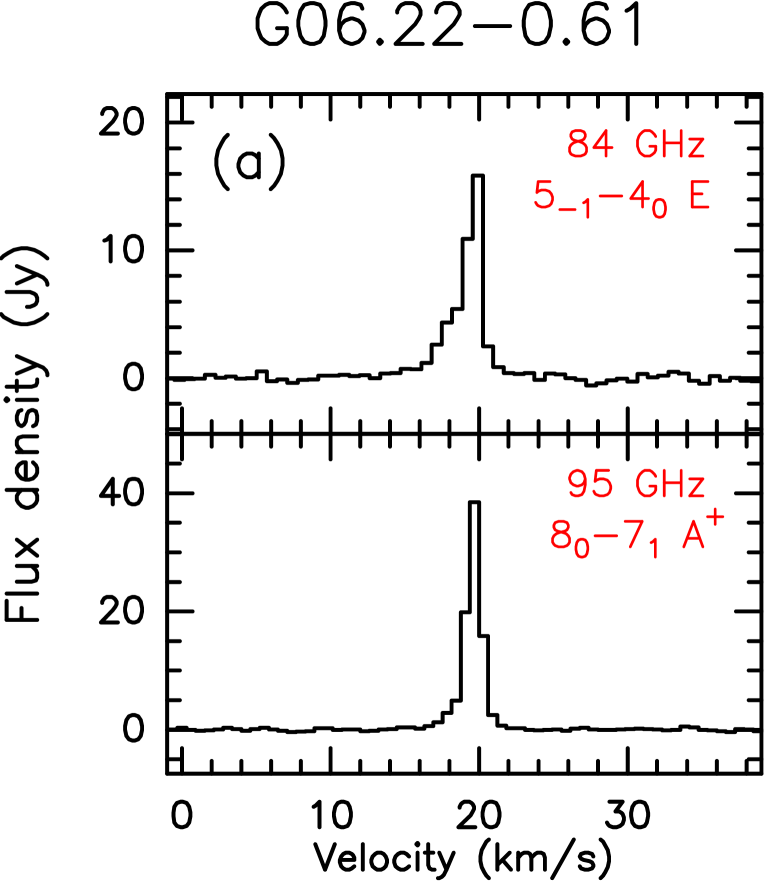
We analyzed the 3-mm wavelength spectral line survey of 408 ATLASGAL clumps observed with the IRAM 30m-telescope, focusing on the class I methanol masers with frequencies near 84, 95 and 104.3 GHz. We detect narrow, maser-like features towards 54, 100 and 4 sources in the maser lines near 84, 95 and 104.3 GHz, respectively. Among them, fifty 84 GHz masers, twenty nine 95 GHz masers and four rare 104.3 GHz masers are new discoveries. The new detections increase the number of known 104.3 GHz masers from 5 to 9. The 95 GHz class I methanol maser is generally stronger than the 84 GHz maser counterpart. We find 9 sources showing class I methanol masers but no SiO emission, indicating that class I methanol masers might be the only signpost of protostellar outflow activity in extremely embedded objects at the earliest evolutionary stage. Class I methanol masers that are associated with sources that show SiO line wings are more numerous and stronger than those without such wings. The total integrated intensity of class I methanol masers is well correlated with the integrated intensity and velocity coverage of the SiO (2--1) emission. The properties of class I methanol masers are positively correlated with the bolometric luminosity, clump mass, peak H$_2$ column density of their associated clumps but uncorrelated with the luminosity-to-mass ratio, dust temperature, and mean H$_2$ volume density. We suggest that the properties of class I masers are related to shocks traced by SiO. Based on our observations, we conclude that class I methanol masers at 84 and 95 GHz can trace a similar evolutionary stage as H$_2$O maser, and appear prior to 6.7 and 12.2 GHz methanol and OH masers. Despite their small number, the 104.3 GHz class I masers appear to trace a short and more evolved stage compared to the other class I masers. [abridged]
研究の動機と目的
- 高質量星形成領域における84、95、104.3 GHzのクラスIメタノールメーザーの検出を目的とする。
- クラスIメーザーとSiO放射(例:衝撃を示す線幅)といった衝撃トレーサーとの統計的関係を調査すること。
- 進化段階に応じたメーザー特性とその母体クラスターの特性を比較すること。
- 複数のクラスIメーザーが同時に励起される物理的条件を制約すること。
- 異なるクラスIメーザー遷移が他のメーザー種(例:H₂O、6.7/12.2 GHzメタノール、OH)と比較して、どの進化段階を示しているかを特定すること。
提案手法
- IRAM 30m望遠鏡を用いて408個のATLASGALクラスターの3-mmスペクトルラインサーベイを実施した。
- クラスIメタノールメーザーの84、95、104.3 GHz遷移における狭帯域でメーザー的特徴を特定することに焦点を当てた。
- メーザー検出を、特に衝撃を示す線幅を有するSiO (2–1)放射と相関させた。
- メーザーの積分強度とクラスター特性(ボリオメトリック光度、質量、H₂質量密度、チリ温度、H₂体積密度)との相関を分析した。
- 複数のメーザー遷移が存在する領域における力学的温度、パラ-H₂密度、メタノール質量密度を推定するために物理的モデルを用いた。
- 光度対質量比とメーザー存在の有無に基づき、進化段階との関連性を評価する統計的分析を実施した。
実験結果
リサーチクエスチョン
- RQ1高質量星形成クラスターにおける84、95、104.3 GHzのクラスIメタノールメーザーの検出率はどの程度か?
- RQ2メーザー特性は、特に衝撃を示す線幅を有するSiO放射とどのように相関するか?
- RQ3ボリオメトリック光度、質量、H₂質量密度などのクラスター特性のうち、メーザー強度と最も強く相関するのはどれか?
- RQ484および95 GHzのクラスIメーザーは、H₂Oメーザーと同一の進化段階を示しているか?6.7/12.2 GHzメタノールおよびOHメーザーと比較するとどうか?
- RQ5複数のクラスIメーザー遷移が同時に励起されるために必要な物理的条件は何か?
主な発見
- 84 GHzで54件、95 GHzで100件、104.3 GHzで4件の新しいクラスIメタノールメーザーが検出され、既知の104.3 GHzメーザー数は5から9件に増加した。
- 95 GHzクラスIメーザーは一般的に84 GHzメーザーよりも強度が高く、メーザーとシステム的径速度との相対的ドップラー速度は約±5 km s⁻¹の範囲内にあった。
- 9件の源ではクラスIメーザーが検出されたがSiO放射は検出されず、これは初期の埋蔵段階においてメーザーがプロト星噴流活動の唯一の指標である可能性を示している。
- メーザー強度はSiO (2–1)の積分強度および速度幅(FWZP)と正の相関を示しており、衝撃活動と強い関連があることを示している。
- クラスIメーザー特性はボリオメトリック光度、クラスター質量、ピークH₂質量密度と正の相関を示したが、光度対質量比、チリ温度、平均H₂体積密度とは相関しなかった。
- 104.3 GHzメーザーはH II領域段階でのみ検出され、84および95 GHzメーザーと比較してより高いクラスター光度(>10⁴ L⊙)、質量(>200 M⊙)、H₂質量密度(>10²³ cm⁻²)を要することが判明し、より進化した段階を示している。
この論文を読む
Nubintのビューアで原文を開き、読みながら気になる箇所をすぐに質問できます。
Nubintでこの論文を読むこのレビューはAIが論文の原文をもとに作成しました。引用する前に原文をご確認ください。