
[論文レビュー] Capse.jl: efficient and auto-differentiable CMB power spectra emulation
Capse.jl は、CMB-S4 に向けたスケールでマイクロ秒未満で CMB 温度・偏光・レンズ効果パワー スペクトルを予測するニューラルネットワークベースのエミュレータであり、0.1σ未満の誤差を達成する。微分可能アーキテクチャと勾配ベースのサンプラー(例:NUTS や Pathfinder)を組み合わせることで、従来の方法に比べて 6 時間分の高速化を実現し、1 秒未満でプランクに相当する宇宙論的制約を達成する。
We present Capse.jl, a novel neural network-based emulator designed for rapid and accurate prediction of Cosmic Microwave Background (CMB) temperature, polarization, and lensing angular power spectra. The emulator computes predictions in just a few microseconds with emulation errors below $0.1σ$ for all the scales relevant for the upcoming CMB-S4 survey. Capse.jl can also be trained in an hour's time on a 8-cores CPU. We test Capse.jl on Planck 2018, ACT DR4, and 2018 SPT-3G data and demonstrate its capability to derive cosmological constraints comparable to those obtained by traditional methods, but with a computational efficiency that is three to six orders of magnitude higher. We take advantage of the differentiability of our emulators to use gradient-based methods, such as Pathfinder and Hamiltonian Monte Carlo (HMC), which speed up the convergence and increase sampling efficiency. Together, these features make Capse.jl a powerful tool for studying the CMB and its implications for cosmology. When using the fastest combination of our likelihoods, emulators, and analysis algorithm, we are able to perform a Plancky TT + TE + EE analysis in less than a second. To ensure full reproducibility, we provide open access to the codes and data required to reproduce all the results of this work.
研究の動機と目的
- CAMB のような従来のボルツマンソルバを用いた Bayesian 宇宙論的推論における CMB ライクリフ評価の高コストを解消すること。
- 温度・偏光・レンズ効果のすべての CMB 角度パワー スペクトルをカバーする、高効率で高精度かつ微分可能なエミュレータの開発。
- ハミルトニアン・モンテカルロや Pathfinder などの勾配ベースの推論手法を用いた高速なサンプリングと最適化の実現。
- CAMB と Cobaya を用いた標準的な MCMC パイプラインと比較して、3〜6 時間分の計算高速化を達成すること。
- コミュニティの採用と検証を可能にするために、コードとトレーニングデータの完全な再現可能性とオープンアクセスを確保すること。
提案手法
- 広範な宇宙論的パrameter スペースにおいて、CMB 角度パワー スペクトル(TT, TE, EE, BB, レンズ効果)をエミュレートするための深層ニューラルネットワークをトレーニングする。
- Julia の自動微分機能を活用してエミュレータを完全に微分可能にし、勾配ベースの推論アルゴリズムの利用を可能にする。
- 出力次元を低減し、尤度評価を高速化するために、チェビシェフ多項式分解を適用し、計算効率を向上させる。
- CMB-S4 に必要な全多重数範囲にわたる精度を保証するため、合成パラメータの組み合わせを用いたマルチスケールトレーニング戦略を採用する。
- Cobaya フレームワークを用いて、CAMB の尤度評価を置き換える完全な Bayesian 推論パイプラインにエミュレータを統合する。
- NUTS, MicroCanonical HMC, Pathfinder などの勾配ベースのサンプラーを用いて性能をベンチマークし、収束性とサンプリング効率を比較する。
実験結果
リサーチクエスチョン
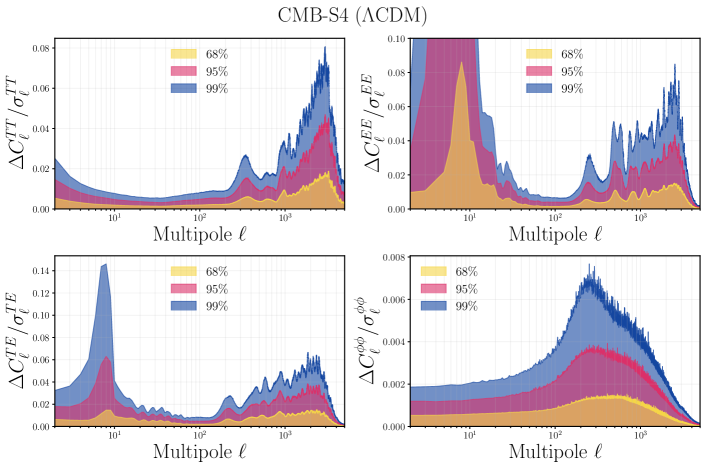
- RQ1微分可能なニューラルネットワークエミュレータは、近い将来の調査に向けたすべての関連スケールで 0.1σ 未塔の精度で CMB パワー スペクトルを予測できるか?
- RQ2NUTS や Pathfinder のような勾配ベースのサンプラーを微分可能なエミュレータと組み合わせることで、宇宙論的推論がどの程度高速化できるか?
- RQ3CMB-S4 の計測データ(Planck, ACT DR4, SPT-3G)に対して、Capse.jl の計算性能は従来の CAMB ベースのパイプラインと比べて、ウォールクロック時間でどの程度優れているか?
- RQ4チェビシェフ多項式分解は、精度を損なわず尤度評価の効率を著しく向上させられるか?
- RQ5エミュレータは、実データにおける CAMB や Cobaya と同等の宇宙論的制約を再現できるほど、頑健で正確であるか?
主な発見
- Capse.jl は 1 回の呼び出しで 10 マイクロ秒未塔で CMB パワー スペクトルを計算し、CMB-S4 に必要なすべてのスケールで 0.1σ 未塔のエミュレーション誤差を達成する。
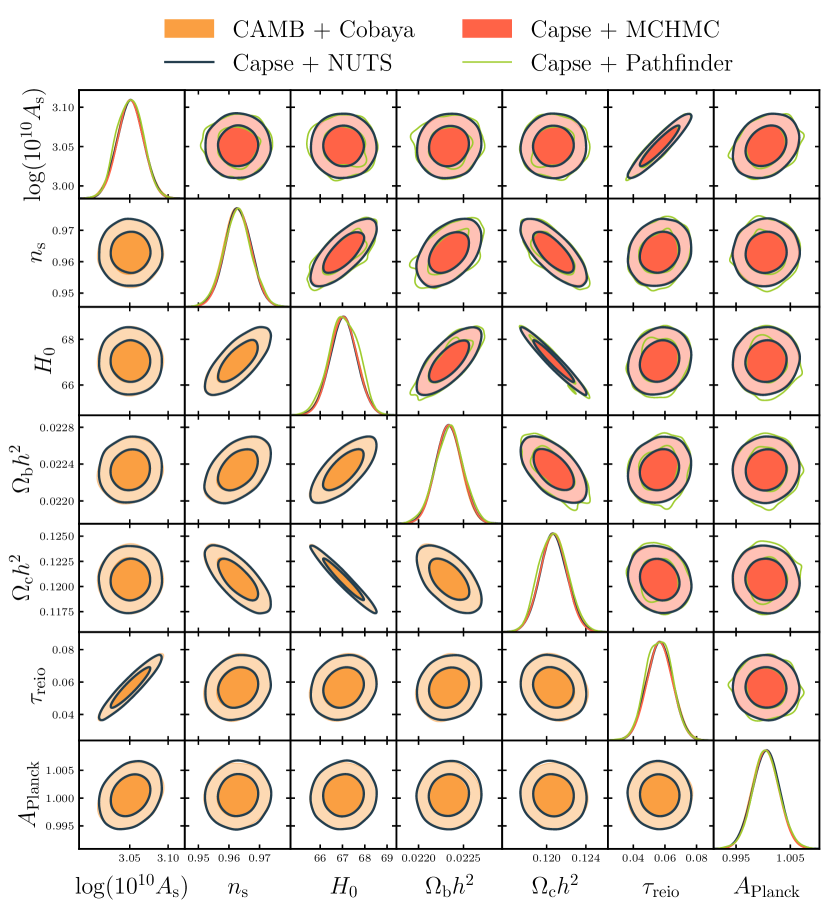
- Capse.jl は、Planck 2018, ACT DR4, SPT-3G 2018 データに対して、CAMB ベースのパイプラインと同等の完全な宇宙論的制約を達成し、事後分布の差が 0.1σ 未塔である。
- Capse.jl を用いた Planck TT+TE+EE 分析(最も高速な尤度コンビネーション)に NUTS サンプリングを適用した場合、1 秒未塔で完了する。一方、CAMB と Cobaya を用いた従来の方法では約 100 CPU 時間を要する。
- NUTS や Pathfinder などの勾配ベースのサンプラーを用いることで、分析時間は 2〜6 時間分の高速化が達成される:Planck で 0.5 CPU 時間、ACT で 1 時間、SPT-3G で 14 時間。
- MicroCanonical HMC は、ほぼ同一の事後分布を生成しながら、標準 NUTS よりも 2〜3 倍の効率を発揮する。
- チェビシェフ多項式分解により、Planck 分析の効率がほぼ 1 時間分向上し、スケーラブルで高精度なエミュレーションが可能になる。将来的には銀河集団解析への応用も視野に入れる。
より良い研究を、今すぐ始めましょう
論文の読解から最終レビューまで、研究時間を劇的に削減しましょう。
クレジットカード登録不要
このレビューはAIが作成し、人間の編集者が確認しました。