
[論文レビュー] CRIRES$^+$ transmission spectroscopy of WASP-127b. Detection of the resolved signatures of a supersonic equatorial jet and cool poles in a hot planet
本研究では、熱いジュピター WASP-127b の高分解能 CRIRES+ Kバンド透過スペクトロスコピーを用いて、空間的に解像された大気の不均一性を検出する。その結果、音速を超える赤道付近のジェット気流と、冷たい極域が明らかになった。クロス相関信号に2次元ベイズ的リトリーブモデルを適用することで、朝の終止線と夕方の終止線からの明確な速度シフトが特定され、赤道風速は 9.3 ± 0.2 km s⁻¹、終止線間の温度差は 175 K となった。極域からの信号が弱いことから、低温または高高度の雲層による遮断が示唆された。
General circulation models of gas giant exoplanets predict equatorial jets that drive inhomogeneities in the atmospheric physical parameters across the planetary surface. We studied the transmission spectrum of the hot Jupiter WASP-127\,b during one transit in the K band with CRIRES$^+$. Telluric and stellar signals were removed from the data using SYSREM. The planetary signal was investigated using the cross-correlation technique. After detecting a spectral signal indicative of atmospheric inhomogeneities, we employed a Bayesian retrieval framework with a 2D modelling approach tailored to address this scenario. We detected strong signals of H$_2$O and CO, which exhibited not one but two distinct cross-correlation peaks. The double-peaked signal can be explained by a supersonic equatorial jet and muted signals at the planetary poles, with the two peaks representing the signals from the planet's morning and evening terminators. We calculated a jet velocity of $7.7\pm0.2$ km~s$^{-1}$ and derive distinct atmospheric properties for the two terminators as well as the polar region. Our retrieval yields a solar C/O ratio and metallicity and challenges previous studies of WASP-127b's atmosphere. It provides tentative evidence for the morning terminator to be cooler than the evening terminator by $-175^{+133}_{-117}$K and shows that the muted signals from the poles can be explained by either significantly lower temperatures or a high cloud deck. The presence of a clear double-peaked signal highlights the importance of taking planetary 3D structure into account during interpretation of atmospheric signals. The supersonic jet velocity and lack of signal from the polar regions, representing a detection of latitudinal inhomogeneity in a spatially unresolved target, showcases the power of high-resolution transmission spectroscopy for the characterisation of global circulation in exoplanet atmospheres.
研究の動機と目的
- 高分解能透過スペクトロスコピーを用いて、熱いジュピター WASP-127b の大気不均一性を調査すること。
- 赤道ジェットや惑星の緯度にわたる温度変化といった、グローバル循環の特徴を検出・特徴付けること。
- 速度分解能を活用したスペクトル信号を用いて、朝の終止線、夕方の終止線、極域といった異なる大気領域の寄与を解明すること。
- C/O比や金属量といった、回収された大気パラメータが太陽値と整合するかを検証すること。
- 風速と緯度にわたる温度対比の観測的制約を提供することで、3次元一般循環モデル(GCMs)の妥当性を検証すること。
提案手法
- WASP-127b の単一食を対象として、VLT の CRIRES+ 計器を用いて高分解能 Kバンド透過スペクトロスコピーを取得した。
- 大気信号を分離するために、大気圏および恒星の汚染を SYSREM アルゴリズムで除去した。
- 分子種(H₂O および CO)の検出に、ドップラー補正された速度プロファイルを用いたクロス相関技術を適用した。
- 朝の終止線、夕方の終止線、極域それぞれのための、2次元ベイズ的リトリーブフレームワークを構築した。
- 速度依存の信号カーネルを考慮することで、異なる経度および緯度における大気寄与を解像可能にした。
- パイプラインの不確実性における系統的過大評価を補正するため、誤差スケーリングに β 要因 0.6089 ± 0.0004 を使用した。
実験結果
リサーチクエスチョン
- RQ1高分解能透過スペクトロスコピーは、潮汐ロックされた系外惑星における異なる経度(朝の終止線 vs. 夕方の終止線)からの明確な大気信号を解像可能か?
- RQ2WASP-127b の大気における赤道ジェットの速度と構造は何か?また、惑星の自転速度に対して音速を超えるか?
- RQ3朝の終止線、夕方の終止線、極域における温度および化学成分の組成はどのように異なるか?
- RQ4惑星の極域からのスペクトル信号が弱い原因は何か?これは低温または高高度の雲層による遮断で説明可能か?
- RQ5回収された大気パラメータ(C/O比や金属量)は太陽値と整合的か?この惑星における CO の過去の非検出結果をどう説明できるか?
主な発見
- 本研究では、WASP-127b の大気における CO の最初の明確な検出を報告し、長年の非検出結果との矛盾を解消した。
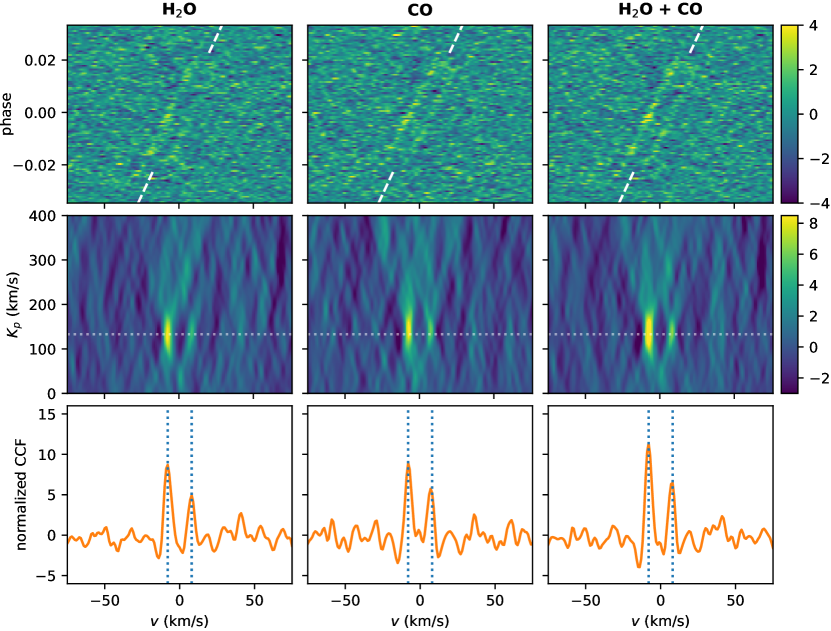
- ±8 km s⁻¹ の二つの明確なクロス相関ピークが観測され、ゼロ速度での信号は認められなかった。これにより、9.3 ± 0.2 km s⁻¹ の回収された赤道風速を持つ音速を超えるジェット気流が存在することが示された。
- 赤道ジェットの風速は、予想される潮汐ロックされた自転速度の約6倍に達するほど速く、音速を超える流れであることが示された。
- 夕方の終止線は、朝の終止線よりも 175⁺¹¹⁶₋₁₃₃ K 高温であり、強い経度方向の温度非対称性が示された。
- 極域ではスペクトル信号が弱く、低温または高高度の雲層が透過を遮断していることで最もよく説明された。
- 回収された C/O 比および金属量は太陽値と整合的であり、この惑星の大気化学を説明するために、特異な形成歴は必要ないことが示唆された。
この論文を読む
Nubintのビューアで原文を開き、読みながら気になる箇所をすぐに質問できます。
Nubintでこの論文を読むこのレビューはAIが論文の原文をもとに作成しました。引用する前に原文をご確認ください。