
[論文レビュー] Excitation and Abundance of C3 in star forming cores:Herschel/HIFI observations of the sight-lines to W31C and W49N
本研究では、星形成核 W31C および W49N における C3 の励起状態と濃度を、Herschel/HIFI の観測データを用いて分析した。放射線輸送モデルの結果、振動-回転遷移は赤外線による強く励起されており、吸収ラインを形成する。導出された C3 の柱密度は約 1.5 × 10¹⁵ cm⁻² であり、これは約 10⁻⁸ の濃度に対応し、温暖化化学モデルと整合的であり、薄い雲層における濃度よりも顕著に高い。
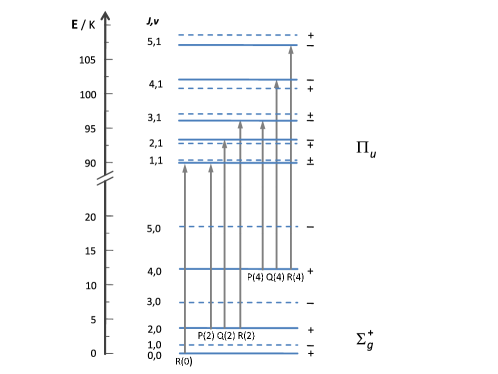
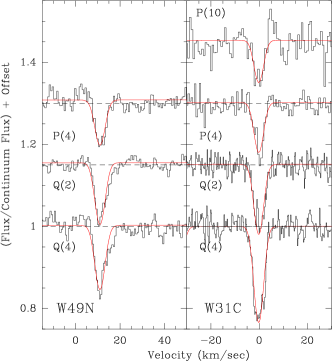
We present spectrally resolved observations of triatomic carbon (C3) in several ro-vibrational transitions between the vibrational ground state and the low-energy nu2 bending mode at frequencies between 1654-1897 GHz along the sight-lines to the submillimeter continuum sources W31C and W49N, using Herschel's HIFI instrument. We detect C3 in absorption arising from the warm envelope surrounding the hot core, as indicated by the velocity peak position and shape of the line profile. The sensitivity does not allow to detect C3 absorption due to diffuse foreground clouds. From the column densities of the rotational levels in the vibrational ground state probed by the absorption we derive a rotation temperature (T_rot) of ~50--70 K, which is a good measure of the kinetic temperature of the absorbing gas, as radiative transitions within the vibrational ground state are forbidden. It is also in good agreement with the dust temperatures for W31C and W49N. Applying the partition function correction based on the derived T_rot, we get column densities N(C3) ~7-9x10^{14} cm^{-2} and abundance x(C3)~10^{-8} with respect to H2. For W31C, using a radiative transfer model including far-infrared pumping by the dust continuum and a temperature gradient within the source along the line of sight we find that a model with x(C3)=10^{-8}, T_kin=30-50 K, N(C3)=1.5 10^{15} cm^{-2} fits the observations reasonably well and provides parameters in very good agreement with the simple excitation analysis.
研究の動機と目的
- 高分解能の準分子帯域観測を用いて、星形成核における C3 の励起状態と柱密度を特定すること。
- 特に ν₂ = 1–0 遷移における C3 の振動-回転準位を励起する赤外線励起の役割を評価すること。
- 観測された吸収プロファイルと放射線輸送モデルを比較し、正確な C3 濃度を導出し、簡易二層モデルにおける仮定を検証すること。
- 力学的温度、光学濃度、チリ温度が観測されたラインプロファイルおよび励起温度に与える影響を評価すること。
提案手法
- W31C および W49N 星形成核に向けて、Herschel/HIFI 計器を用いて C3 の回転遷移および振動-回転遷移の高分解能スペクトル観測を実施した。
- 衝突励起、赤外線励起、チリ連続スペクトル放射を組み込んだ放射線輸送モデルを用いてラインプロファイルを再現した。
- 力学的温度(Tkin)、柱密度、光学濃度の変動を考慮し、特に ν₂ = 1–0 遷移に注目した。
- 衝突励起と放射励起の両方を考慮し、基底振動状態の回転準位および第一励起振動状態(ν₂ = 1)の励起温度を計算した。
- 比較のため、源の覆い被さる割合が 1 で、励起温度がチリ温度に熱平衡化していると仮定した二層モデルを用いた。
- モデルは観測された光学濃度およびライン形状と照合され、衝突断面積および密度の変動に対する感度解析が実施された。
実験結果
リサーチクエスチョン
- RQ1星形成核における C3 の基底状態および第一励起振動状態の励起機構として、支配的であるのは何か?
- RQ2導出された C3 の柱密度および濃度は、温暖化化学モデルの予測とどのように一致するか?
- RQ3衝突断面積、力学的温度、光学濃度の不確実性が、推定される励起状態および濃度に与える影響はどの程度か?
- RQ4なぜ W31C および W49N の明るい連続スペクトルに対して C3 の吸収ラインが観測されるのか?これは回転準位の励起温度とどのように関係するか?
- RQ5赤外線励起は、観測された光学濃度および ν₂ = 1–0 遷移の見かけの励起温度にどのように影響を与えるか?
主な発見
- C3 の ν₂ = 1–0 遷移は、主に赤外線励起によって励起されており、W31C および W49N の明るい連続スペクトルに対して強い吸収ラインを形成している。
- 基底振動状態の回転準位では、低 J レベルで励起温度は 35–37 K、内部領域の高 J レベルでは約 20 K であり、外層では 10–20 K に低下する。
- 放射線輸送モデルにより、30 K の力学的温度における W31C の C3 柱密度は 1.5 × 10¹⁵ cm⁻² に達するが、これは連続スペクトルの光学濃度による部分的再充填のため、二層モデルの推定値よりも高い。
- W31C および W49N における C3 濃度は約 10⁻⁸ であり、n(H₂) ≈ 2 × 10⁵ cm⁻³ および A_V ≈ 10 の温暖化化学モデルの予測と整合的である。
- これらの核における C3 柱密度は、薄い雲層や半透明雲層(通常 10¹²–10¹³ cm⁻²)の約 100 倍高く、前方の薄いガスでは非検出となる理由が説明できる。
- 柱密度は下限値である。これは、二層モデルの仮定(覆い被さる割合が 1、T_ex ≪ T_c)により、真の励起温度が低く見積もられ、結果として柱密度も低く見積もられるためである。
この論文を読む
Nubintのビューアで原文を開き、読みながら気になる箇所をすぐに質問できます。
Nubintでこの論文を読むこのレビューはAIが論文の原文をもとに作成しました。引用する前に原文をご確認ください。