
[論文レビュー] Full-Atom Protein Pocket Design via Iterative Refinement
FAIR は、反復的・粗いから細かい段階への最適化を通じて、残基配列と 3D 構造を同時に設計する、画期的な深層生成フレームワークである。側鎖原子のモデル化、リガンドの柔軟性、配列-構造の一貫性をエンドツーエンドで E(3)-等長最適化により扱うことで、先行手法と比較して平均 AAR 15.5% 向上、RMSD 13.5% 向上を達成し、最先端の性能を実現した。
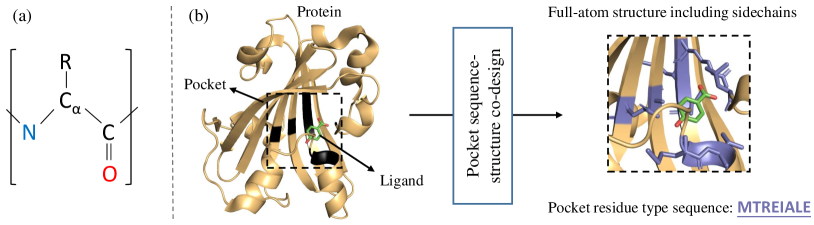
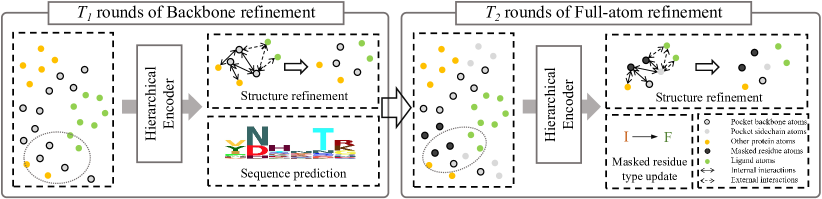
The design of \emph{de novo} functional proteins that bind specific ligand molecules is paramount in therapeutics and bio-engineering. A critical yet formidable task in this endeavor is the design of the protein pocket, which is the cavity region of the protein where the ligand binds. Current methods are plagued by inefficient generation, inadequate context modeling of the ligand molecule, and the inability to generate side-chain atoms. Here, we present the Full-Atom Iterative Refinement (FAIR) method, designed to address these challenges by facilitating the co-design of protein pocket sequences, specifically residue types, and their corresponding 3D structures. FAIR operates in two steps, proceeding in a coarse-to-fine manner (transitioning from protein backbone to atoms, including side chains) for a full-atom generation. In each iteration, all residue types and structures are simultaneously updated, a process termed full-shot refinement. In the initial stage, the residue types and backbone coordinates are refined using a hierarchical context encoder, complemented by two structure refinement modules that capture both inter-residue and pocket-ligand interactions. The subsequent stage delves deeper, modeling the side-chain atoms of the pockets and updating residue types to ensure sequence-structure congruence. Concurrently, the structure of the binding ligand is refined across iterations to accommodate its inherent flexibility. Comprehensive experiments show that FAIR surpasses existing methods in designing superior pocket sequences and structures, producing average improvement exceeding 10\% in AAR and RMSD metrics. FAIR is available at \url{https://github.com/zaixizhang/FAIR}.
研究の動機と目的
- 治療的・バイオエンジニアリング応用を目的とした、特定のリガンドを結合する機能的タンパク質パッチのデノボ設計という重要な課題に取り組む。
- 従来手法の限界、すなわち生成効率の悪さ、リガンドの柔軟性の不十分なモデル化、側鎖原子の省略を克服する。
- エンドツーエンドで反復的かつ一貫性のあるフレームワークを通じて、タンパク質パッチの配列と 3D 構造を共同設計する。
- 幾何的補完性と結合親和性が向上した高精度な全原子生成によるタンパク質-リガンド複合体の生成を可能にする。
提案手法
- FAIR は二段階の粗いから細かい段階への反復的最適化パイプラインを採用:最初に骨格座標と残基タイプを最適化し、次に側鎖原子を統合し、全原子構造を再最適化する。
- タンパク質-リガンド複合体におけるマルチスケールの構造的依存関係をモデル化するため、残基レベルおよび原子レベルのエンコーダーを備えた階層的コンテキストエンコーダーを用いる。
- 相互作用の最適化に二つの構造最適化モジュールを採用:一つは残基間相互作用、もう一つはパッチ-リガンド相互作用をそれぞれ更新する。これらは反復的に更新される。
- 全ショット最適化(各イテレーションで全残基タイプと座標を同時に更新)を適用し、効率性と収束性を向上させる。
- 隣接する残基に基づいて欠落した残基タイプを予測することで、配列-構造の一貫性を保証するマスク付き残基タイプ更新機構を導入する。
- リガンドの 3D 構造を反復的に最適化し、構造的柔軟性を考慮することで、結合適合性を向上させる。
実験結果
リサーチクエスチョン
- RQ1反復的かつ全ショットの最適化により、逐次的(autoregressive)またはワンショット手法と比較して、デノボタンパク質パッチ設計の品質が向上するか?
- RQ2側鎖原子とリガンドの柔軟性が、設計パッチにおける結合親和性および幾何的補完性の向上にどの程度寄与するか?
- RQ3マスク付き残基タイプ予測による配列-構造一貫性モデリングの統合は、設計精度の向上にどの程度有効か?
- RQ4階層的エンコーダーと E(3)-等長設計は、タンパク質-リガンド複合体生成における一般化性能と表現学習を向上させるか?
- RQ5AAR、RMSD、Vina スコアといった主要指標において、FAIR は物理ベース、テンプレートマッチング、深層生成ベースラインと比較してどの程度優れているか?
主な発見
- FAIR は CrossDocked データセットで平均 40.17% のアミノ酸回復率(AAR)を達成し、Binding MOAD では 43.75% を記録。これはベースラインと比較して平均 15.5% の向上を示した。
- FAIR は CrossDocked で RMSD を 1.42 Å、Binding MOAD で 1.35 Å まで低下させ、構造的正確性において平均 13.5% の向上を示した。
- アブレーションスタディーにより、階層的エンコーダーを削除すると性能が最も顕著に低下(AAR:25.30% vs. 40.17%)し、表現学習におけるその重要性が確認された。
- 全原子最適化とリガンド構造最適化の導入が性能向上に大きく寄与しており、それぞれを削除すると AAR は 35.52% および 33.16% に低下した。
- 全ショット最適化を逐次的デコードに置き換えると、CrossDocked での AAR は 31.04% に低下し、反復的かつ共同最適化がより効率的かつ正確であることが示された。
- FAIR は逐次的手法よりも短時間で高品質なパッチを生成でき、1パッチあたりの平均生成時間は 1.8 秒であり、速度と正確性の両面でベースラインを上回った。
より良い研究を、今すぐ始めましょう
論文の読解から最終レビューまで、研究時間を劇的に削減しましょう。
クレジットカード登録不要
このレビューはAIが作成し、人間の編集者が確認しました。