
[論文レビュー] Gravitational Waves from SMBH Binaries in Light of the NANOGrav 15-Year Data
本論文は、SMBH連星が重力波だけでなく環境効果(ガス、星、暗黒物質)によってエネルギーを失うモデルとともに NANOGrav 15 年データに適合し、GWのみの進化より良い適合を示すとともに高い SMBH 合併効率を示唆している。
The NANOGrav Collaboration has recently announced evidence for nHz gravitational waves (GWs), in the form of a Hellings-Downs angular correlation in the common-spectrum process that had been observed previously by them and other Pulsar Timing Arrays (PTAs). We analyze the possibility that these GWs originate from binary supermassive black holes (SMBHs) with total masses $\gtrsim 10^9\, M_{\odot}$. The spectral index of the GW signal differs at 95 % CL from that predicted for binary evolution by GW emission alone, and we find $> 3 σ$ evidence that environmental effects such as dynamical friction with gas, stars, and dark matter may be affecting the binary evolution. We estimate the required magnitude and spectrum of such environmental effects and comment on their possible implications for measurements of GWs at higher frequencies.
研究の動機と目的
- NG15 nanohertz GW 信号の解釈を、銀河環境内の SMBH 連星から生じるものとして動機づける。
- SMBH-ハロー質量関係の散乱と環境エネルギー損失を組み込むことで、従来の SMBH 連星集団モデリングを拡張する。
- 環境効果が GW スペクトルをどのように変化させるかを定量化し、PTA 観測および高周波 GW の展望への影響を評価する。
提案手法
- 拡張プレス-シュペンサー形式を用いて SMBH 連星の形成と融合率を推定する。
- 対数正規分布の占有分布 p_occ(m|M,z) と一定の合併効率 p_BH で SMBH 質量関数をモデル化する。
- 環境エネルギー損失を冪則依存 f_GW( M, η, z ) = f_ref (M/10^9 M_sun)^{-β} で組み込み、β を固定して β=0.4, α と f_ref によって t_env/t_GW をパラメータ化する。
- 融合集団からの GW エネルギー密度スペクトル Omega_GW(f) と、環境効果を含むその進化を計算し、周波数ビン分布 P_data(Omega|f_i) を用いて完全な尤度を生成する。
- 最も強い源のモンテカルロ風の実現を行い、残りを狭いガウス分布としてモデル化し、Omega_GW(f) の長尾の変動を捉える。
- GW のみ vs GW+環境適合を尤度比 ell_max で比較し、(p_BH, α, f_ref) の事後制約を報告する。
実験結果
リサーチクエスチョン
- RQ1環境エネルギー損失を含めることが、NG15 データに対する SMBH連星 GW バックグラウンドの適合を GW のみの進化と比較して改善するか?
- RQ2推定された SMBH 合併効率 p_BH、環境パラメータ f_ref および α の値と相関はどのようで、それらが予測される GW スペクトルにどう影響するか?
- RQ3環境効果は PTA データにおける低周波ダイップおよび Omega_GW(f) の全体的なスペクトル形状にどのように影響するか?
- RQ4LISA、AEDGE、または原子干渉計による高周波 GW バンドでの低質量 BH 合併の観測に対する含意は何か?
主な発見
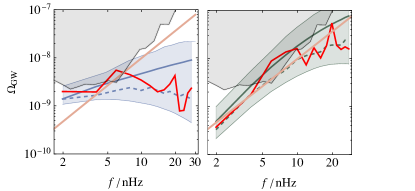
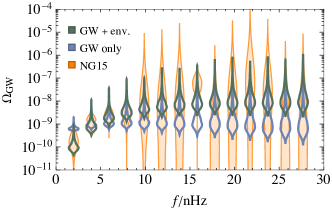
- GW のみのモデルでは p_BH = 0.07_{-0.07}^{+0.05}(68% CL)だが、環境効果はより大きい p_BH の値を好む。
- 環境効果を含む最良適合パラメータ: p_BH = 0.84, α = 2.0, f_ref ≈ 34 nHz.
- 環境モデルは Δχ^2 ≈ 11 の尤度改善を GW のみモデルよりももたらし、ガウス近似では約 2σ の水準で環境モデルを有利にしている。
- 分析は、平均 Omega_GW およびそのゆらぎが環境エネルギー損失でよりよく捉えられることを示し、f = 2 nHz のダイップを含み、GW のみモデルでは再現が難しい。
- この枠組みは、より高周波の GW 探索器で観測可能性のある低質量 BH 合併の割合を予測し、LISA および量子/原子干渉計ベースの検出器への含意を論じている。
より良い研究を、今すぐ始めましょう
論文設計から論文執筆まで、研究時間を劇的に削減しましょう。
クレジットカード登録不要
このレビューはAIが作成し、人間の編集者が確認しました。