
[論文レビュー] Helium as an Indicator of the Neutron-Star Merger Remnant Lifetime and its Potential for Equation of State Constraints
本論文では、中性子星合体残りの寿命を推定するため、キロノーバスペクトルにおけるヘリウム発光—特に He i λ1083.3 nm 線—を用いる手法を提案する。AT2017gfo のスペクトルを分析することで、残りの寿命が ≤30 ms であることが制限され、これは直接的ブラックホール崩壊の閾値に近い合体二重星質量(M_thres ≲ 2.93 M⊙)を示唆する。これにより、中性子星状態方程式は最大質量 M_max ≲ 2.3 M⊙、1.6 M⊙ の中性星の半径が約 12 ± 1 km に制限される。
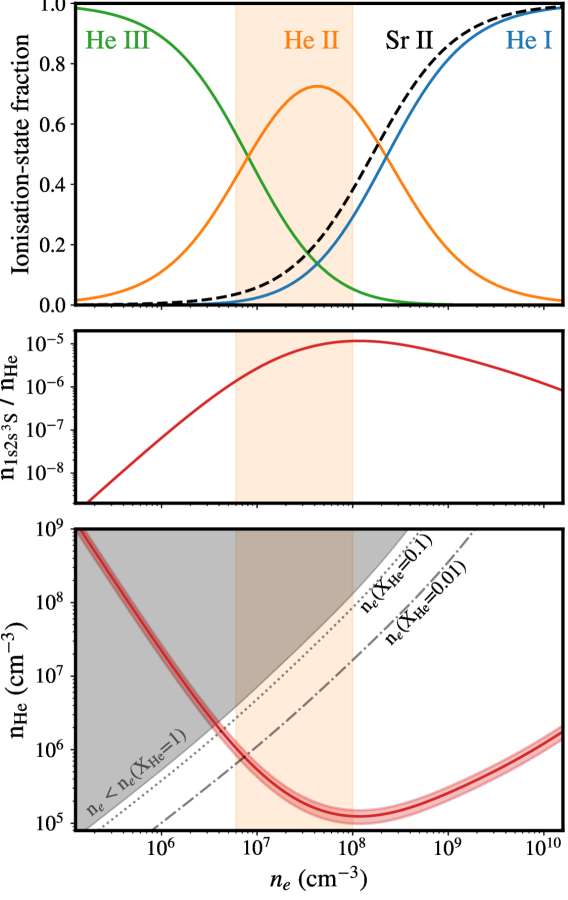
The time until black hole formation in a binary neutron-star (NS) merger contains invaluable information about the nuclear equation of state (EoS) but has thus far been difficult to measure. We propose a new way to constrain the merger remnant's NS lifetime, which is based on the tendency of the NS remnant neutrino-driven winds to enrich the ejected material with helium. Based on the He I $λ1083.3$ nm line, we show that the feature around 800-1200 nm in AT2017gfo at 4.4 days seems inconsistent with a helium mass fraction of $X_{\mathrm{He}} \gtrsim 0.05$ in the polar ejecta. Our recent neutrino-hydrodynamic simulations of merger remnants are only compatible with this limit if the NS remnant collapses within 20-30 ms. Such a short lifetime implies that the total binary mass of GW170817, $M_\mathrm{ m tot}$, lay close to the threshold binary mass for direct gravitational collapse, $M_\mathrm{thres}$, for which we estimate $M_{\mathrm{thres}}\lesssim 2.93 M_\odot$. This upper bound on $M_\mathrm{thres}$ yields upper limits on the radii and maximum mass of cold, non-rotating NSs, which rule out simultaneously large values for both quantities. In combination with causality arguments, this result implies a maximum NS mass of $M_\mathrm{max}\lesssim2.3 M_\odot$. The combination of all limits constrains the radii of 1.6 M$_\odot$ NSs to about 12$\pm$1 km for $M_\mathrm{max}$ = 2.0 M$_\odot$ and 11.5$\pm$1 km for $M_\mathrm{max}$ = 2.15 M$_\odot$. This $\sim2$ km allowable range then tightens significantly for $M_\mathrm{max}$ above $\approx2.15$ M$_\odot$. This rules out a significant number of current EoS models. The short NS lifetime also implies that a black-hole torus, not a highly magnetized NS, was the central engine powering the relativistic jet of GRB170817A. Our work motivates future developments... [abridged]
研究の動機と目的
- 中性子星合体残りの寿命を、噴出物におけるヘリウムの増加を用いて制限する新しい手法を開発すること。
- AT2017gfo のスペクトルにヘリウムが観測されないという事実を、残りの生存時間の制限に結びつけること。
- 状態方程式(EoS)の境界を、残りの寿命とブラックホール形成のための二重星質量閾値を用いて導出すること。
- 特にブラックホール・トルスかマグネタロンかの中央エンジンの可能性を検討すること。
提案手法
- 合体後 4.4 日における AT2017gfo の光学/赤外スペクトルにおける He i λ1083.3 nm 線を分析する。
- 中性子星合体残りのニュートリノ流体力学的シミュレーションを用いて、極方向噴出物におけるヘリウム質量分率(X_He)を残りの寿命の関数として予測する。
- 非局所熱平衡(non-LTE)条件と簡素化された噴出物幾何形状を仮定して、X_He の上限を推定するスペクトルモデリングを適用する。
- シミュレートされた X_He(τ_BH) 関係に基づき、推定された X_He の上限から 20–30 ms の最大残り寿命をマッピングする。
- 状態方程式依存のシミュレーションを用いて、残りの寿命から閾値合体質量 M_thres を導出する。
- M_thres の制限を因果性制約および質量-半径関係と組み合わせ、M_max と R_1.6 を、R_1.6 と M_max の逆関係を用いて境界付ける。
![Figure 1: VLT/X-shooter spectrum of AT2017gfo 4.4 days post merger with a blackbody continuum overlaid ( $T_{\rm BB}=3200$ K from the best-fit blackbody compilation in Sneppen et al. [ 66 ] ) and P Cygni features for various helium abundances computed using the model described in Sect. II . Given a](https://ar5iv.labs.arxiv.org/html/2411.03427/assets/x1.png)
実験結果
リサーチクエスチョン
- RQ1キロノーバスペクトルにおけるヘリウム発光は、中性子星合体残りの寿命を推定するために用いることができるか?
- RQ2AT2017gfo の極方向噴出物におけるヘリウム質量分率の上限は何か? それは残りの生存時間にどのような意味を持つのか?
- RQ3残りの寿命は、直接的ブラックホール崩壊のための閾値合体質量 M_thres をどのように制限するか?
- RQ4M_thres ≲ 2.93 M⊙ が得られた場合、中性星状態方程式の境界、特に M_max と R_1.6 はどのようなものか?
- RQ5残りの寿命は、GRB170817A を駆動する中央エンジンの性質にどのような示唆を与えるか? それはブラックホール・トルスかマグネタロンか?
主な発見
- AT2017gfo における He i λ1083.3 nm 特徴は、極方向噴出物におけるヘリウム質量分率 X_He ≳ 0.05 と整合しない。
- ニュートリノ流体力学的シミュレーションは、中性子星残りが 20–30 ms 以内に崩壊する場合にのみ、この X_He 制限と整合する。
- これは、GW170817 に対して直接的ブラックホール崩壊の閾値合体質量 M_thres ≲ 2.93 M⊙ であることを示唆する。
- M_thres の上限は、因果性制約と組み合わせることで、最大中性星質量 M_max ≲ 2.3 M⊙ を導く。
- M_max = 2.0 M⊙ の場合、1.6 M⊙ 中性星の半径は R_1.6 = 12 ± 1 km に制限され、M_max = 2.15 M⊙ の場合、R_1.6 = 11.5 ± 1 km である。
- 約 20 ms の残り寿命は、GRB170817A がブラックホール・トルス中央エンジンによって駆動されたことを示唆する。
より良い研究を、今すぐ始めましょう
論文の読解から最終レビューまで、研究時間を劇的に削減しましょう。
クレジットカード登録不要
このレビューはAIが作成し、人間の編集者が確認しました。