
[論文レビュー] Local minima in quantum systems
この論文は、古典的コンピュータでは量子系における局所的最小値を見つけることが計算的に困難であるが、熱勾配降下法を用いた量子コンピュータでは効率的に解けることを確立している。主な貢献は、局所的最小値が基底状態よりも簡単であるものの、BQP-hardハミルトニアンの下では古典的非効率性が依然として残ることを証明したことである—自然冷却過程のシミュレーションにおける量子優位性を強調している。
Finding ground states of quantum many-body systems is known to be hard for both classical and quantum computers. As a result, when Nature cools a quantum system in a low-temperature thermal bath, the ground state cannot always be found efficiently. Instead, Nature finds a local minimum of the energy. In this work, we study the problem of finding local minima in quantum systems under thermal perturbations. While local minima are much easier to find than ground states, we show that finding a local minimum is computationally hard for classical computers, even when the task is to output a single-qubit observable at any local minimum. In contrast, we prove that a quantum computer can always find a local minimum efficiently using a thermal gradient descent algorithm that mimics the cooling process in Nature. To establish the classical hardness of finding local minima, we consider a family of two-dimensional Hamiltonians such that any problem solvable by polynomial-time quantum algorithms can be reduced to finding ground states of these Hamiltonians. We prove that for such Hamiltonians, all local minima are global minima. Therefore, assuming quantum computation is more powerful than classical computation, finding local minima is classically hard and quantumly easy.
研究の動機と目的
- 熱的摂動の下での量子多体系における局所的最小値を求める計算複雑性を調査すること。
- 基底状態よりも簡単であるにもかかわらず、局所的最小値が古典的非可解性を保ち続けるかどうかを特定すること。
- 多項式時間の量子アルゴリズムを構築することで、局所的最小値問題に対する量子優位性を確立すること。
- 広範なハミルトニアンのクラスに対して、すべての局所的最小値がグローバル最小値であることを証明し、問題とBQP-hardnessを結びつけること。
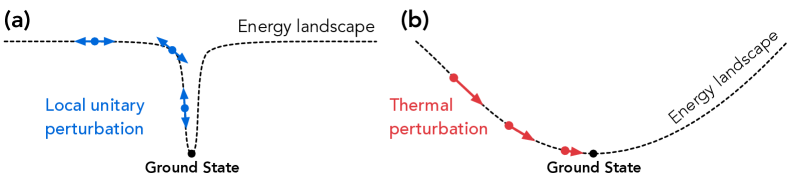
- 熱的および局所的ユニタリ摂動を用いた物理的に妥当な定義を提示することで、量子系における局所的最小値を形式化すること。
提案手法
- 小さな熱的および局所的ユニタリ摂動の下でのエネルギー期待値を用いて、量子系における局所的最小値を定義すること。
- 自然冷却過程を模倣する量子コンピュータ上で動作する熱勾配降下法を導入すること。
- 低温の熱浴に結合する開放系をモデル化するために、熱的 Lindbladian を用いること。
- 小さな摂動の下で、熱的摂動におけるエネルギー勾配が単調であることを証明し、収束を保証すること。
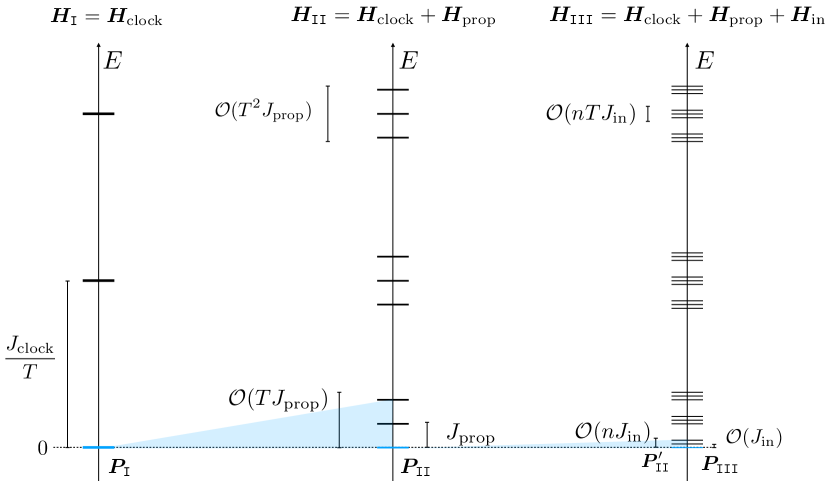
- 摂動論を用いて、特に低エネルギー部分空間における固有値および固有部分空間の変化を分析すること。
- 任意のBQP問題を、すべての局所的最小値がグローバル最小値である2次元局所的ハミルトニアンの基底状態問題に還元すること。
実験結果
リサーチクエスチョン
- RQ1古典的コンピュータにとって、量子系における局所的最小値の特定は計算的に困難か?
- RQ2物理的に妥当なアルゴリズムを用いて、量子コンピュータが局所的最小値を効率的に見つけられるか?
- RQ3すべての局所的最小値がグローバル最小値であるようなハミルトニアンは存在するか?そのような問題の複雑度はいかほどか?
- RQ4熱的摂動の下でエネルギー勾配はどのように振る舞い、小さなハミルトニアンの変更に対しても保存可能か?
- RQ5局所的最小値の計算複雑度と、BQPにおける量子優位性の関係は何か?
主な発見
- 局所的最小値の特定は古典的非可解性である:局所的最小値における1キュービット観測量を出力することですら、古典的コンピュータにとって計算的に非効率である。
- 熱勾配降下法を用いた多項式時間の量子アルゴリズムが存在し、量子優位性を証明している。
- 2次元局所的ハミルトニアンの族に対して、すべての局所的最小値がグローバル最小値であり、基底状態問題はBQP完全である。
- 摂動がエネルギーギャップに対してあまり大きくない限り、熱的摂動におけるエネルギー勾配は保存される。
- 一部のケースでは、小さな摂動がエネルギー勾配を完全に破壊する可能性があり、勾配の保存が自発的ではないことを示している。
- 量子アルゴリズムの成功は、レベル分裂の下でのエネルギー勾配の単調性に依存しており、これは摂動論および定常近似を用いて証明されている。
より良い研究を、今すぐ始めましょう
論文の読解から最終レビューまで、研究時間を劇的に削減しましょう。
クレジットカード登録不要
このレビューはAIが作成し、人間の編集者が確認しました。