
[論文レビュー] Low-rank quantics tensor train representations of Feynman diagrams for multiorbital electron-phonon models
本稿では、多軌道電子フォノン模型におけるフェニマン図の効率的計算を目的として、低ランクの量子的テンソルトレイン(QTT)表現とテンソルクロス補間(TCI)を組み合わせた手法を提案する。積分誤差の計算コストに対する指数的収束性と、不連続性および対称性の破れに対するロバスト性を示し、符号問題を伴わない高分解能の数値的積分が可能になる。
Feynman diagrams are an essential tool for simulating strongly correlated electron systems. However, stochastic quantum Monte Carlo sampling suffers from the sign problem, particularly when solving a multiorbital quantum impurity model. Recently, two approaches have been proposed for efficient numerical treatment of Feynman diagrams: Tensor Cross Interpolation (TCI) to replace stochastic sampling and the Quantics Tensor Train (QTT) representation for compressing space-time dependence. One of the remaining challenges is the nontrivial task of identifying low-rank structures in weak-coupling Feynman diagrams for multiorbital electron-phonon systems. In particular, the traditional TCI algorithm faces an ergodicity problem, which prevents it from fully exploring the multiorbital space. To address this, we incorporate a new algorithm called global search, which resolves this issue. By combining this approach with QTT, we uncover low-rank structures and achieve efficient numerical integration with exponential resolution in time and faster-than-power-law convergence of error relative to computational cost. Additionally, our approach does not require the division of discontinuous regions necessary in non-quantics TCI.
研究の動機と目的
- 多軌道電子フォノン系における自己エネルギーフェニマン図に、低ランクテンソルトレイン(TT)構造が存在するかどうかを調査すること。
- 連続的および離散的自由度を併せ持つ複雑な被積分関数に対するテンソルクロス補間(TCI)のロバスト性を評価すること。
- 量子モンテカルロ(QMC)法で悪化する可能性のあるフォノン寄与を、TCIが効果的に扱えるかどうかを評価すること。
- 量子的テンソルトレイン(QTT)表現が、計算コストに対して積分誤差の指数的収束を可能にするかどうかを特定すること。
提案手法
- 時間方向の指数的分解能を達成するため、時間変数の離散化に量子的テンソルトレイン(QTT)形式を用いる。
- スピン軌道指数やフォノン振動モードといった離散的自由度を、連続的時間変数と同じテンソルトレインに埋め込む。
- 高次元フェニマン図被積分関数の学習と積分に、低ランクTT近似を用いたテンソルクロス補間(TCI)を適用する。
- 被積分関数の圧縮と、ドメイン分割を伴わない効率的な数値積分を可能にするため、階層的低ランク構造を用いる。
- 結合次元χの関数としての補間誤差と収束速度を評価し、最大関数値で正規化した誤差を用いる。
- 展開係数の期待される減衰を確認するため、結果をIR基底に射影することで妥当性を検証する。
実験結果
リサーチクエスチョン
- RQ1多軌道電子フォノン模型における自己エネルギーフェニマン図の被積分関数に、低ランクテンソルトレイン(TT)構造が存在するか?
- RQ2連続的および離散的自由度を併せ持つ被積分関数、特に不連続性を有するものに対しても、TCIはロバストか?
- RQ3確率的QMCシミュレーションで悪化する可能性のあるフォノン寄与を、TCIは効果的に扱えるか?
- RQ4QTT表現が、計算コストに対して積分誤差の指数的収束を可能にするか?
主な発見
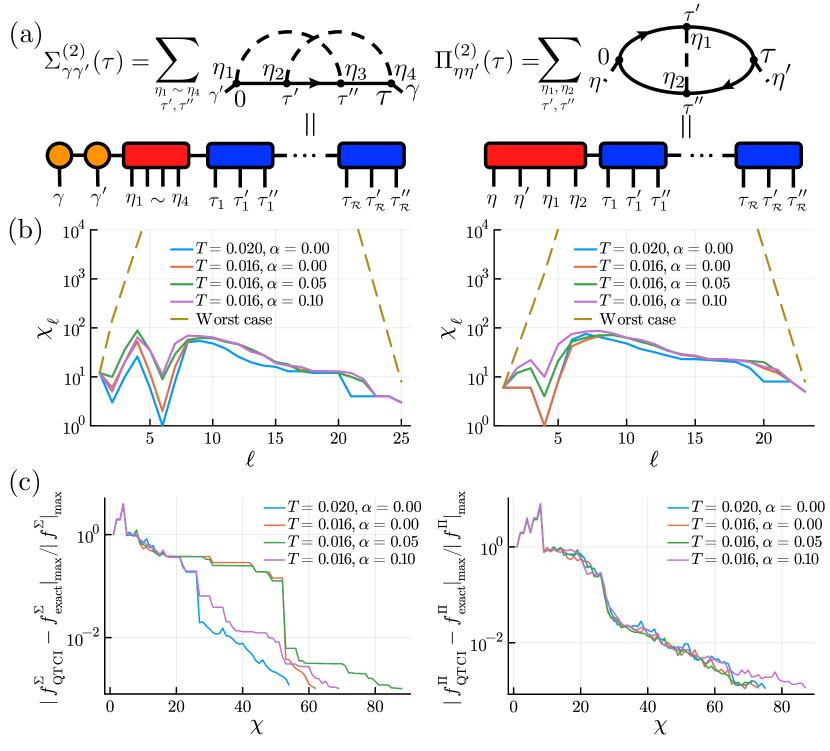
- 2次図における電子およびフォノン自己エネルギーの被積分関数は、低ランク構造を示し、TCI許容誤差ε = 10⁻³の下で結合次元χ ≈ 35–55の範囲に収まり、圧縮不能限界よりも顕著に低い。
- 補間誤差は結合次元χの増加に伴い指数的に減少し、収束率がa > 1/2のO(1/n_s^a)を上回ることから、標準的QMCサンプリングよりも優れた性能を示す。
- 超伝導転移や外部場(α)の存在により、ε = 10⁻²を達成するための必要χが約2倍に増加するが、これは自己エネルギーに非ゼロ成分が存在するためである。
- 自己エネルギー被積分関数に不連続性が存在しても、QTT表現はコンパクト性を維持し、指数的誤差減少を実現する。これにより、ドメイン分割の必要性が排除される。
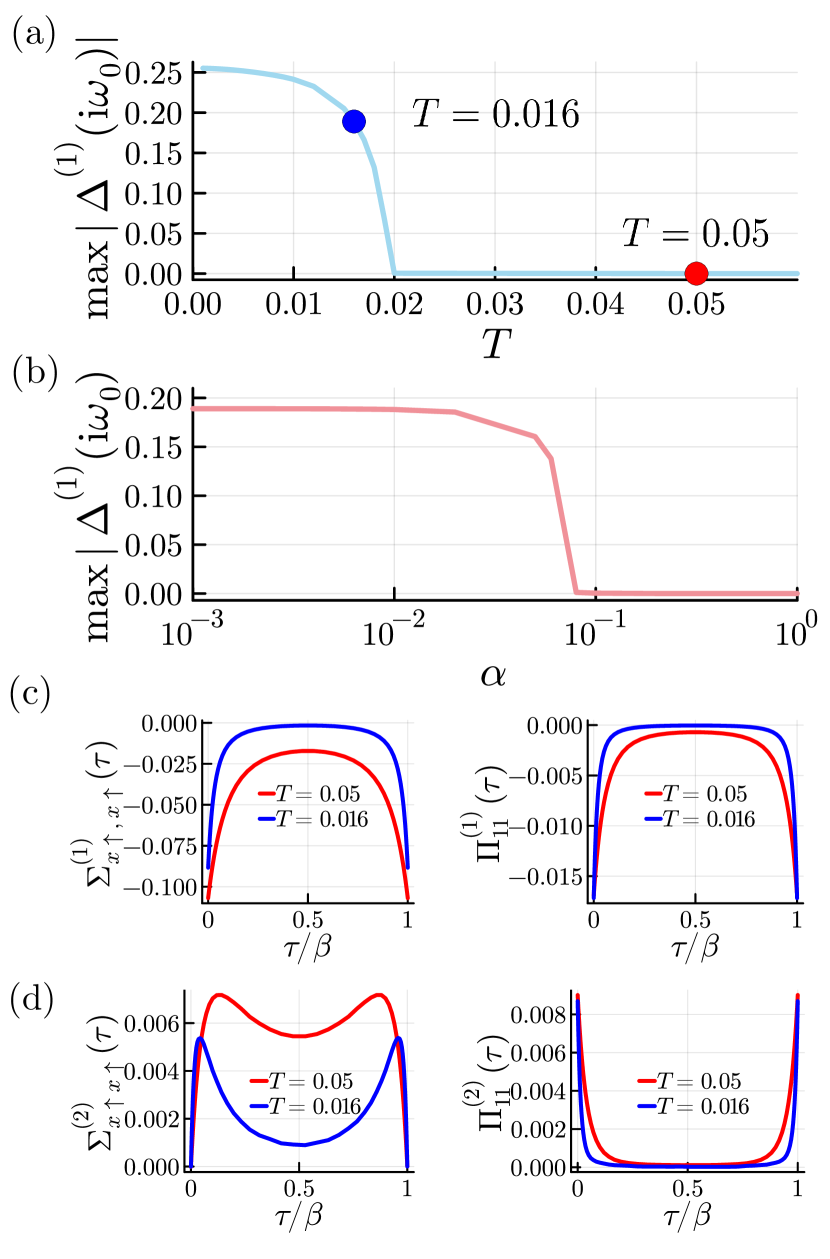
- 再構成された自己エネルギーには離散化アーチファクトがなく、指数的分解能に一致する滑らかで高分解能のτ依存性を示す。
- 本手法は、Σ⁽²⁾およびΠ⁽²⁾図の両方を、Σ⁽¹⁾およびΠ⁽¹⁾と比べて著しく小さい振幅で効果的に積分可能であり、2次近似におけるワンショット近似の妥当性が裏付けられる。
より良い研究を、今すぐ始めましょう
論文の読解から最終レビューまで、研究時間を劇的に削減しましょう。
クレジットカード登録不要
このレビューはAIが作成し、人間の編集者が確認しました。