
[論文レビュー] Partial Identification of Causal Effects Using Proxy Variables
本稿は、通常の点特定に必要な完全性条件を要しない代理変数を用いた因果効果の部分的同定手法を提案する。条件付き独立性と従属構造の上限を活用することで、平均処置効果および処置対象への効果に関する非滑らか境界を導出し、実用的実装のためLogSumExp近似とブートストラップ推論を用いる。
Proximal causal inference is a recently proposed framework for evaluating causal effects in the presence of unmeasured confounding. For point identification of causal effects, it leverages a pair of so-called treatment and outcome confounding proxy variables, to identify a bridge function that matches the dependence of potential outcomes or treatment variables on the hidden factors to corresponding functions of observed proxies. Unique identification of a causal effect via a bridge function crucially requires that proxies are sufficiently relevant for hidden factors, a requirement that has previously been formalized as a completeness condition. However, completeness is well-known not to be empirically testable, and although a bridge function may be well-defined, lack of completeness, sometimes manifested by availability of a single type of proxy, may severely limit prospects for identification of a bridge function and thus a causal effect; therefore, potentially restricting the application of the proximal causal framework. In this paper, we propose partial identification methods that do not require completeness and obviate the need for identification of a bridge function. That is, we establish that proxies of unobserved confounders can be leveraged to obtain bounds on the causal effect of the treatment on the outcome even if available information does not suffice to identify either a bridge function or a corresponding causal effect of interest. Our bounds are non-smooth functionals of the observed data distribution. As a consequence, in the context of inference, we initially provide a smooth approximation of our bounds. Subsequently, we leverage bootstrap confidence intervals on the approximated bounds. We further establish analogous partial identification results in related settings where identification hinges upon hidden mediators for which proxies are available.
研究の動機と目的
- 因果効果の点特定に通常必要とされる検証不能な完全性条件を要しない、プロキシス因果推論の制限を解消すること。
- 1つまたは十分に豊かなプロキシス変数が利用できない状況において、点特定が不可能な場合に因果効果推定を可能にすること。
- 完全性の欠如により交渉ブリッジ関数が同定不能な場合でも、有効な境界を提供する手法の開発。
- 代理変数の可用性が限られたり、代理変数の関連性が弱い現実世界の状況にまで、プロキシス因果推論の適用範囲を拡大すること。
- 滑らか近似(LogSumExp)とブートストラップ信頼区間を用いて、これらの境界に対する推論手順を提供すること。
提案手法
- 条件付き独立性仮定とプロキシス変数の関係を用いて、平均処置効果(ATE)および処置対象への効果(ETT)の非滑らか関数的境界を導出する。
- 非滑らか境界を滑らかに近似するためLogSumExp近似を用い、微分可能性と数値的安定性を確保する。
- 近似された境界の周囲に信頼区間を構築するためにブートストラップ再標本を適用し、有効な頻度的推論を保証する。
- 処置、結果、プロキシス、観測不能な交絡要因を含む条件付き独立構造を活用し、ブリッジ関数の同定を要しない境界を導出する。
- プロキシス間の従属を捉えるために、同時密度と積密度の比(例:$\frac{p(w,z|a,x)}{p(w|a,x)p(z|a,x)}$)に基づく境界を定式化する。
- 結果変数のサポートに基づく自明な境界を組み込むことで、プロキシス従属が弱くても最終的な境界が有効であることを保証する。
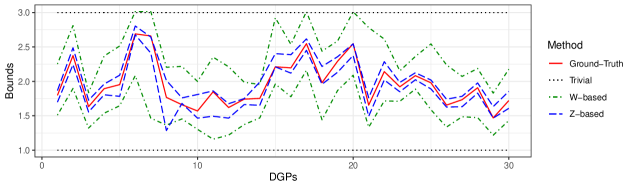
実験結果
リサーチクエスチョン
- RQ1プロキシス変数の完全性条件が満たされない場合、ブリッジ関数の点特定が不可能であっても、因果効果を部分的に同定できるか?
- RQ2単一のプロキシス変数や限られたプロキシスの豊かさしか利用できない状況では、平均処置効果の境界をどのように導出できるか?
- RQ3完全性仮定を緩和することで、プロキシスを用いた因果効果推定の実行可能性と妥当性にどのような影響を与えるか?
- RQ4滑らか近似と再標本法を用いて、部分的に同定された因果効果に対する信頼性のある推論を構築できるか?
- RQ5プロキシスが弱いか不完全な場合、有限標本において提案手法の境界が他の手法と比べてどのように異なるか?
主な発見
- 本稿は、完全性がなくても、プロキシス変数を用いて平均処置効果および処置対象への効果の境界を導出することにより、因果効果の部分的同定が可能であることを確立した。
- 境界は、観測分布の非滑らか関数的であるが、条件付き独立性とプロキシス従属構造に基づいて導出される。
- LogSumExp近似は、非滑らか境界の滑らかで微分可能な近似を提供し、実用的推定と推論を可能にする。
- ブートストラップ信頼区間は、近似された境界の周囲に構築され、部分的に同定された因果パrameterに対して有効な頻度的カバレッジを保証する。
- 1種類のプロキシスしか利用できない場合でも本手法は有効であり、処置および結果の交絡要因の両方のプロキシスを必要としない。
- 理論的結果により、プロキシス従属が強い場合には、自明なサポート境界よりも境界がタイトであることが示され、現実的状況での推定精度が向上することがわかった。
より良い研究を、今すぐ始めましょう
論文の読解から最終レビューまで、研究時間を劇的に削減しましょう。
クレジットカード登録不要
このレビューはAIが作成し、人間の編集者が確認しました。