
[論文レビュー] Prospective and retrospective coding in cortical neurons
本稿では、特にナトリウムチャネルの不活性化および適応メカニズムを介して、内在的な膜動態によって、個々の皮質ニューロンが入力に対して先行する出力放電を示す「予測的符号化」を示しうることを提案している。ヒルディン・フックスモデルとシミュレーションベースの推論を用いて、このタイミングの前倒しを制御する最小限の3つの主要パラメータを同定し、単一ニューロンの動的特性が、生物学的遅延を伴う高速神経処理を可能にするリアルタイムの未来入力予測を実現できることを示している。
Brains can process sensory information from different modalities at astonishing speed; this is surprising as the integration of inputs through the membrane of each individual neuron already causes a delayed response. Neuronal recordings {\em in vitro} reveal a possible explanation for this fast processing, in terms of individual neurons advancing their output firing rates with respect to the input, a concept which we refer to as prospective coding. The underlying mechanisms of prospective coding, however, are not completely understood. We propose a mechanistic explanation for individual neurons advancing their output on the level of single action potentials and instantaneous firing rates. We show that the spike generation mechanism can be the source for prospective (advanced) or retrospective (delayed) responses. A simplified Hodgkin-Huxley model identifies sodium inactivation as a source for prospective firing, controlling the timing of the neuron's output as a function of the voltage and its temporal derivative. We further show that slow adaptation processes, such as spike-frequency adaptation or deactivating dendritic currents, represent mechanisms generating prospective firing for inputs that undergo slow temporal modulations. In general, we show that adaptation processes at different time scales can cause advanced neuronal responses to time-varying inputs that are modulated on the corresponding time scales.
研究の動機と目的
- 個々の皮質ニューロンが時間的に変化する入力に対して、予測的(前倒し)の応答を生成できるかどうかを調査すること。これは、このようなタイミングの前倒しが集団レベルのメカニズムに依存するとの仮定に挑戦するものである。
- 単一ニューロン内での予測的符号化を可能にするバイオフィジカル的メカニズム、特にイオンチャネルのダイナミクスと適応プロセスを同定すること。
- ヒルディン・フックスモデルのどのパラメータが、ニューロンの出力が予測的か後向き(遅延)かの遷移を制御するかを特定すること。
- 完全なヒルディン・フックスシミュレーションの計算コストの一部にとどまる、予測的符号化を捉えた簡略化されたレートモデルを開発すること。
- 予測的応答が統計的アーチファクトではなく、単一試行における内在的ニューロンダイナミクスから生じることを検証すること。
提案手法
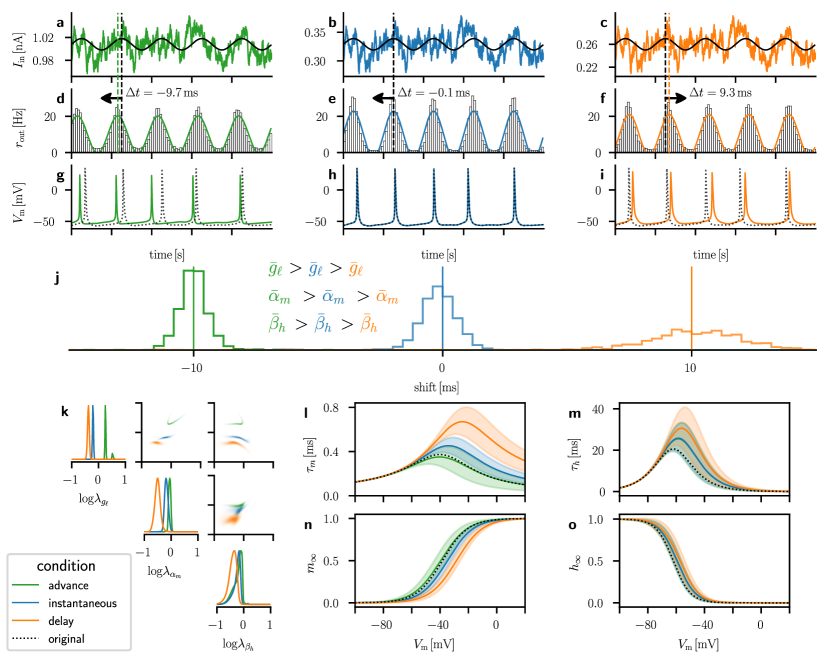
- 著者らは、新皮質および海馬ニューロンの実験的フィッティング済みヒルディン・フックスモデルを用い、10 Hzのノイズを含む正弦波変調入力に対する応答をシミュレートした。
- 逆問題を解くために、シミュレーションベースの推論(SBI)を適用し、ニューロンの出力が予測的か後向きかを決定する最小限のパラメータセットを同定した。
- SBIフレームワークは、観察された位相シフト(例:+4.2 ms の前倒し)を条件として、事後分布を推定し、パラメータ空間の解析と事後予測チェックによる妥当性の検証を可能にした。
- 簡略化されたレートモデルを導出し、完全なヒルディン・フックスシミュレーションの計算コストの一部で予測的応答を再現した。適応プロセスを用いて、より長い時間スケールへの拡張も行った。
- 信号解析では、出力放電率に正弦関数をフィットして位相シフトを推定し、スパイク列間の時間遅延を定量化するために離散相互相関を用いた。
- ゲーティング変数(m, h, n)のダイナミクスとその時間定数を分析し、活性化および不活性化動態の変化が応答タイミングに与える影響に焦点を当てた。
![Figure 1 : Hodgkin-Huxley model parameters define whether neuronal firing is prospective or retrospective. (a, b) The output firing rate $r_{\mathrm{out}}$ of a neocortical neuron model [ 10 ] is phase-advanced by $4.2\,$ ms with respect to the $10\text{\,}\mathrm{H}\mathrm{z}$ amplitude modulation](https://ar5iv.labs.arxiv.org/html/2405.14810/assets/x1.png)
実験結果
リサーチクエスチョン
- RQ1個々の皮質ニューロンは、単一試行においても、入力に対して先行する出力応答を生成できるか?
- RQ2ヒルディン・フックスフレームワーク内での、単一ニューロンにおける予測的符号化と後向き符号化を可能にするバイオフィジカル的メカニズムは何か?
- RQ3ヒルディン・フックスモデルのどの特定のパラメータが、ニューロン出力のタイミングを入力変調に対して制御するか?
- RQ4スパイク周波数適応やゆっくりとした不活性化といった、異なる時間スケールの適応プロセスは、それらに対応する時間スケールで変調された入力に対して予測的応答を生成できるか?
- RQ5観察された位相前倒しは統計的アーチファクトであるのか、それとも内在的ニューロンダイナミクスから生じるのか?
主な発見
- ヒルディン・フックスモデルは、10 Hzの振幅変調入力に対して、実験的観察と一致する4.2 msの位相前倒しを再現した。
- SBIにより、ニューロンの応答が予測的か後向きかを決定する最小限の3つのパラメータ(λgℓ、λαm、λβh)のパラメータ空間が同定された。
- ナトリウムチャネルの不活性化(hゲートの動態によって制御)が、予測的放電を可能にする主なメカニズムであると特定され、出力のタイミングは電圧およびその微分の両方に依存することがわかった。
- 本研究は、スパイク周波数適応やゆっくりとした不活性化といった、異なる時間スケールの適応プロセスが、それらに対応する時間スケールで変調された入力に対して予測的応答を生成できることを示した。
- 簡略化されたレートモデルは、完全なヒルディン・フックスシミュレーションの一部の計算コストで、予測的符号化を効果的に再現でき、長時間スケールのダイナミクスの効率的探索を可能にした。
- 事後予測チェックにより、モデルが条件付けられた位相シフトを正確に再現していることが確認され、推論フレームワークおよび同定されたメカニズムの生物学的妥当性が裏付けられた。
より良い研究を、今すぐ始めましょう
論文の読解から最終レビューまで、研究時間を劇的に削減しましょう。
クレジットカード登録不要
このレビューはAIが作成し、人間の編集者が確認しました。