
[論文レビュー] Quantum complexity phase transitions in monitored random circuits
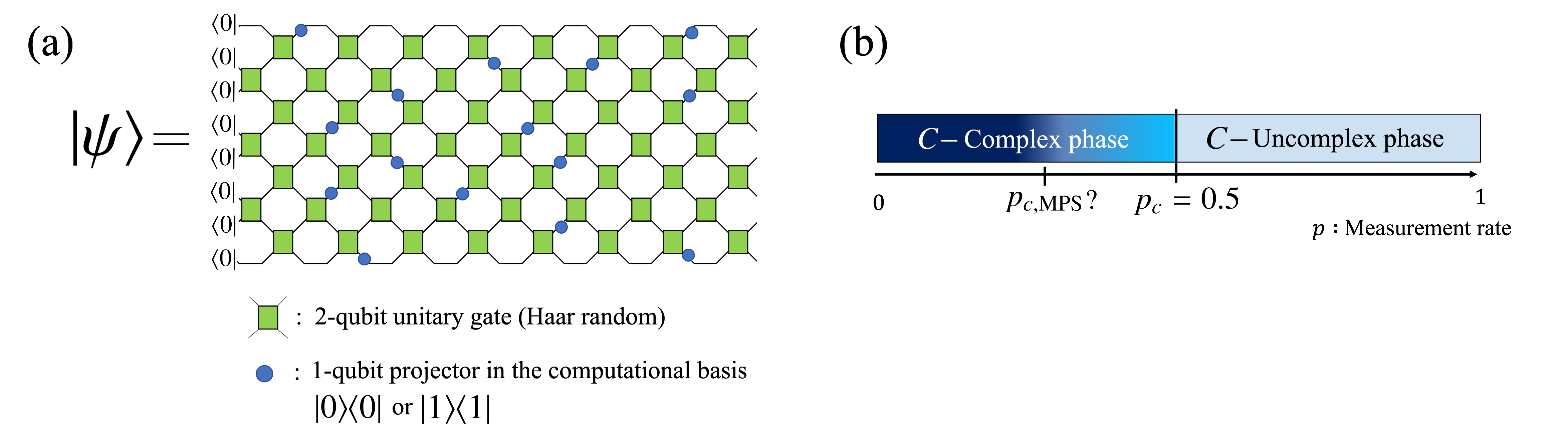
本稿は、量子ビットがランダムなユニタリ発展と確率的測定を受ける監視付きランダム回路における量子複雑性を調査する。測定率の臨界値 $ p_c = 0.5 $ における相転移が特定され、これより低い場合、複雑性は時間とともに指数関数的に増加する($ e^{\text{poly}(n)} $)、これより高い場合、多項式的($ \text{poly}(n) $)にとどまる。これは、パーコレーション理論と代数幾何学的手法によって確立された。
Recently, the dynamics of quantum systems that involve both unitary evolution and quantum measurements have attracted attention due to the exotic phenomenon of measurement-induced phase transitions. The latter refers to a sudden change in a property of a state of $n$ qubits, such as its entanglement entropy, depending on the rate at which individual qubits are measured. At the same time, quantum complexity emerged as a key quantity for the identification of complex behaviour in quantum many-body dynamics. In this work, we investigate the dynamics of the quantum state complexity in monitored random circuits, where $n$ qubits evolve according to a random unitary circuit and are individually measured with a fixed probability at each time step. We find that the evolution of the exact quantum state complexity undergoes a phase transition when changing the measurement rate. Below a critical measurement rate, the complexity grows at least linearly in time until saturating to a value $e^{Ω(n)}$. Above, the complexity does not exceed $\operatorname{poly}(n)$. In our proof, we make use of percolation theory to find paths along which an exponentially long quantum computation can be run below the critical rate, and to identify events where the state complexity is reset to zero above the critical rate. We lower bound the exact state complexity in the former regime using recently developed techniques from algebraic geometry. Our results combine quantum complexity growth, phase transitions, and computation with measurements to help understand the behavior of monitored random circuits and to make progress towards determining the computational power of measurements in many-body systems.
研究の動機と目的
- 確率的測定を伴う監視付きランダム回路における量子複雑性の時間的変化を理解すること。
- 測定率の関数として、量子複雑性に相転移が生じるかどうか、またその場所を特定すること。
- 代数幾何学とパーコレーション理論を用いて、正確な量子状態複雑性の厳密な下界を確立すること。
- 多体量子系における測定誘発ダイナミクスの計算的パワーを明確にすること。
提案手法
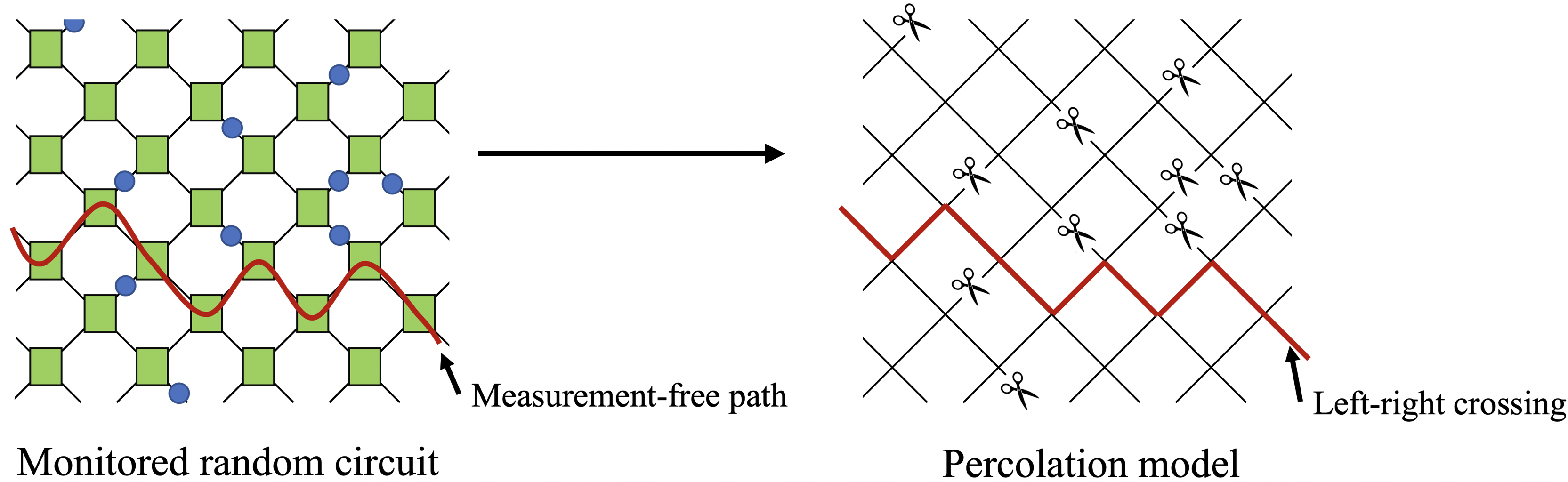
- 測定フリーな経路を分析するため、監視付き回路のダイナミクスを正方形格子上の結合パーコレーション問題に写像する。
- パーコレーション理論を用いて、臨界測定率 $ p_c = 0.5 $ より低い場合に線形長の測定フリー経路が存在することを証明する。
- 代数幾何学的手法を適用して、量子回路の到達可能な次元の下界を導出し、正確な量子複雑性の下界を得る。
- FKG不等式を用いて、傾いた格子と傾いていない格子におけるパーコレーションを関連づけ、臨界点の等価性を保証する。
- ランダム格子における左端から右端への貫通確率を用いて、複雑性に対する指数的下界を導出する。
- すべてのクラスタが高確率で小さいことを示すことで、$ p_c $ より高い場合に複雑性が $ \text{poly}(n) $ に有界であることを証明する。
実験結果
リサーチクエスチョン
- RQ1監視付きランダム回路における量子複雑性は、測定率の関数として相転移を示すか?
- RQ2臨界測定率の下および上での正確な量子複雑性のスケーリング挙動は何か?
- RQ3パーコレーション理論を用いて、指数関数的複雑性増加を支える長大な測定フリー経路を特定できるか?
- RQ4代数幾何学は、ランダム回路の正確な量子複雑性の下界を求めるのにどのように寄与するか?
- RQ5測定誘発状態リセットは、臨界率を超えた場合に複雑性を制限する役割を果たすか?
主な発見
- 量子複雑性に臨界測定率 $ p_c = 0.5 $ を特徴とする相転移が生じ、二つの異なる力学的領域に分かれる。
- 臨界率未満では、正確な量子複雑性は時間に対して少なくとも線形に増加し、$ e^{\text{poly}(n)} $ に飽和する。これは指数的複雑性を示している。
- 臨界率を超えると、複雑性は $ \text{poly}(n) $ に有界となり、古典的シミュレーションが効率的に行えることを示唆する。
- 臨界率未満では $ \Omega(n) $ の測定フリー経路が存在し、指数的長さの量子計算が可能になる。
- パーコレーション理論により、臨界率未満では高確率で $ \Omega(n) $ の左端から右端への貫通が存在し、指数的複雑性を支える。
- 臨界率を超えると、すべてのオープンクラスタが高確率で小さくなるため、複雑性がリセットされ、指数的増加は防がれる。
より良い研究を、今すぐ始めましょう
論文の読解から最終レビューまで、研究時間を劇的に削減しましょう。
クレジットカード登録不要
このレビューはAIが作成し、人間の編集者が確認しました。