
[論文レビュー] Scale-Free Networks beyond Power-Law Degree Distribution
本稿では、従来の次数分布(DD)よりも、次数同士の距離分布(DDDD)がスケールフリー・ネットワークのより普遍的な指標であることを示している。すべてのべき則的DDを示すネットワークは、べき則的DDDDを示すが、逆は成り立たない。著者らは、優先的付加とフィットネスに基づくメカニズムに依存する2つのネットワークモデルを提案し、これらはべき則的DDを示さないがべき則的DDDDを示す。これにより、DDDDが現実のネットワークにおけるスケールフリー性の背後にあるメカニズムをよりよく捉えられると示された。
Complex networks across various fields are often considered to be scale free -- a statistical property usually solely characterized by a power-law distribution of the nodes' degree $k$. However, this characterization is incomplete. In real-world networks, the distribution of the degree-degree distance $η$, a simple link-based metric of network connectivity similar to $k$, appears to exhibit a stronger power-law distribution than $k$. While offering an alternative characterization of scale-freeness, the discovery of $η$ raises a fundamental question: do the power laws of $k$ and $η$ represent the same scale-freeness? To address this question, here we investigate the exact asymptotic {relationship} between the distributions of $k$ and $η$, proving that every network with a power-law distribution of $k$ also has a power-law distribution of $η$, but \emph{not} vice versa. This prompts us to introduce two network models as counterexamples that have a power-law distribution of $η$ but not $k$, constructed using the preferential attachment and fitness mechanisms, respectively. Both models show promising accuracy by fitting only one model parameter each when modeling real-world networks. Our findings suggest that $η$ is a more suitable indicator of scale-freeness and can provide a deeper understanding of the universality and underlying mechanisms of scale-free networks.
研究の動機と目的
- べき則的次数同士の距離分布(DDDD)とべき則的次数分布(DD)が、複雑ネットワークにおけるスケールフリー性を同じくするかどうかを調査すること。
- 次数 $k$ と次数同士の距離 $\eta$ の分布の漸近的関係を特定すること。
- べき則的DDDDを示すがべき則的DDを示さないネットワークの反例を構築し、DDがスケールフリー性の唯一の指標であるという主張に疑問を呈すること。
- DDがべき則的でない場合にも有効な、より強固で普遍的なスケールフリー・ネットワークメカニズムの指標としてDDDDを提唱すること。
- DDがべき則的でないネットワークに対しても、パーコレーションや動的システム理論をDDDDを組み込むことで拡張すること。
提案手法
- 解析的導出と極限解析を用いて、次数分布 $f(k) \propto k^{-\alpha}$ と次数同士の距離分布 $g(\eta)$ の間の漸近的関係を理論的解析する。
- エリック・ポール・エルドーシとアーロン・レニのランダムグラフモデルにおけるDDDDの導出を行い、$\eta$ の有限上界と指数的減衰項の存在により、べき則的でないことを示した($p_0$ が固定されていても同様)。
- 時間に依存するフィットネス閾値を用いた優先的付加と、フィットネスに基づく付加メカニズムを用いた2つのネットワークモデルの構築。両モデルとも、べき則的DDを示さないがべき則的DDDDを示すように設計された。
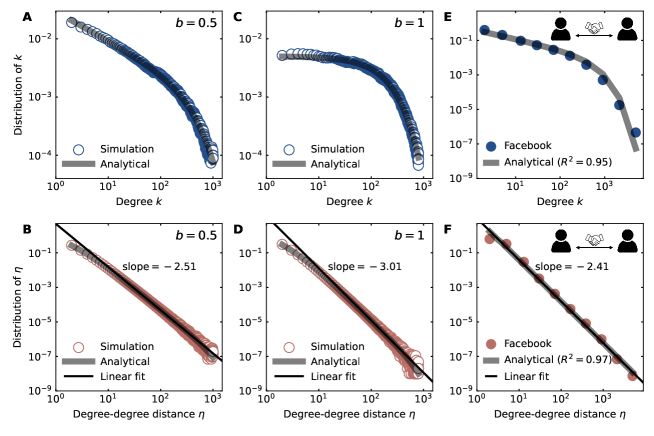
- 両モデルのDDDDを解析的に導出し、漸近的領域で $g(\eta) \propto \eta^{-\beta}$($\beta \approx 2.5$)となることを示したが、$f(k)$ はべき則的でない。
- リンクベースの指標として、$\eta = \exp\left|\ln k_i - \ln k_j\right|$ を用い、ノードベースの次数 $k$ の代わりに接続の不均衡を定量化する。
- 実世界のネットワーク(例:Facebook、WorldCity)におけるモデルの妥当性を検証し、各モデルで1つの調整可能なパrameterのみで良好なフィッティングが得られ、実証的妥当性を裏付けた。
実験結果
リサーチクエスチョン
- RQ1次数同士の距離 $\eta$ のべき則的分布は、ネットワークがスケールフリーと見なされるために必要条件か、十分条件か?
- RQ2べき則的次数分布 $f(k)$ を示すすべてのネットワークが、べき則的次数同士の距離分布 $g(\eta)$ を示すか?
- RQ3べき則的 $g(\eta)$ を示すがべき則的 $f(k)$ を示さないネットワークは存在するか? もし存在するなら、それらを生成するメカニズムは何か?
- RQ4DDDDは、実世界の複雑ネットワークの背後にあるメカニズムを、DDと比較してどれほどよく捉えられるか?
- RQ5有限サイズや非理想状態のネットワークにおいて、DDに比べてDDDDがスケールフリー性のより普遍的で強固な指標として機能できるか?
主な発見
- べき則的次数分布 $f(k) \propto k^{-\alpha}$ を示すすべてのネットワークは、べき則的次数同士の距離分布 $g(\eta) \propto \eta^{-\beta}$ を示す。これは、べき則的DDDDがべき則的DDの必然的結果であることを証明する。
- 逆は成り立たない:優先的付加とフィットネスメカニズムに基づく2つの構築モデルにより、べき則的DDを示さないがべき則的DDDDを示すネットワークが存在することが示された。
- エルドーシ–レニのランダムグラフモデルにおけるDDDDは、$\eta$ の有限上界と指数的減衰項の存在により、べき則的でない。これは、$N$ が非常に大きい場合でも同様である。
- 構築された優先的付加モデルとフィットネスベースモデルの両方とも、$\beta \approx 2.5$ のべき則的DDDDを生成するが、$f(k)$ はべき則的でない。これは、DDDDがDDとは独立してべき則的である可能性を確認した。
- DDよりDDDDがスケールフリー性の指標としてより普遍的である。DDがべき則的でない場合でも、DDDDはスケール不変な接続の不均衡を捉えることができる。
- 実世界のネットワーク(例:Facebook、WorldCity)へのDDDDに基づくモデルのフィッティングは、1つの調整可能なパrameterのみで高い精度を達成した。これは、複雑系のモデリングにおける実用的有用性を示唆している。
![Figure 2: Distributions of (a,c) $k$ and (b,d) $\eta$ for the "hard-threshold" model, a network model that assigns a uniformly distributed fitness $\omega\in[0,\omega_{\max}=1]$ to each node, where two nodes are linked if and only if their fitness sum is larger than a threshold $z$ . The model simul](https://ar5iv.labs.arxiv.org/html/2310.08110/assets/x2.png)
より良い研究を、今すぐ始めましょう
論文の読解から最終レビューまで、研究時間を劇的に削減しましょう。
クレジットカード登録不要
このレビューはAIが作成し、人間の編集者が確認しました。