
[論文レビュー] Shallower radius valley around low-mass hosts: Evidence for icy planets, collisions or high-energy radiation scatter
本研究では、高時間分解能のKepler光曲線を用いて、低質量星の周囲を回る72個の小惑星系外惑星を分析し、惑星パラメータを精緻化し、半径の谷の深さを評価した。その結果、光蒸発モデルが予測するよりも、低質量の主系列星の周囲では半径の谷が浅いことが判明した。これは、氷惑星形成や衝突的進化といった追加のメカニズムが関与している可能性を示唆しており、惑星質量の測定がそれらを区別するために不可欠である。
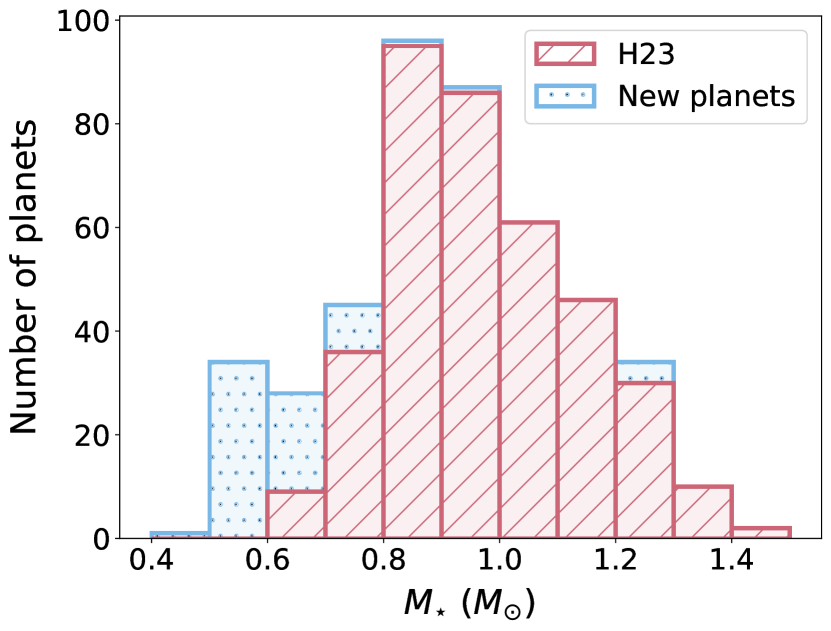
The radius valley, i.e., a dearth of planets with radii between 1.5 and 2 Earth radii, provides insights into planetary formation and evolution. Using homogenously revised planetary parameters from Kepler 1-minute short cadence light curves, we remodel transits of 72 small planets mostly orbiting low-mass stars, improving the precision and accuracy of planet parameters. By combining this sample with a similar sample of planets around higher-mass stars, we determine the depth of the radius valley as a function of stellar mass. We find that the radius valley is shallower for low-mass stars compared to their higher mass counterparts. Upon comparison, we find that theoretical models of photoevaporation under-predict the number of planets observed inside the radius valley for low-mass stars: with decreasing stellar mass, the predicted fraction of planets inside the valley remains approximately constant whereas the observed fraction increases. We argue that this provides evidence for the presence of icy planets around low-mass stars. Alternatively, planets orbiting low-mass stars undergo more frequent collisions and scatter in the stars' high-energy output may also cause planets to fill the valley. We predict that more precise mass measurements for planets orbiting low mass stars would be able to distinguish between these scenarios.
研究の動機と目的
- 高時間分解能のKepler光曲線を用いて、低質量星の周囲を回る小惑星系外惑星の惑星パラメータの精度を向上させること。
- 半径の谷(1.5~2地球半径の間で惑星が乏しい領域)の深さが星の質量にどのように依存するかを調査すること。
- 標準的な光蒸発モデルが、低質量星系で観測された半径の谷を説明できるかどうかを検証すること。
- 氷惑星形成、惑星衝突、XUV放射の散乱といった代替メカニズムが、浅くなった半径の谷の説明として妥当かどうかを評価すること。
- 観測的制約と今後の方向性を特定し、特に、競合する形成シナリオを区別するための正確な質量および年齢測定の必要性を明らかにすること。
提案手法
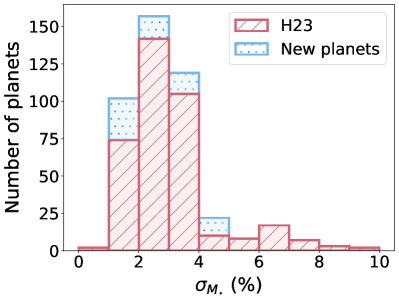
- 高時間分解能のKepler 1分間隔短時間分解光曲線を用いて、低質量星の周囲を回る72個の Transit 系外惑星を再分析し、転食の適合精度を向上させた。
- 階層ベイズモデル(ハミルトニアンモンテカルロ法)を適用し、惑星半径および軌道パラメータの事後分布を導出した。
- 精緻化されたサンプルをHo & Van Eylen (2023) の類似データセットと組み合わせ、星の質量帯ごとの半径の谷の深さを比較した。
- 観測された半径の谷内に存在する惑星の割合を定量し、観測バイアスや初期条件の分散を含めた光蒸発モデルの予測と比較した。
- 岩石コアを仮定した場合の期待される大気層の割合を推定し、観測された集団が氷惑星の存在か衝突的歴史を支持するかどうかを評価した。
- NASA 系外惑星アーカイブを用いてサンプルを補完し、惑星の組成と構造に関する集団レベルのトレンドを評価した。
実験結果
リサーチクエスチョン
- RQ1半径の谷の深さは、特に低質量のM型星に対して、主系列星の質量に従って体系的に変化するか?
- RQ2理論的光蒸発モデルは、低質量星の周囲で観測された半径の谷内に存在する惑星の割合をどの程度正確に再現できるか?
- RQ3低質量星の周囲で観測された半径の谷の浅さは、氷惑星の存在や惑星衝突の頻度上昇と整合的か?
- RQ4星の年齢および惑星質量の不確実性は、惑星の組成や進化経路の解釈にどのように影響するか?
- RQ5将来のミッション、例えば TESS や PLATO は、氷惑星形成と衝突的シナリオのあいまいさを解消するのに役立つだろうか?
主な発見
- 低質量星の周囲では、より高い質量のFGK型星の周囲と比較して、半径の谷が顕著に浅く、星の質量が小さくなるほど観測された深さが減少する。
- 光蒸発モデルは、低質量星の周囲で半径の谷内に存在する惑星の数を過小評価している。観測された割合は星の質量が小さくなるほど増加するが、モデル予測の割合はほぼ一定のままである。
- 観測と光蒸発モデルの乖離は、観測バイアスや初期条件の分散では説明できず、追加の物理的メカニズムの存在を示唆している。
- データは、低質量星の周囲に氷惑星が存在するか、または衝突頻度が高まっている可能性と整合的であるが、現在の集団統計ではどちらのシナリオも一意に支持されていない。
- 大多数の惑星について正確な質量および年齢測定が行われていないため、浅くなった谷の主な原因が氷惑星形成か衝突的進化かを明確に区別する能力に制限がある。
- 将来的な高精度な質量測定と改善された年齢推定(TESS や PLATO によって可能)が、背後にある形成メカニズムを解明するために不可欠である。
より良い研究を、今すぐ始めましょう
論文の読解から最終レビューまで、研究時間を劇的に削減しましょう。
クレジットカード登録不要
このレビューはAIが作成し、人間の編集者が確認しました。