
[論文レビュー] State Preparation on Quantum Computers via Quantum Steering
本稿では、近い将来の超伝導量子コンピュータにおける任意の量子状態を準備するための測定誘発量子スティアリングプロトコルを提示する。系キュービットをアーキテクチャキュービットと繰り返しエンタングルさせ、アーキテクチャキュービットを測定し、それを|0⟩に能動的にリセットすることで、系状態が望ましいターゲット状態へとスティアリングされる。この手法は、量子ビットおよび量子三値状態の両方で実証され、指数関数的収束を示し、測定結果からの古典的フィードバックによって加速される。
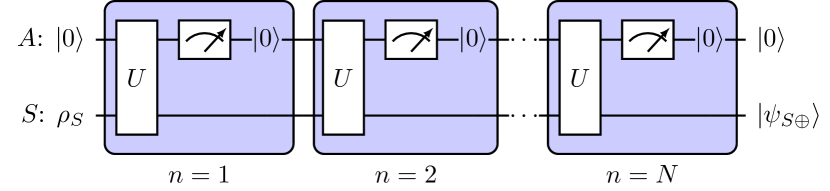
One of the major components for realizing quantum computers is the ability to initialize the computer to a known fiducial state, also known as state preparation. We demonstrate a state preparation method via measurement-induced steering on contemporary, digital quantum computers. By delegating ancilla qubits and systems qubits, the system state is prepared by repeatedly performing the following steps: (1) executing a designated system-ancilla entangling circuit, (2) measuring the ancilla qubits, and (3) re-initializing ancilla qubits to known states through active reset. While the ancilla qubits are measured and reinitialized to known states, the system qubits are steered from arbitrary initial states to desired final states. We show results of the method by preparing arbitrary qubit states and qutrit (three-level) states. We also demonstrate that the state convergence can be accelerated by utilizing the readouts of the ancilla qubits to guide the protocol in an active manner. This protocol serves as a nontrivial example that incorporates and characterizes essential operations such as qubit reuse (qubit reset), entangling circuits, and measurement. These operations are not only vital for near-term noisy intermediate-scale quantum (NISQ) applications but are also crucial for realizing future error-correcting codes.
研究の動機と目的
- 長寿命化するに伴い、受動的熱化が非現実的になる中で、量子コンピュータを任意の非基準状態に初期化する課題に対処すること。
- 正確なゲートキャリブレーションや広範な誤り補正を必要としない、スケーラブルでゲートに依存しない状態準備手法を開発すること。
- エンタングルゲート、中間回路測定、キュービットリセットといったNISQの主要な操作の包括的性能を、状態保全度を用いて評価すること。
- 実際のIBM量子ハードウェア上での量子ビットおよび高次元のクーディット(量子三値状態)の両方における状態準備の可能性を実証すること。
- 測定結果をリアルタイムで活用するフィードバック駆動型スティアリングが、収束をどのように加速するかを検討すること。
提案手法
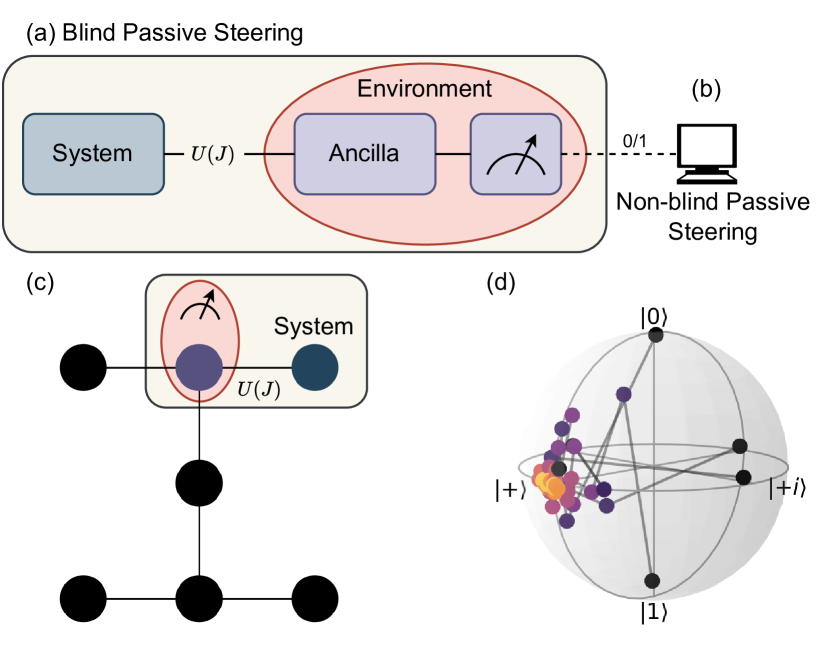
- 系キュービットとアーキテクチャキュービットの間のユニタリなエンタングル操作$ U(J) $を用い、結合強度$ J $でパラメータ化することで、系にバックアクションを引き起こす。
- 各エンタングル操作の後、IBMプロセッサで利用可能な中間回路測定と量子リセット操作を用いて、アーキテクチャキュービットを測定し、|0⟩に能動的にリセットする。
- エンタングル操作と測定誘発的崩壊の繰り返しにより、系キュービットは初期状態に依存せず、望ましいターゲット状態へとスティアリングされる。
- 能動的スティアリングでは、古典的フィードバックがアーキテクチャキュービットの測定結果を用いてプロトコルパラメータを適応的に調整し、収束を加速する。
- 量子三値状態の準備は、Qiskit Pulseを用いたパルスレベル制御により、$ \pi_{1\to2} $遷移のラビ振動と周波数スイープのキャリブレーションによって実現される。
- 系キュービットまたは量子三値状態の密度行列を再構築するために、ゲル・マン行列を用いた量子状態トモグラフィーが実施され、測定読み出しには誤り補正が適用されている。
実験結果
リサーチクエスチョン
- RQ1測定誘発的量子スティアリングは、ゲートベースの状態準備に依存せずに、現在のデジタル量子コンピュータ上で任意の状態を準備可能か?
- RQ2系状態のターゲット状態への収束速度は、反復回数$ n $と結合強度$ J $にどのように依存するか?
- RQ3アーキテクチャキュービットの測定結果からの古典的フィードバックが、スティアリングプロトコルの収束をどの程度加速できるか?
- RQ4実ハードウェア上での能動的リセットと測定フィードバックを用いた場合、量子ビットおよび量子三値状態の状態準備の保全度はどの程度か?
- RQ5中間回路測定と能動的リセットの性能特性が、全体の状態準備保全度にどのように影響するか?
主な発見
- 理論的モデルが予測するように、初期状態に依存せず、反復回数$ n $の増加に伴い、系状態は$ \ket{+} $状態へ指数関数的に収束する。
- 最速の収束は$ J = \pi/2 $で発生し、理想的な状況では1ステップで完全な収束を達成する。
- IBMのibm_perthプロセッサ上では、任意の量子ビット状態が正常に準備され、最終状態はブロッホ球上でターゲット$ \ket{+} $状態の周辺に集まっていた。
- 校正済みの$ \pi_{1\to2} $パルスを用いて量子三値状態の準備が達成され、誤り補正後、測定ディスcriminatorの精度は0.917に達した。
- 複数回の連続リセットにより、能動的リセットの保全度が向上し、テストデバイスでは$ \ket{0} $準備保全度が90%を超えた。
- フィードバック駆動型スティアリングにより収束が顕著に加速され、高精度なターゲット状態に到達するための反復回数が削減された。
より良い研究を、今すぐ始めましょう
論文の読解から最終レビューまで、研究時間を劇的に削減しましょう。
クレジットカード登録不要
このレビューはAIが作成し、人間の編集者が確認しました。