
[論文レビュー] Testing correlation of unlabeled random graphs
本稿は、隠れたノード対応関係の下で、2つのラベルなしランダムグラフ間のエッジ相関を検出する問題を研究する。条件付き2次モーメント法を用いて、密度の高いガウス型およびエッジ・レニー・グラフにおける相関検出の鋭い閾値を確立し、スパースなエッジ・レニー・グラフでは定数倍の要因内で閾値を特定する。n→∞のとき、検出誤差確率における段階的転移が明らかになる。
We study the problem of detecting the edge correlation between two random graphs with $n$ unlabeled nodes. This is formalized as a hypothesis testing problem, where under the null hypothesis, the two graphs are independently generated; under the alternative, the two graphs are edge-correlated under some latent node correspondence, but have the same marginal distributions as the null. For both Gaussian-weighted complete graphs and dense Erdős-Rényi graphs (with edge probability $n^{-o(1)}$), we determine the sharp threshold at which the optimal testing error probability exhibits a phase transition from zero to one as $n o \infty$. For sparse Erdős-Rényi graphs with edge probability $n^{-Ω(1)}$, we determine the threshold within a constant factor. The proof of the impossibility results is an application of the conditional second-moment method, where we bound the truncated second moment of the likelihood ratio by carefully conditioning on the typical behavior of the intersection graph (consisting of edges in both observed graphs) and taking into account the cycle structure of the induced random permutation on the edges. Notably, in the sparse regime, this is accomplished by leveraging the pseudoforest structure of subcritical Erdős-Rényi graphs and a careful enumeration of subpseudoforests that can be assembled from short orbits of the edge permutation.
研究の動機と目的
- ラベルなしの2つのランダムグラフ間の相関をテストする問題を形式化し、解明すること。
- ノードラベルが不明で、観測可能なのは同型類のみである状況下でのエッジ相関検出の根本的限界を特定すること。
- ガウス重み付きおよびエッジ・レニー・グラフを含む、さまざまなランダムグラフモデルにおける検出誤差確率の段階的転移を分析すること。
- 隠れたノード対応関係によって誘発されるエッジ置換のサイクル構造を考慮する条件付き2次モーメント法を構築すること。
- それぞれ密度的およびスパースなグラフ領域において、検出の鋭いまたはほぼ鋭い閾値を確立すること。
提案手法
- 問題を仮説検定として定式化:H₀(独立なグラフ) 対 H₁(隠れたノード対応関係下でのエッジ相関付きグラフ)。
- 条件付き2次モーメント法を適用し、交差グラフの典型的構造を条件とする、尤度比の切り捨てられた2次モーメントを評価する。
- 隠れたノード対応関係によって誘発されるランダム置換のサイクル分解を用いて、エッジ軌道構造を分析する。
- 密度的領域では、生成関数およびガウス型および密度的エッジ・レニー・モデル下での2次モーメントの漸近的解析を用いて鋭い閾値を導出する。
- スパース領域では、亜臨界エッジ・レニー・グラフにおける擬似森構造を活用し、エッジ置換の短い軌道から部分的擬似森を数える。
- 集中不等式(Hanson-WrightおよびChernoff)およびランダム置換に関する事実(サイクル数およびポアソン近似)を用いて、尾部挙動を制御する。
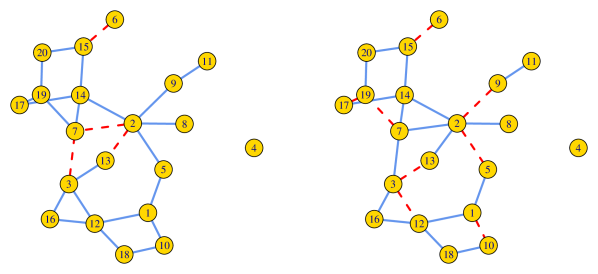
実験結果
リサーチクエスチョン
- RQ1ノードラベルが不明な状況下で、2つのラベルなしランダムグラフ間のエッジ相関を検出する根本的限界は何か?
- RQ2n→∞ のとき、密度的およびスパースなランダムグラフモデルにおける検出誤差確率はどのように振る舞うか?
- RQ3隠れたノード置換のサイクル構造は、エッジ相関の検出可能性にどのような役割を果たすか?
- RQ4条件付き2次モーメント法は、ラベルなしグラフおよび隠れた同型性によって生じる組合せ的複雑性に対応して適応可能か?
- RQ5密度的ガウス重み付きおよび密度的エッジ・レニー・グラフにおける相関検出の鋭い閾値は何か?
主な発見
- 密度的ガウス重み付きおよび密度的エッジ・レニー・グラフ(エッジ確率 n^{-o(1)})において、本稿は、n→∞ のとき検出誤差確率が0から1に段階的転移を示す鋭い閾値を確立した。
- エッジ確率 n^{-Ω(1)} のスパースなエッジ・レニー・グラフにおいて、本稿は検出閾値を定数倍の要因内で特定し、この閾値未満では相関検出が不可能であることを示した。
- 不可能性の結果は、条件付き2次モーメント法を用いて証明され、尤度比の2次モーメントが典型的な交差グラフを条件として、エッジ置換のサイクル構造を分析することで有界にされた。
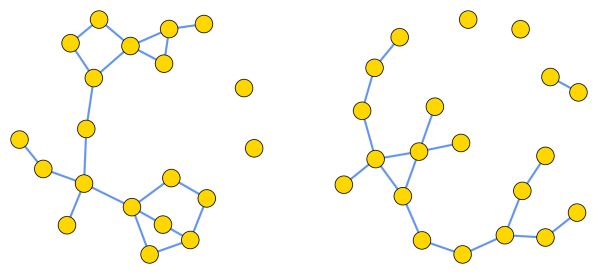
- スパース領域では、証明は亜臨界エッジ・レニー・グラフにおける擬似森構造およびエッジ置換の短い軌道から形成される部分的擬似森のきめ細やかな数え上げに依存している。
- 解析により、2次モーメントの主な寄与は、エッジ置換における短いサイクルに由来することが明らかになった。これらは交差グラフのボトムアップ構造に関連している。
- 結果は、グラフ不変量およびトポロジカル構造そのものが、ノードの識別子が不明であっても、適切なスパarsityおよび相関の範囲下では相関の検出を可能にできることを示している。
より良い研究を、今すぐ始めましょう
論文の読解から最終レビューまで、研究時間を劇的に削減しましょう。
クレジットカード登録不要
このレビューはAIが作成し、人間の編集者が確認しました。