
[論文レビュー] Variational preparation of entangled states on quantum computers
本論文は、NISQデバイス上でGHZ状態、W状態、および絶対的に最大にエンタングルされた状態などのエンタングル状態を、ハイパーグラフに基づくアーキテクチャを用いたトレーニング可能なユニタリを用いて、効率的に準備する変分量子アルゴリズムを提案する。Fubini-Study距離をAdamや量子自然勾配などの勾配ベース最適化手法により最小化することで、キュービット数に依存しない多項式的回路深さスケーリング(O(L))を達成し、ノイズやバーレンプレート(barren plateaus)に対して耐性を持つスケーラブルで低深さの状態準備が可能になる。
We propose a variational approach for preparing entangled quantum states on quantum computers. The methodology involves training a unitary operation to match with a target unitary using the Fubini-Study distance as a cost function. We employ various gradient-based optimization techniques to enhance performance, including Adam and quantum natural gradient. Our investigation showcases the versatility of different ansatzes featuring a hypergraph structure, enabling the preparation of diverse entanglement target states such as GHZ, W, and absolutely maximally entangled states. Remarkably, the circuit depth scales efficiently with the number of layers and does not depend on the number of qubits. Moreover, we explore the impacts of barren plateaus, readout noise, and error mitigation techniques on the proposed approach. Through our analysis, we demonstrate the effectiveness of the variational algorithm in maximizing the efficiency of quantum state preparation, leveraging low-depth quantum circuits.
研究の動機と目的
- 近い将来の量子コンピュータ上で、複雑なエンタングル状態をスケーラブルに準備する変分的手法を開発すること。
- 特に多キュービットエンタングル状態に対して指数的回路深さを示す従来の量子状態準備手法の課題を解決すること。
- 最適化されたアーキテクチャ設計と誤り補正を用いて、NISQデバイスにおけるノイズやバーレンプレートに対する耐性を高めること。
- 量子自然勾配とAdam最適化が、状態準備のためのユニタリをトレーニングする際に有効であることを示すこと。
- 量子コンパイルに基づく単一で柔軟なフレームワークを用いて、任意のターゲット状態を普遍的に準備可能にする
提案手法
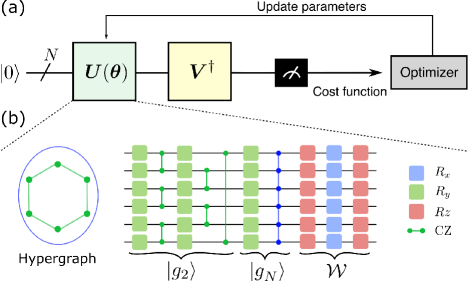
- 計算基底状態 |0⟩^⊗N をターゲットのエンタングル状態に変換するため、トレーニング可能なユニタリ操作を最適化する変分量子回路を採用する。
- コスト関数は、変化した状態とターゲット状態の間のFubini-Study距離であり、勾配ベース最適化手法により最小化される。
- エンタングルゲートの構造をハイパーグラフに基づくアーキテクチャで定義し、柔軟かつハードウェアに適合する回路設計を可能にし、キュービット数に伴う効率的スケーリングを実現する。
- 収束性とバーレンプレートの回避を向上させるために、量子自然勾配(QNG)とAdam最適化手法を用いる。
- 2^N 個の計算基底回路から構築された測定行列 M を用いた準確率的分解により、誤り補正を実施する。
- 回路深さはキュービット数 N に依存せず、L(レイヤー数)に対して O(L) に保たれるため、スケーラビリティが実現される。
実験結果
リサーチクエスチョン
- RQ1変分量子アルゴリズムは、NISQデバイス上で多様なエンタングルメントクラス(GHZ、W、AME)を、低深さの回路で準備できるか?
- RQ2アーキテクチャ構造の選択(例:ハイパーグラフ、リング、スターダム)が、状態準備の収束性と忠実度に与える影響は何か?
- RQ3Adam や量子自然勾配といった勾配ベース最適化手法が、変分状態準備におけるバーレンプレート問題をどれほど緩和できるか?
- RQ4完全な誤り訂正が利用できない状況下で、誤り補正は読み取りノイズおよび回路ノイズ下での忠実度回復にどの程度効果的か?
- RQ5キュービット数に依存しない回路深さを維持しながら、さまざまなエンタングルメントクラスにおいても高い状態忠実度を達成できるか?
主な発見
- 変分的手法により、キュービット数 N に依存しない回路深さスケーリング O(L) を達成し、エンタングル状態のスケーラブルな準備が可能になった。
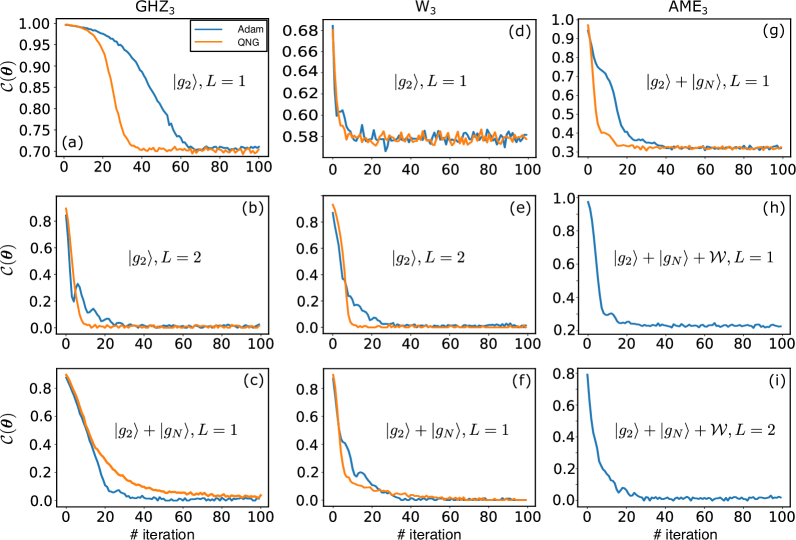
- N=5 の場合、|g₂⟩+|g_N⟩+𝒲 アーキテクチャを用い、L=2 レイヤーでW状態を準備したところ、Fubini-Study距離は 0.0001 にまで低下し、ほぼ完全な状態忠実度を達成した。
- 誤り補正により、Fubini-Study距離が元のノイズなし状態レベルに近づき、図4の補正結果は効果的なノイズ抑制を示している。
- 量子自然勾配(QNG)最適化は、特に高次元パラメータ空間において、標準的なAdam最適化を上回る収束速度と耐性を示した。
- N=3 のAME状態は、回路深さ22で成功裏に準備され、ターゲットユニタリの深さ24よりも顕著に低い深さで実現され、効率性の向上が確認された。
- バーレンプレート効果は観察されたが、慎重なアーキテクチャ設計と最適化手法の選択により緩和され、10回の実行平均において安定した収束が得られた。
より良い研究を、今すぐ始めましょう
論文の読解から最終レビューまで、研究時間を劇的に削減しましょう。
クレジットカード登録不要
このレビューはAIが作成し、人間の編集者が確認しました。