
[논문 리뷰] A lanthanide-rich kilonova in the aftermath of a long gamma-ray burst
본 논문은 장기간 GRB(GRB 230307A) 이후의 kainal kilonova를 보고하며, 두 개의 란타나이드 풍부한 방출 기여로 가장 잘 설명되고, 후기의 전체 복사 감소와 r-프로세스 원소 생산의 증거가 제시됩니다.
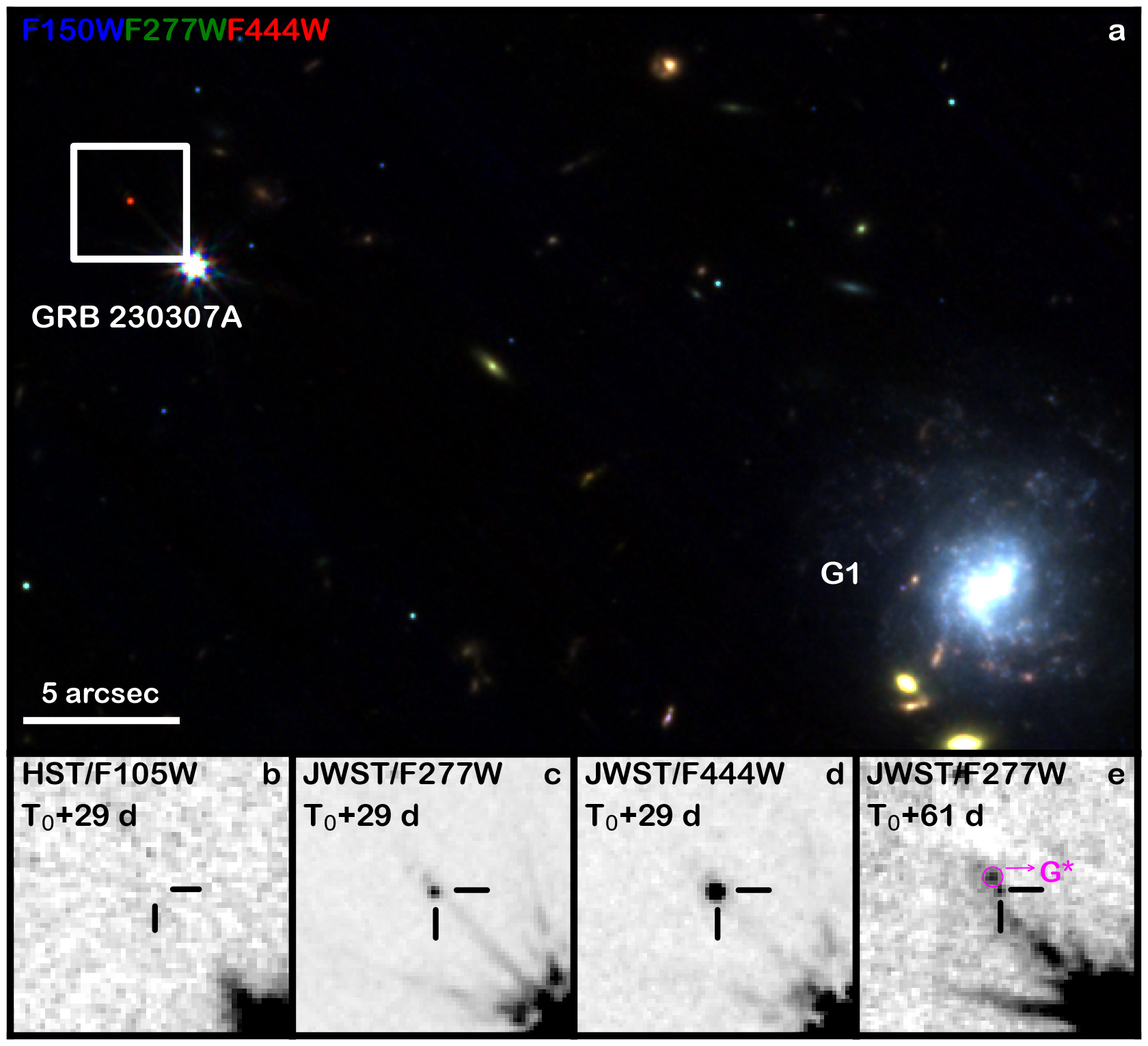
Kilonovae are a rare class of astrophysical transients powered by the radioactive decay of nuclei heavier than iron, synthesized in the merger of two compact objects. Over the first few days, the kilonova evolution is dominated by a large number of radioactive isotopes contributing to the heating rate. On timescales of weeks to months, its behavior is predicted to differ depending on the ejecta composition and merger remnant. However, late-time observations of known kilonovae are either missing or limited. Here we report observations of a luminous red transient with a quasi-thermal spectrum, following an unusual gamma-ray burst of long duration. We classify this thermal emission as a kilonova and track its evolution up to two months after the burst. At these late times, the recession of the photospheric radius and the rapidly-decaying bolometric luminosity ($L_{ m bol}\propto t^{-2.7\pm 0.4}$) support the recombination of lanthanide-rich ejecta as they cool.
연구 동기 및 목표
- 장기간 gamma-ray bursts와 연관된 kilonova 탐색을 촉진하고 이러한 사건이 무거운 r-프로세스 원소를 합성하는지 테스트한다.
- kilonova 열적 성분과 비열적 후광을 구별하기 위해 후기(emission)을 특징짓는 특징을 확인한다.
- 방출물의 속성(질량, 속도, 비투과성, 구성)을 제한하고 란타나이드 풍부 물질이 광곡선을 구동하는지 평가한다.
- GRB 기원 시나리오와 호스트 은하 환경을 조사하여 GRB 230307A의 소형-바이너리 병합 기원을 평가한다.]
- method
- [Optical, near-infrared, X-ray 데이터를 XSPEC로 사용한 파워-law + blackbody 구성 요소를 포함한 공동 분광 에너지 분포(SED) 모델링(zphabs/zdust 및 zigm를 통해 적색편향 민감도 반영).
- 2-성분 kilonova 모델링: 다양한 방출물 질량, 속도, 비투과성으로 kilonova/X선/IR 빛 곡선을 비교하고 단일성분 KN 및 afterglow 모델과 비교.
- 외부 전방 충격 프레임워크(afterglowpy)와 gwemlightcurves의 kilonova 빛 곡선을 이용한 다파장 데이터 적합을 위한 afterglow 모델링.
- MCMC/중첩 샘플링(pymultinest)을 통한 베이지안 추론으로 최적 적합 매개변수를 도출하고 모델 증거(ΔBIC)를 평가한다.
- 블랙바디 적합으로 추론된 볼로메트릭 광도, 광도 반경, 온도 진화를 통해 방출물 냉각 및 재결합 추적.
- JWST/HST 관측으로 호스트 은하 특성과 적색편향 제약을 평가하여 거리 규모와 기원 해석에 정보를 제공한다.]
- research_questions
- [GRB 230307A 호스트가 r-프로세스가 강화된 란타나이드 풍부 방출에 의해 구동되는 kilonova를 갖고 있는가?
- kilonova 방출물의 질량, 속도, 비투과성은 관찰된 빛 곡선과 스펙트를 재현하는 데 어떤가?
- 광학/근적외선/적외선 진화를 설명하기 위해 두 성분의 kilonova가 필요한가, 그리고 이것이 방출물 조성 및 이온화 상태에 대해 무엇을 시사하는가?
- 호스트 환경과 프롬트 방출 특성으로 볼 때 GRB 원인체(소형 바이너리 병합 대 대형별 붕괴)에 대한 시사점은 무엇인가?
- 후기 볼로메트적 광도와 광 면적 진화가 에너지 공급(강한 자기중성자체/핵분해 신호의 부재 등)을 제약하고 란타나이드의 존재 여부를 어떻게 제시하는가?
제안 방법
- The multi-wavelength 데이터에 대한 공동 SED 모델링( Optical, NIR, X-ray) using XSPEC with power-law plus blackbody components (zphabs/zdust 및 zigm 포함, 적색편향 민감도 반영).
- 다중 구성의 kilonova 모델링: 질량, 속도, 비투과성을 달리 하여 빛 곡선을 비교하고 단일 성분 KN 및 afterglow 모델과 비교.
- GWEMLIGHTCURVES의 kilonova 빛 곡선을 사용한 2성분 KN과 external forward shock 프레임워크를 이용한 afterglow 모델링으로 다파장 데이터를 맞춤.
- Bayesian 추론(MCMC/nested sampling, pymultinest)을 통해 최적 매개변수를 도출하고 모델 증거(ΔBIC)를 평가한다.
- 블랙바디 적합으로 추정된 볼로메트릭 광도, 광사진 반경, 온도 진화를 통해 방출물 냉각 및 재결합 추적.
- JWST/HST 관측으로 호스트 은하 특성과 적색편향 제약을 평가하여 거리 규모와 기원 해석에 정보를 제공한다.]
- research_questions
- 2-성분 kilonova가 광학/근적외선/적외선 진화를 설명하는가?
- 후기 볼로메트릭 광도 및 광사진 진화가 에너지 전달(예: 강한 자발자기장-핵분해 서명 부재)을 제약하고 란타나이드를 존재로 보이는가?
실험 결과
연구 질문
- RQ1Does GRB 230307A host a kilonova powered by r-process–enhanced, lanthanide-rich ejecta?
- RQ2What are the masses, velocities, and opacities of the kilonova ejecta required to reproduce the observed light curves and spectra?
- RQ3Is a two-component kilonova necessary to explain the optical/NIR/IR evolution, and what does this imply about ejecta composition and ionization state?
- RQ4What does the event imply about the GRB progenitor (compact binary merger vs. massive-star collapse) given the host environment and prompt emission properties?
- RQ5How do late-time bolometric luminosity and photospheric evolution constrain energy deposition (e.g., absence of strong magnetar/fission signatures) and the presence of lanthanides?
주요 결과
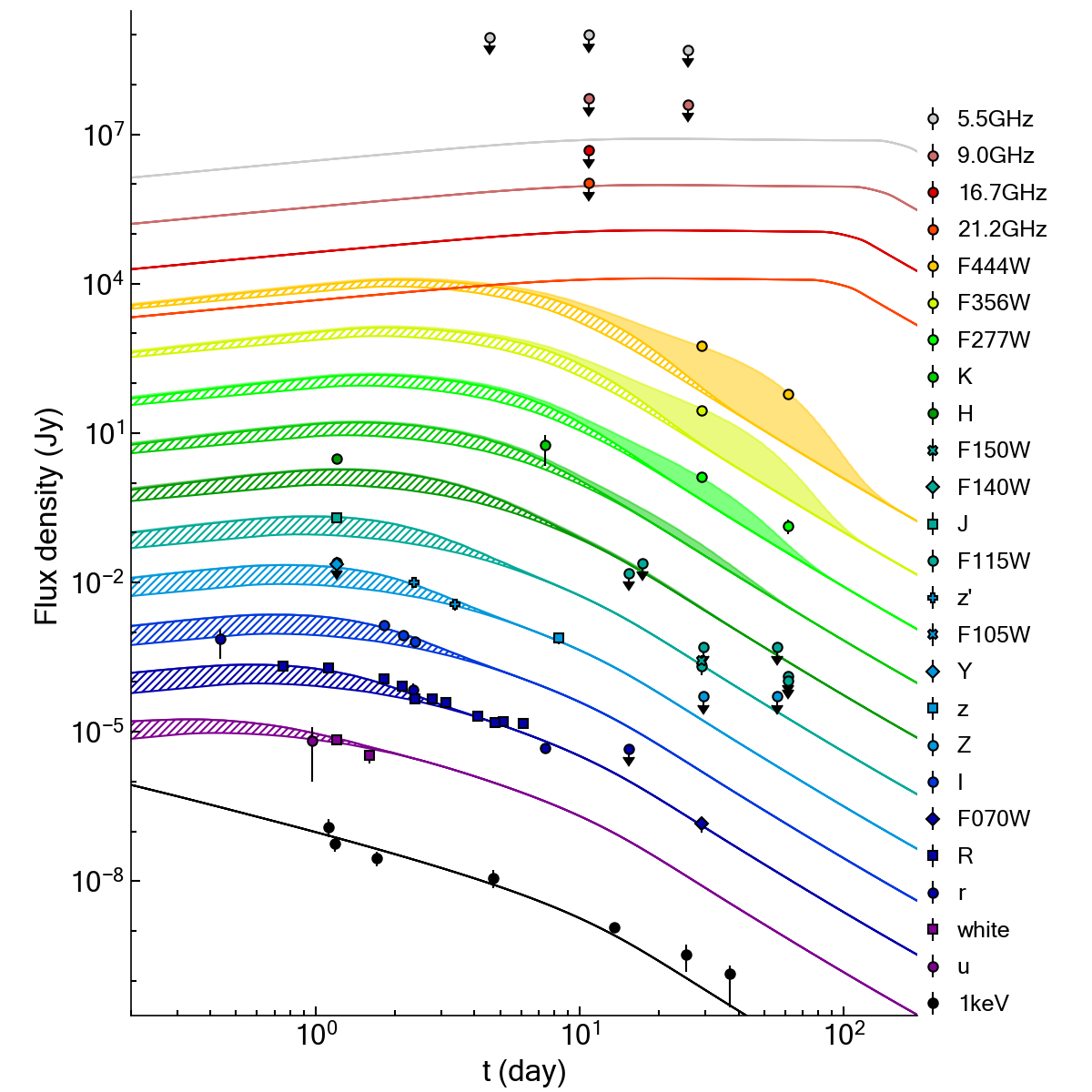
- The afterglow plus kilonova model provides a significantly better fit than an afterglow-only model (ΔBIC > 140).
- Two kilonova components are favored: a fast, low-opacity ejecta (v ~ 0.2c, M ≈ 0.03 M_sun, κ ≲ 3 cm^2 g^-1) dominating early emission, and a slower, high-opacity component (v ~ 0.03c, M ≈ 0.05 M_sun, κ ≳ 13 cm^2 g^-1) dominating late-time emission.
- The bolometric luminosity decays as L_bol ∝ t^-2.7 ± 0.4 from ~29 d to ~61 d, with temperatures dropping below ~2000 K, consistent with lanthanide-rich ejecta recombination and photospheric recession.
- The late-time COs/nIR evolution and high opacity imply production of r-process elements beyond the first peak (A ≳ 85), consistent with lanthanide synthesis in the merger ejecta.
- Host analysis supports a nearby (z ≈ 0.0647; D_L ≈ 291 Mpc) galaxy (G1) as the most likely host, with properties indicating a low-mass, low-SFR, relatively old stellar population; the environment is compatible with compact binary merger progenitors for long GRBs.
- Prompt emission properties and Amati relation positioning allow multiple redshift scenarios; the z < 3.3 constraint from SED, plus host association hints, favor a nearby origin over a very high-redshift GRB.
- The data favor a compact binary merger as the progenitor, with a kilonova signature similar in nature to those observed in other nearby GRBs (e.g., GRB 211211A) and consistent with lanthanide-rich ejecta.
이 논문 읽기
누빈트 뷰어에서 원문을 열고, 읽으면서 궁금한 곳을 바로 물어보세요.
누빈트에서 이 논문 읽기이 리뷰는 AI가 논문 원문을 바탕으로 만들었습니다. 인용하기 전에 원문을 확인해 주세요.