
[논문 리뷰] A physics and data co-driven surrogate modeling approach for temperature field prediction on irregular geometric domain
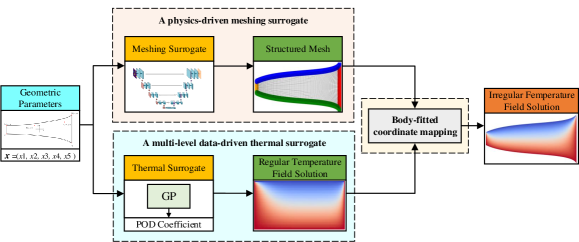
이 논문은 비정규 기하 도메인에서 빠르고 정확한 온도장 예측을 위한 물리학 및 데이터 공구동 기반의 서rogate 모델을 제안한다. 체계적으로 비정규 기하 구조를 정규화된 계산 평면으로 매핑하기 위해 바디-맞춤 좌표를 사용하고, 물리학 기반 메시 생성 서rogate와 다중 수준 축소된 순서 기반 데이터 기반 열역학 서rogate를 결합함으로써, 표준 CNN 모델들인 U-Net과 FNO에 비해 작은 데이터셋과 훨씬 감소된 학습 시간으로도 높은 정확도를 달성한다.
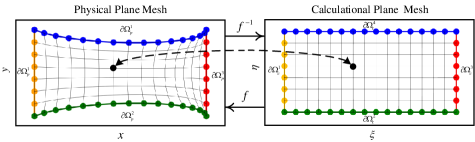
In the whole aircraft structural optimization loop, thermal analysis plays a very important role. But it faces a severe computational burden when directly applying traditional numerical analysis tools, especially when each optimization involves repetitive parameter modification and thermal analysis followed. Recently, with the fast development of deep learning, several Convolutional Neural Network (CNN) surrogate models have been introduced to overcome this obstacle. However, for temperature field prediction on irregular geometric domains (TFP-IGD), CNN can hardly be competent since most of them stem from processing for regular images. To alleviate this difficulty, we propose a novel physics and data co-driven surrogate modeling method. First, after adapting the Bezier curve in geometric parameterization, a body-fitted coordinate mapping is introduced to generate coordinate transforms between the irregular physical plane and regular computational plane. Second, a physics-driven CNN surrogate with partial differential equation (PDE) residuals as a loss function is utilized for fast meshing (meshing surrogate); then, we present a data-driven surrogate model based on the multi-level reduced-order method, aiming to learn solutions of temperature field in the above regular computational plane (thermal surrogate). Finally, combining the grid position information provided by the meshing surrogate with the scalar temperature field information provided by the thermal surrogate (combined model), we reach an end-to-end surrogate model from geometric parameters to temperature field prediction on an irregular geometric domain. Numerical results demonstrate that our method can significantly improve accuracy prediction on a smaller dataset while reducing the training time when compared with other CNN methods.
연구 동기 및 목표
- 항공기 구조 최적화를 위한 열분석에서 전통적인 PDE 해법기의 높은 계산 비용을 해결하기 위해.
- 정규 격자에 의존하는 표준 CNN 모델들이 비정규 기하 도메인을 처리하는 데에 한계를 보이는 이유를 극복하기 위해.
- 물리학적 PDE 제약 조건과 데이터 기반 학습을 결합하여 일반화 능력과 효율성을 향상시킬 수 있는 서rogate 모델을 개발하기 위해.
- 복잡한 기하 구조에서 온도장 예측의 정확도를 유지하면서도 학습 시간과 데이터 요구량을 줄이기 위해.
제안 방법
- 비정규 기하 구조를 일관된 기하 표현을 가능하게 하기 위해 Bézier 곡선을 사용해 매개변수화한다.
- 비정규 물리 도메인을 정규화된 계산 평면으로 변환하기 위해 바디-맞춤 좌표 매핑을 적용한다.
- PDE 잔여 손실을 사용하여 고품질 메시를 생성하는 물리학 기반의 컨volutional 신경망(CNN) 서rogate를 개발한다.
- 정규화된 도메인에서 온도장을 예측하기 위해 적절한 직교 분해(POD) 기반의 다중 수준 축소된 순서 모델(Reduced-Order Model, ROM)을 구축한다.
- 메시 생성 서rogate(격자 위치 제공)와 열역학 서rogate(스칼라 온도 값 제공)를 통합하여 비정규 도메인 예측을 위한 엔드 투 엔드 모델을 구성한다.
- 물리 법칙과 데이터를 모두 활용하여 일반화 능력을 향상시키고 과적합을 줄이기 위해 작은 데이터셋을 사용하여 통합 모델을 학습한다.
실험 결과
연구 질문
- RQ1표준 CNN 모델들이 격자 비정규성으로 인해 실패하는 비정규 기하 도메인에서 공구동 서rogate 모델이 온도장을 효과적으로 예측할 수 있는가?
- RQ2PDE 기반 물리학 제약 조건과 데이터 기반 학습을 통합함으로써, 제한된 학습 데이터로도 예측 정확도가 어떻게 향상되는가?
- RQ3다중 수준 축소된 순서 모델 전략이 온도장 예측에서 학습 복잡도를 얼마나 줄이고 일반화 능력을 향상시키는가?
- RQ4작은 데이터셋에서 최신 기술인 U-Net과 FNO와 같은 CNN 기반 서rogate 모델에 비해 제안된 방법의 정확도와 학습 효율성은 어떻게 비교되는가?
- RQ5제안된 프레임워크는 임의의 경계 조건을 가진 3차원 또는 더 복잡한 열역학 문제로 확장될 수 있는가?
주요 결과
- 제안된 다중 수준 모델은 평균 절대 오차(MAE) 0.0123과 평균 상대 오차(MRE) 0.0299를 기록하여 단일 수준 모델(MAE: 0.0185, MRE: 0.0448)에 비해 뚜렷이 뛰어난 성능을 보였다.
- 다중 수준 모델은 작은 데이터셋 크기에서도 낮은 오차와 높은 정확도를 유지하며, 데이터 크기가 증가함에 따라 성능 저하가 거의 발생하지 않았다.
- 제안된 모델의 학습 시간은 약 2분으로, U-Net과 FNO 모델이 수렴하기까지 약 20분이 소요되는 것에 비해 약 10배 빠르게 수렴하였다.
- U-Net과 FNO 모델은 데이터셋 크기에 매우 민감하여 작은 데이터셋에서 성능이著しく 떨어지지만, 제안된 모델은 안정적이고 정확한 성능을 유지하였다.
- 메시 생성 서rogate는 낮은 오차를 가진 고품질의 메시를 생성하여 물리학 기반 접근법의 격자 생성 효과를 입증하였다.
- 통합 모델은 기하 매개변수에서 비정규 도메인의 온도장에 이르기까지 엔드 투 엔드 예측을 가능하게 하여 실시간 설계 최적화 잠재력을 뚜렷이 보여주었다.
더 나은 연구,지금 바로 시작하세요
논문 읽기부터 검토까지, 연구 시간을 획기적으로 줄여보세요.
카드 등록 없음 · 무료 플랜 제공
이 리뷰는 AI가 만들고, 인간 에디터가 검토했습니다.