
[논문 리뷰] A Practical Review of Mechanistic Interpretability for Transformer-Based Language Models
트랜스포머 LMs의 기계적 해석 가능성(MI)에 대한 포괄적 조사로, 기본 객체, 기법, 평가, 발견 및 초보자 로드맵을 개략적으로 제시한다. 특징, 회로, 보편성 및 향후 방향을 강조한다.
Mechanistic interpretability (MI) is an emerging sub-field of interpretability that seeks to understand a neural network model by reverse-engineering its internal computations. Recently, MI has garnered significant attention for interpreting transformer-based language models (LMs), resulting in many novel insights yet introducing new challenges. However, there has not been work that comprehensively reviews these insights and challenges, particularly as a guide for newcomers to this field. To fill this gap, we provide a comprehensive survey from a task-centric perspective, organizing the taxonomy of MI research around specific research questions or tasks. We outline the fundamental objects of study in MI, along with the techniques, evaluation methods, and key findings for each task in the taxonomy. In particular, we present a task-centric taxonomy as a roadmap for beginners to navigate the field by helping them quickly identify impactful problems in which they are most interested and leverage MI for their benefit. Finally, we discuss the current gaps in the field and suggest potential future directions for MI research.
연구 동기 및 목표
- MI의 기본 객체(특징, 회로, 보편성)와 그것이 transformer LMs와 어떤 관련이 있는지 조사한다.
- MI를 위한 기법( logit lens, probing, SAE, visualization, automated feature explanation, knockout/ablation, CMA)을 요약한다.
- 충실성, 완전성, 최소성, 개연성 등의 평가 기준을 논의하고 이들이 어떻게 적용되는지 설명한다.
- MI에서 특징 및 회로 연구를 수행하기 위한 초보자 친화적 로드맵을 제공한다.
- 특징과 회로, 보편성, 모델 능력, 학습 역학 및 응용의 연구 결과를 요약하고, LMs에서의 격차와 향후 방향을 식별한다.
제안 방법
- MI 연구의 분류체계(특징, 회로, 보편성)를 제시한다.
- 핵심 MI 기법들: logit lens, probing, sparse autoencoders (SAE), visualization, automated feature explanation, knockout/ablation, causal mediation analysis (CMA)을 설명한다.
- 충실성, 완전성, 최소성, 개연성의 평가 지표를 설명한다.
- 특징 및 회도 연구를 위한 초보자 로드맵을 제공한다.
- 특징, 회로, 보편성, 모델 능력, 학습 역학 및 응용에 대한 연구들을 종합하여 정리한다.
실험 결과
연구 질문
- RQ1transformer LMs에 대해 기계적 해석 가능성을 정의하는 기본 객체(특징, 회로, 보편성)는 무엇인가?
- RQ2이 객체들을 연구하는 데 어떤 기법이 사용되며 결과는 어떻게 평가되는가?
- RQ3특징, 회로, 보편성 및 LM 능력에 대해 MI 연구들이 어떤 발견을 내었는가?
- RQ4초보자가 체계적으로 MI 연구를 수행하려면 어떻게 해야 하며 현재의 격차와 향후 방향은 무엇인가?
주요 결과
- LMs의 특징은 종종 다의의(polysemantic)이며 단일 의미 매핑에 도전하는 중첩(슈퍼포지션)을 보일 수 있다.
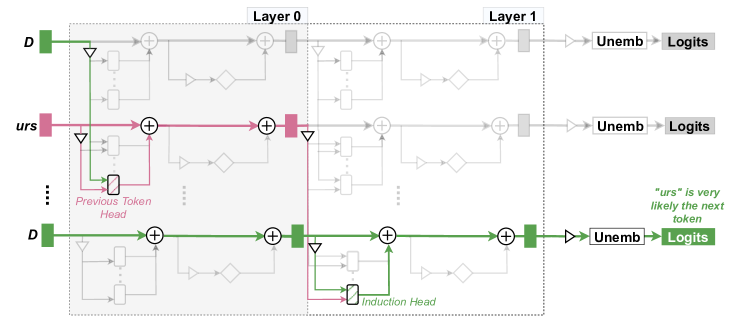
- 회로는 맥락 내 학습, IOI, 산술 등의 LM 동작이 특화된 구성요소를 통해 구현되고 작업 간 재사용된다는 것을 보여 준다.
- 특징과 회로의 보편성은 모델 크기, 초기화 및 학습에 따라 혼재되며, 일부 구성요소는 공유되고 다른 것들은 모델 간에 다를 수 있다.
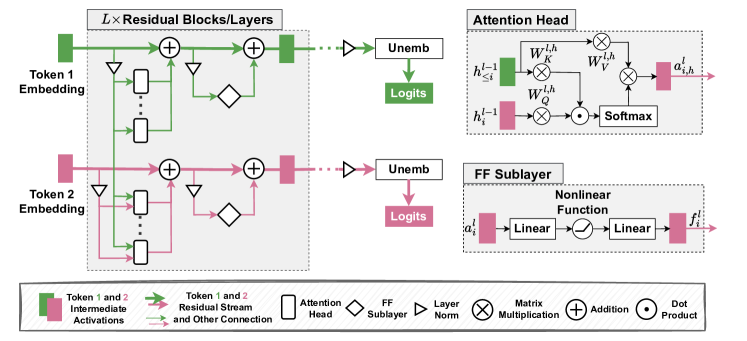
- Transformer 구성요소(잔차 스트림, MHA, FF)는 각기 다른 역할을 가지며, heads는 복사 억제, 귀납, 지식 저장과 같은 특화 기능을 보인다.
- MI 연구는 능력과 역학에 대한 명확한 진행을 보여 주지만, 규모 확장성, 일반화 및 안전 관련 질문은 여전히 남아 있다.
- 초보자 친화적 워크플로우와 로드맵이 제공되어 새로운 연구자들이 LMs에 MI 기법을 적용하도록 돕는다.
이 논문 읽기
누빈트 뷰어에서 원문을 열고, 읽으면서 궁금한 곳을 바로 물어보세요.
누빈트에서 이 논문 읽기이 리뷰는 AI가 논문 원문을 바탕으로 만들었습니다. 인용하기 전에 원문을 확인해 주세요.