
[논문 리뷰] A Study of Autoregressive Decoders for Multi-Tasking in Computer Vision
이 논문은 동결된 사전 훈련된 시각 인코더(예: CLIP)와 다수의 작업에 대해 미세조정된 경량 디코더를 사용하여 다중 작업 컴퓨터 비전에서 자동회귀 디코더를 조사한다. 단일이고 작은 디코더가 작업 정체성에 조건부로 설정될 경우 단일 작업 기반 기준선과 동등하거나 이를 초월하며, 하이퍼파rameter 조정이 적고, 관련 없는 작업조차도 유용함을 발견한다—이러한 결과는 동결된 인코더 기반 자동회귀 다중 작업 학습의 강건성과 전이 가능성에 대한 강력한 증거를 제공한다.
There has been a recent explosion of computer vision models which perform many tasks and are composed of an image encoder (usually a ViT) and an autoregressive decoder (usually a Transformer). However, most of this work simply presents one system and its results, leaving many questions regarding design decisions and trade-offs of such systems unanswered. In this work, we aim to provide such answers. We take a close look at autoregressive decoders for multi-task learning in multimodal computer vision, including classification, captioning, visual question answering, and optical character recognition. Through extensive systematic experiments, we study the effects of task and data mixture, training and regularization hyperparameters, conditioning type and specificity, modality combination, and more. Importantly, we compare these to well-tuned single-task baselines to highlight the cost incurred by multi-tasking. A key finding is that a small decoder learned on top of a frozen pretrained encoder works surprisingly well. We call this setup locked-image tuning with decoder (LiT-decoder). It can be seen as teaching a decoder to interact with a pretrained vision model via natural language.
연구 동기 및 목표
- 자동회귀 디코더의 설계적 상충 관계와 다중 작업 컴퓨터 비전에서의 성능을 이해하기 위해.
- 사전 훈련된 시각 인코더(예: CLIP)를 동결하고, 소형 다중 작업 자동회귀 디코더를 결합한 방식의 효과성을 평가하기 위해.
- 다양한 작업에 걸쳐 정교하게 튜닝된 단일 작업 기반 기준선과 비교하여 다중 작업 자동회귀 디코딩의 성능을 평가하기 위해.
- 작업 조건 설정, 데이터 혼합, 모델 용량이 성능에 미치는 영향을 조사하기 위해.
- 패널오틱 세그멘테이션과 같은 고밀도 예측 작업에 이러한 모델을 사용할 수 있는지의 가능성과 한계를 탐색하기 위해.
제안 방법
- 사전 훈련된 시각 인코더(예: CLIP 사전 훈련된 ViT-Base)를 사용해 이미지 특징을 추출한다.
- 공유된 작업 조건 입력을 사용해 다수의 작업에 대해 경량 자동회귀 디코더(예: 2층 트랜스포머)를 훈련한다.
- 생성 지침을 위해 작업 전용 접두어 토큰(예: 'classify:', 'caption:', 'answer:')를 디코더에 조건부로 설정한다.
- 표준 훈련 기법을 적용: 인코더 토큰에 대한 크로스 어텐션, 표준 크로스 엔트로피 손실, 디코딩을 위한 빔 서치.
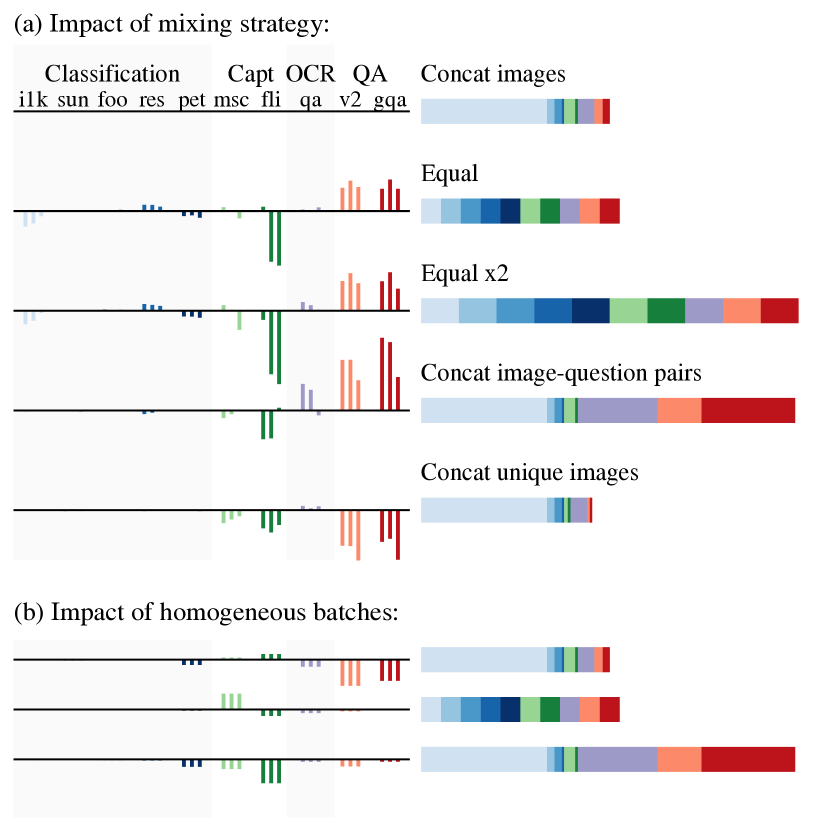
- 균형 잡힌 샘플링을 통해 다양한 데이터셋(예: ImageNet, COCO, VQAv2, TPU, OCR)의 혼합을 사용해 다중 작업 디코더를 훈련한다.
- 표준 메트릭(정확도, BLEU, CIDEr, PQ 등)을 사용해 보류된 테스트 세트에서 성능을 평가한다.
실험 결과
연구 질문
- RQ1모두 정교하게 튜닝된 경우, 다중 작업 자동회귀 디코더는 단일 작업 기준선 대비 어떻게 성능을 내는가?
- RQ2작업 조건 설정(예: 접두어 토큰)이 다양한 작업에 걸쳐 디코더 성능에 어떤 영향을 미치는가?
- RQ3작업 수와 디코더 용량이 성능와 일반화에 어떤 영향을 미치는가?
- RQ4관련 없는 작업을 추가하면 다중 작업 학습의 성능이 떨어지거나 향상되는가?
- RQ5동결된 인코더는 패널오틱 세그멘테이션과 같은 고밀도 출력 작업을 지원할 수 있는가, 아니면 미세조정이 필요한가?
주요 결과
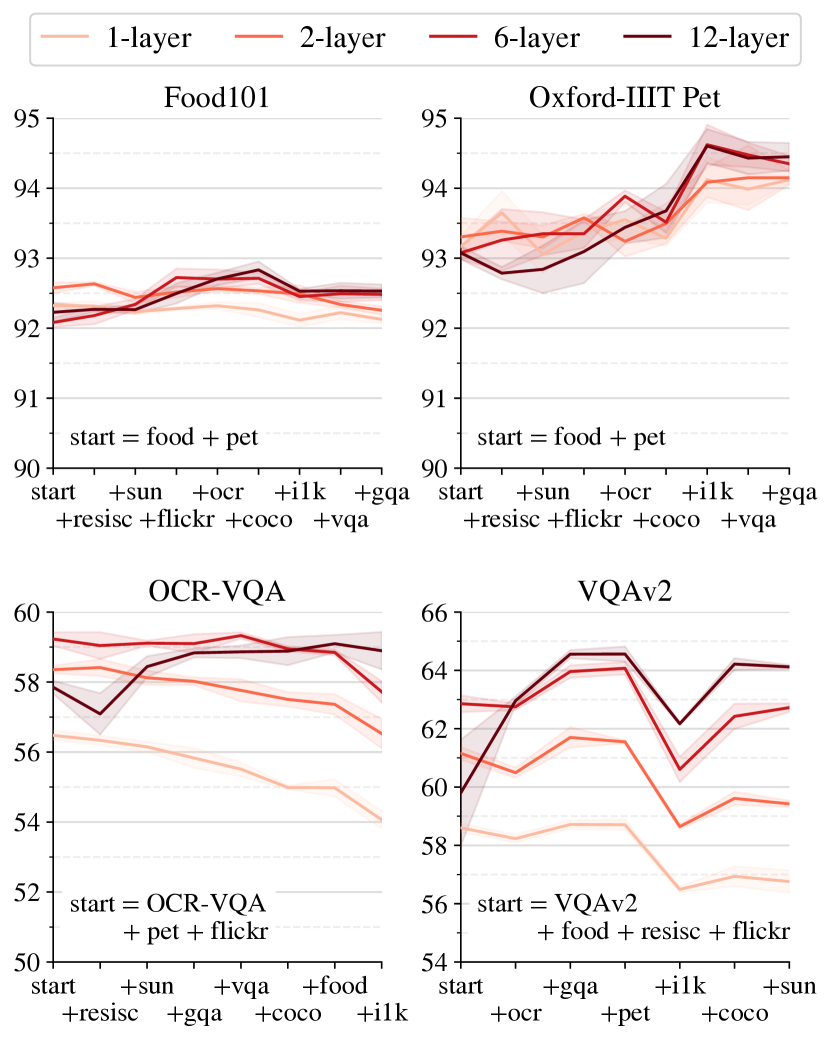
- 동결된 사전 훈련된 시각 인코더 위에 미세조정된 소형 2층 자동회귀 디코더(LiT 디코더)는 작업 정체성에 따라 조건부로 설정된 경우, 정교하게 튜닝된 단일 작업 기준선과 동등하거나 이를 초월하는 성능을 보인다.
- 작업 조건 설정이 핵심적이다: 이를 생략할 경우 모든 작업에서 성능이 크게 떨어지며, 이는 디코더가 맥락만으로 작업을 인식할 수 없다는 것을 시사한다.
- 다중 작업 학습은 하이퍼파rameter 조정에 민감도가 낮고 과적합의 위험도 단일 작업 학습보다 낮으며, 관련 없는 작업을 추가해도 마찬가지로 성능이 유지된다.
- 관련 없는 작업을 추가하는 것이 유익함을 보이며, 이는 모델이 일반화 가능한 표현을 학습하고 후행 작업의 일반화에 기여하기 때문임을 시사한다.
- 패널오틱 세그멘테이션과 같은 고밀도 예측 작업에서는 동결된 인코더만으로는 성능이 열악하다(5.0% PQ), 그러나 디코더를 미세조정하면 성능이 32.1% PQ로 향상되며, 이는 동결된 인코더의 공간적 의미 특징만으로는 이러한 작업에 충분하지 않음을 시사한다.
- 인코더 출력 토큰을 압축(예: 평균 풀링 또는 브로드캐스트 레이어를 통한)하면 성능이 심각하게 저하되며, 특히 캡션 생성 및 VQA 작업에서 두드러진다. 이는 디코더가 전체 공간적 맥락이 필수적임을 시사한다.
이 논문 읽기
누빈트 뷰어에서 원문을 열고, 읽으면서 궁금한 곳을 바로 물어보세요.
누빈트에서 이 논문 읽기이 리뷰는 AI가 논문 원문을 바탕으로 만들었습니다. 인용하기 전에 원문을 확인해 주세요.