
[논문 리뷰] A Survey for Biomedical Text Summarization: From Pre-trained to Large Language Models
생물의학 텍스트 요약(BTS)에 대한 체계적 검토로, 사전학습 언어 모델(PLMs)과 대형 언어 모델(LLMs)에 초점을 맞추고, 데이터셋, 방법, 평가, 도전과제 및 향후 방향을 다루며 오픈 리소스가 이용 가능한다.
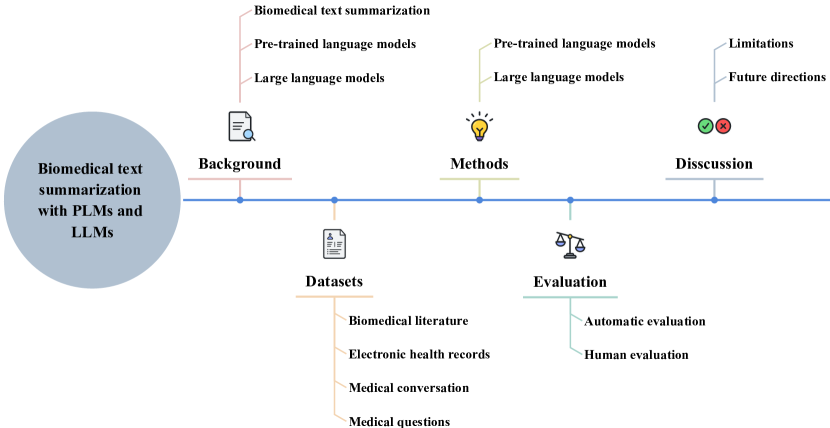
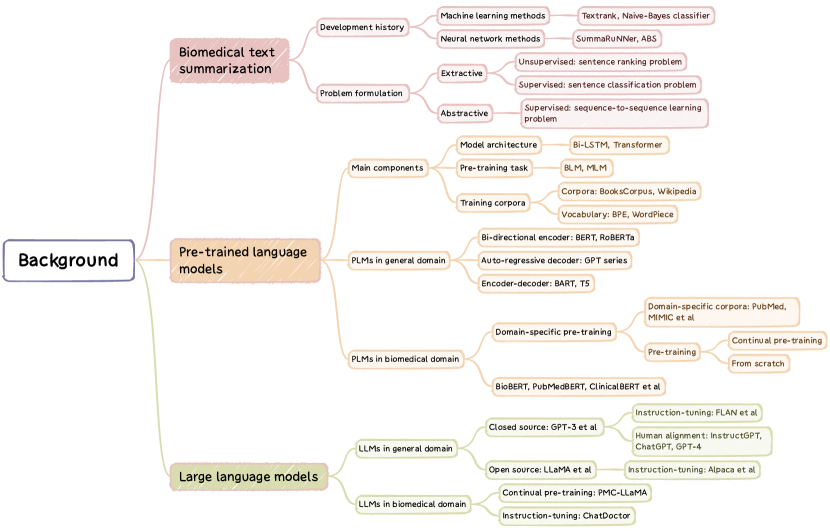
The exponential growth of biomedical texts such as biomedical literature and electronic health records (EHRs), poses a significant challenge for clinicians and researchers to access clinical information efficiently. To tackle this challenge, biomedical text summarization (BTS) has been proposed as a solution to support clinical information retrieval and management. BTS aims at generating concise summaries that distill key information from single or multiple biomedical documents. In recent years, the rapid advancement of fundamental natural language processing (NLP) techniques, from pre-trained language models (PLMs) to large language models (LLMs), has greatly facilitated the progress of BTS. This growth has led to numerous proposed summarization methods, datasets, and evaluation metrics, raising the need for a comprehensive and up-to-date survey for BTS. In this paper, we present a systematic review of recent advancements in BTS, leveraging cutting-edge NLP techniques from PLMs to LLMs, to help understand the latest progress, challenges, and future directions. We begin by introducing the foundational concepts of BTS, PLMs and LLMs, followed by an in-depth review of available datasets, recent approaches, and evaluation metrics in BTS. We finally discuss existing challenges and promising future directions in the era of LLMs. To facilitate the research community, we line up open resources including available datasets, recent approaches, codes, evaluation metrics, and the leaderboard in a public project: https://github.com/KenZLuo/Biomedical-Text-Summarization-Survey/tree/master. We believe that this survey will be a useful resource to researchers, allowing them to quickly track recent advancements and provide guidelines for future BTS research within the research community.
연구 동기 및 목표
- 생물의학 텍스트 요약에서 기초적인 BTS 개념과 PLMs 및 LLMs의 역할을 명확히 한다.
- 생물의학 문헌, EHR, 대화에 걸친 벤치마크 BTS 데이터셋을 분류하고 분석한다.
- PLMs와 LLMs를 활용한 기존 BTS 접근법을 검토하고 강점과 한계를 강조한다.
- LLMs 시대의 평가 지표, 현재의 도전과제 및 향후 방향에 대해 논의한다.
제안 방법
- 2018년 이후 PLMs와 LLMs에 초점을 맞춘 BTS 연구에 대한 체계적 문헌고찰.
- PLM/LLM 시대에서 추출적 vs 추상적 방법의 분류.
- 벤치마크 데이터셋과 작업 설정(단일 문서 vs 다중 문서)의 편집.
- 평가 지표와 리더보드에 대한 논의, 오픈 리소스에 중점.
- LLMs하의 BTS에서의 한계점과 향후 방향 식별.
실험 결과
연구 질문
- RQ1PLMs와 LLMs를 활용한 BTS에서 사용되는 벤치마크 데이터셋과 평가 표준은 무엇인가?
- RQ2PLMs와 LLMs가 생물의학 분야의 추출적 및 추상적 BTS 작업에 어떻게 적용되었는가?
- RQ3LLMs 시대의 BTS에서의 현재 한계와 유망한 향후 방향은 무엇인가?
주요 결과
- PLMs와 LLMs가 BTS의 주된 방법이 되었으며, 생물의학 텍스트의 인코딩 및 요약을 향상시킬 수 있다.
- 생물의학 문헌, EHR, 의학 대화 및 질문에 걸친 광범위한 공개 BTS 데이터셋이 있으며 단일 및 다중 문서 작업을 포함한다.
- LLMs는 제로샷 및 지시어 조정 기능을 가능하게 하며 특정 설정에서 더 작은 PLMs과 대등하거나 능가할 수 있다.
- 오픈소스 및 공개 데이터셋, 코드 및 리더보드가 BTS 연구의 신속한 진전을 지원하도록 강조된다.
- 생의학 특화 PLMs(BioBERT, PubMedBERT 등)는 일반 도메인 PLMs에 존재하는 어휘 및 용어 격차를 해소한다.
이 논문 읽기
누빈트 뷰어에서 원문을 열고, 읽으면서 궁금한 곳을 바로 물어보세요.
누빈트에서 이 논문 읽기이 리뷰는 AI가 논문 원문을 바탕으로 만들었습니다. 인용하기 전에 원문을 확인해 주세요.