
[논문 리뷰] A Survey of Graph Retrieval-Augmented Generation for Customized Large Language Models
이 설문은 그래프 검색 기반 생성(GraphRAG)를 통해 LLM을 맞춤화하기 위한 분류 체계, 검색 및 통합 기술, 도메인 적용, 도전과제 및 향후 방향을 제시합니다.
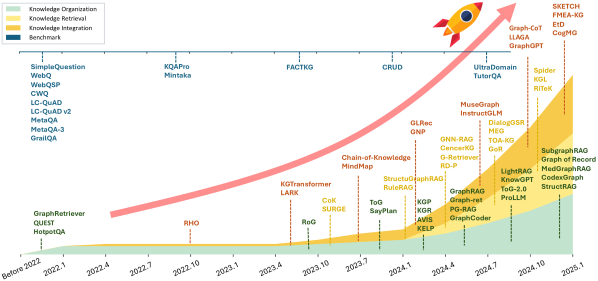
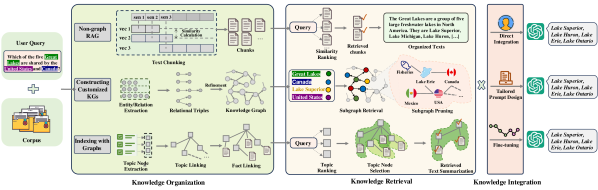
Large language models (LLMs) have demonstrated remarkable capabilities in a wide range of tasks, yet their application to specialized domains remains challenging due to the need for deep expertise. Retrieval-Augmented generation (RAG) has emerged as a promising solution to customize LLMs for professional fields by seamlessly integrating external knowledge bases, enabling real-time access to domain-specific expertise during inference. Despite its potential, traditional RAG systems, based on flat text retrieval, face three critical challenges: (i) complex query understanding in professional contexts, (ii) difficulties in knowledge integration across distributed sources, and (iii) system efficiency bottlenecks at scale. This survey presents a systematic analysis of Graph-based Retrieval-Augmented Generation (GraphRAG), a new paradigm that revolutionizes domain-specific LLM applications. GraphRAG addresses traditional RAG limitations through three key innovations: (i) graph-structured knowledge representation that explicitly captures entity relationships and domain hierarchies, (ii) efficient graph-based retrieval techniques that enable context-preserving knowledge retrieval with multihop reasoning ability, and (iii) structure-aware knowledge integration algorithms that leverage retrieved knowledge for accurate and logical coherent generation of LLMs. In this survey, we systematically analyze the technical foundations of GraphRAG and examine current implementations across various professional domains, identifying key technical challenges and promising research directions. All the related resources of GraphRAG, including research papers, open-source data, and projects, are collected for the community in https://github.com/DEEP-PolyU/Awesome-GraphRAG.
연구 동기 및 목표
- GraphRAG가 전문 분야에 맞춘 LLM을 조정하는 데 필요한 이유를 설명한다.
- 지식 기반, 인덱스 기반, 하이브리드 GraphRAG로 구성된 구조화된 분류 체계를 제시하고 이를 전통적인 RAG와 비교한다.
- GraphRAG에서의 지식 구성, 검색 및 통합과 같은 핵심 구성요소를 설명한다.
- 도메인 전반에 걸친 실용적 구현, 데이터셋, 벤치마크 및 오픈 소스 자원을 조사한다.
- 주요 도전과제를 식별하고 GraphRAG 시스템에 대한 유망한 연구 방향을 제안한다.
제안 방법
- 전통적인 RAG에서 GraphRAG으로의 발전을 개괄하고 GraphRAG 정의를 형식화한다.
- GraphRAG 접근법을 지식 기반, 인덱스 기반, 하이브리드 GraphRAG의 세 가지 범주로 분류한다.
- 구조화된 지식을 위한 그래프 기반 계획자와 다중 홉 추론을 포함한 검색 기술을 검토한다.
- 노드, 경로 및 서브그래프 수준에서의 지식 통합 전략과 맥락 내 학습 향상을 논의한다.
- 벤치마크로 뒷받침되는 오픈 소스 프로젝트, 데이터셋 및 도메인별 사례 연구를 모은다.
- 지식 품질, 검색 효율성, 일반화 및 보안의 한계와 향후 방향을 강조한다.
실험 결과
연구 질문
- RQ1GraphRAG가 무엇이며 지식 구성, 검색 및 통합에서 전통적 RAG와 어떻게 다른가?
- RQ2주요 GraphRAG 패러다임(지식 기반, 인덱스 기반, 하이브리드)과 각 패러다임의 트레이드오프는 무엇인가?
- RQ3그래프 구조 지식을 위한 검색 기술과 계획자는 무엇이며 다중 홉 및 추론 기능을 포함하는가?
- RQ4검색된 그래프 지식을 노드, 경로, 서브그래프 등 다양한 수준에서 LLM 프롬프트에 어떻게 효과적으로 통합할 수 있는가?
- RQ5현재 도메인 응용, 데이터셋, 벤치마크 및 GraphRAG를 위한 오픈 소스 자원은 무엇이며 남아 있는 도전과제는 무엇인가?
주요 결과
- GraphRAG는 그래프 구조 지식을 활용하여 복잡한 관계를 포착하고 맥락 보존된 다중 홉 검색을 가능하게 한다.
- 세 가지 분류 체계가 있으며: 지식 기반 GraphRAG, 인덱스 기반 GraphRAG, 하이브리드 GraphRAG로 각각 고유한 목표와 메커니즘을 가진다.
- GraphRAG는 분산된 지식 소스에서의 검색 효율성과 추론을 평문 텍스트 RAG에 비해 향상시킨다.
- 본 조사는 실용적 배치를 돕기 위해 오픈 소스 프로젝트, 데이터셋 및 도메인별 사례 연구를 통합한다.
- 지식 품질, 검색 효율성, 시스템 일반화, 보안과 같은 핵심 도전과제를 식별하고 향후 연구 방향을 제시한다.
이 논문 읽기
누빈트 뷰어에서 원문을 열고, 읽으면서 궁금한 곳을 바로 물어보세요.
누빈트에서 이 논문 읽기이 리뷰는 AI가 논문 원문을 바탕으로 만들었습니다. 인용하기 전에 원문을 확인해 주세요.