
[논문 리뷰] A Survey on Explainability of Graph Neural Networks
본 검토는 Graph Neural Networks (GNNs)의 설명가능성 방법에 대한 포괄적 분류체계를 제시하며, 사실적 접근법과 counterfactual 접근법을 모두 다루고, 평가 지표와 데이터셋에 대해 논의한다.
Graph neural networks (GNNs) are powerful graph-based deep-learning models that have gained significant attention and demonstrated remarkable performance in various domains, including natural language processing, drug discovery, and recommendation systems. However, combining feature information and combinatorial graph structures has led to complex non-linear GNN models. Consequently, this has increased the challenges of understanding the workings of GNNs and the underlying reasons behind their predictions. To address this, numerous explainability methods have been proposed to shed light on the inner mechanism of the GNNs. Explainable GNNs improve their security and enhance trust in their recommendations. This survey aims to provide a comprehensive overview of the existing explainability techniques for GNNs. We create a novel taxonomy and hierarchy to categorize these methods based on their objective and methodology. We also discuss the strengths, limitations, and application scenarios of each category. Furthermore, we highlight the key evaluation metrics and datasets commonly used to assess the explainability of GNNs. This survey aims to assist researchers and practitioners in understanding the existing landscape of explainability methods, identifying gaps, and fostering further advancements in interpretable graph-based machine learning.
연구 동기 및 목표
- GNNs의 복잡하고 비선형 구조로 인해 설명가능성의 필요성을 동기 부여한다.
- 설명가능성 방법을 목표와 방법론에 따라 분류하는 새로운 분류체계를 제공한다.
- 각 범주의 강점, 한계 및 적용 시나리오를 요약한다.
- GNN 설명가능성을 평가하기 위한 평가 지표와 일반적으로 사용되는 데이터셋을 강조한다.
- 사실적 또는 반사실적 방법에만 초점을 맞춘 기존 설문에서 남긴 간극을 연결한다.
제안 방법
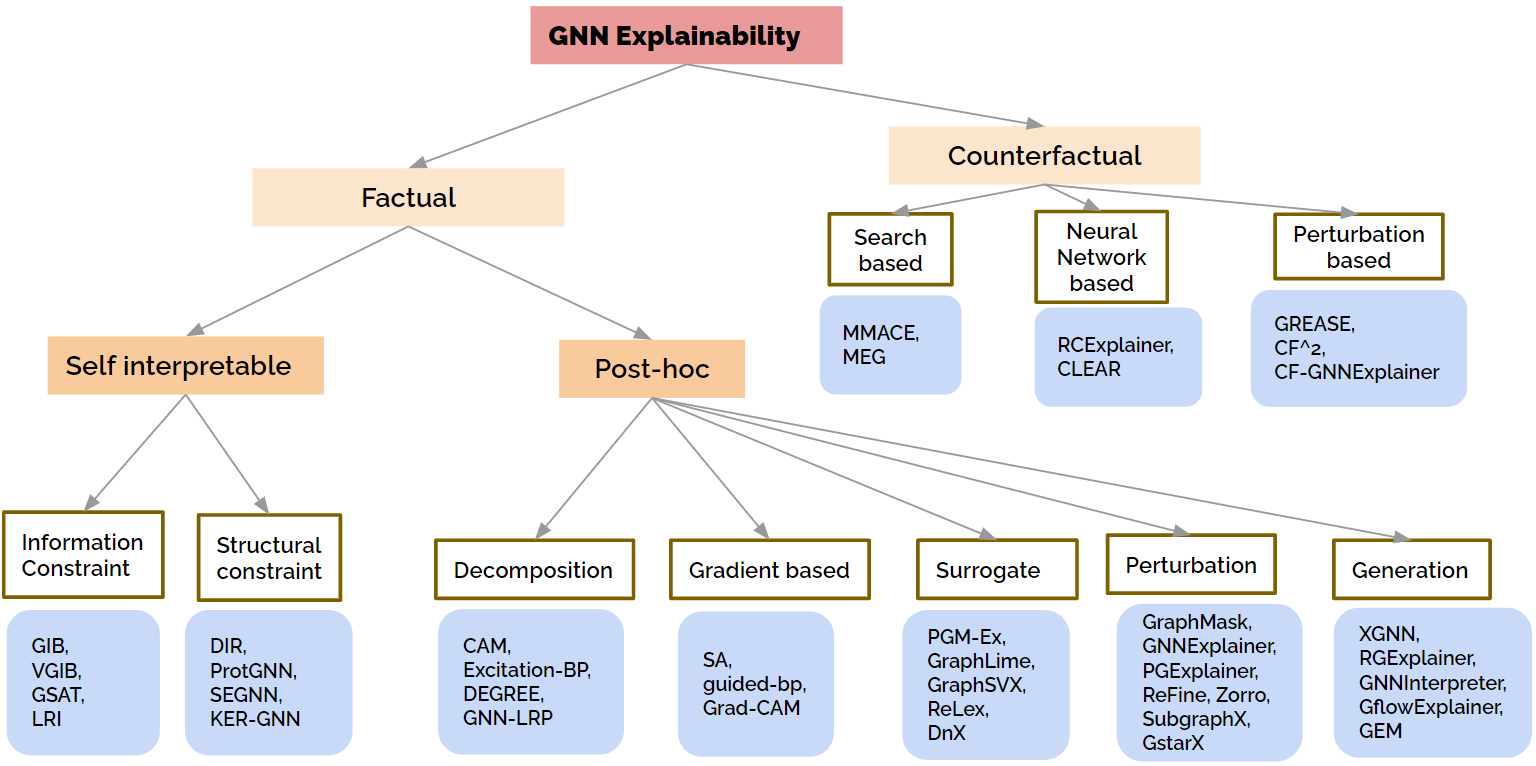
- GNN 설명가능성에 대해 사실적 및 반사실적 방법으로 나뉘는 새로운 분류체계를 제안한다.
- 사실적 방법을 자가 해석 가능(self-interpretable)과 사후 처리(post-hoc)로 분류하고, 사후 처리를 다시 분해(decomposition), 기울기 기반(gradient-based), 대리모델(surrogate), 섭동 기반(perturbation-based), 생성 기반(generation-based) 카테고리로 추가로 나눈다.
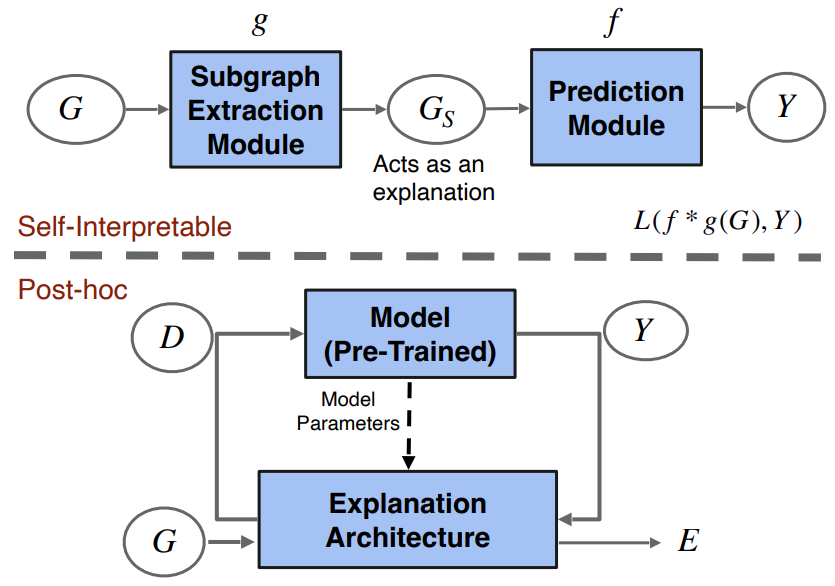
- Y를 예측하는 목표를 가지고 정보 또는 구조적 제약에 기초하여 하위 그래프 추출을 설명하는 자가 해석 가능 방법을 리뷰한다.
- GNN 설명가능성을 평가하기 위한 평가 전략과 데이터셋을 논의한다.
- 그래프 설명의 특성상 조합적 하위구조 탐색과 노드 특성과 그래프 토폴로지 모두를 고려해야 한다는 문제를 다룬다.
실험 결과
연구 질문
- RQ1GNNs를 위한 기존의 설명가능성 방법은 무엇이며 이를 어떻게 체계적으로 분류할 수 있는가?
- RQ2각 범주의 GNN 설명가능성 방법의 강점, 한계 및 적합한 적용 시나리오는 무엇인가?
- RQ3GNN 설명가능성을 평가하는 데 일반적으로 사용되는 데이터셋과 평가 지표는 무엇인가?
- RQ4사실적 및 반사실적 접근 방식은 GNN 설명 맥락에서 어떻게 비교되는가?
주요 결과
- 설명가능성 방법을 사실적과 반사실적으로 자세한 하위 범주와 함께 포괄적으로 정리하는 포괄적 분류체계를 제시한다.
- 사후 처리는 화이트박스(white-box) 또는 블랙박스(black-box)일 수 있으며, 자가 해석 가능 방법은 설명을 모델 아키텍처에 통합한다는 것을 확인한다.
- 분해 기반, 기울기 기반, 대리모델, 섭동 기반, 생성 기반의 사후 처치 방법과 그 일반적인 입력, 출력 및 제약을 요약한다.
- 자가 해석 가능 방법은 통합 제약으로 인해 해석 가능성과 예측 정확도 사이의 트레이드오프를 가질 수 있음을 강조한다.
- GNN 예측을 설명할 때 노드 속성과 그래프 구조를 모두 고려해야 할 필요가 있음을 강조한다.
- GNN 설명가능성에 일반적으로 사용되는 데이터셋과 평가 지표를 검토한다(논문 7장과 8장).
이 논문 읽기
누빈트 뷰어에서 원문을 열고, 읽으면서 궁금한 곳을 바로 물어보세요.
누빈트에서 이 논문 읽기이 리뷰는 AI가 논문 원문을 바탕으로 만들었습니다. 인용하기 전에 원문을 확인해 주세요.