
[논문 리뷰] A Survey on Graph Neural Networks for Time Series: Forecasting, Classification, Imputation, and Anomaly Detection
그래프 신경망(GNN)을 시간 시계열에 적용한 예측, 분류, 이상 탐지 및 보간에 대한 포괄적 고찰로, 작업- 및 방법론 중심의 통일된 프레임워크와 향후 방향을 제시합니다.
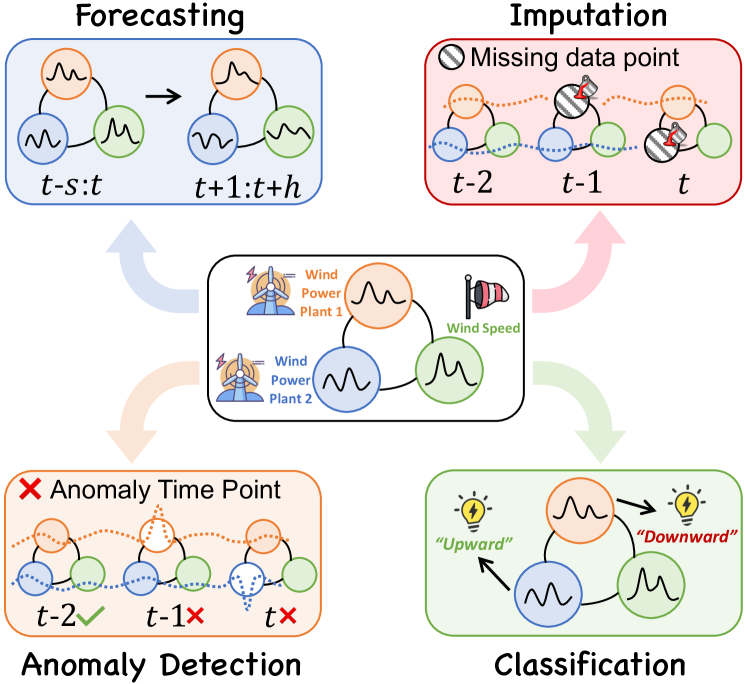
Time series are the primary data type used to record dynamic system measurements and generated in great volume by both physical sensors and online processes (virtual sensors). Time series analytics is therefore crucial to unlocking the wealth of information implicit in available data. With the recent advancements in graph neural networks (GNNs), there has been a surge in GNN-based approaches for time series analysis. These approaches can explicitly model inter-temporal and inter-variable relationships, which traditional and other deep neural network-based methods struggle to do. In this survey, we provide a comprehensive review of graph neural networks for time series analysis (GNN4TS), encompassing four fundamental dimensions: forecasting, classification, anomaly detection, and imputation. Our aim is to guide designers and practitioners to understand, build applications, and advance research of GNN4TS. At first, we provide a comprehensive task-oriented taxonomy of GNN4TS. Then, we present and discuss representative research works and introduce mainstream applications of GNN4TS. A comprehensive discussion of potential future research directions completes the survey. This survey, for the first time, brings together a vast array of knowledge on GNN-based time series research, highlighting foundations, practical applications, and opportunities of graph neural networks for time series analysis.
연구 동기 및 목표
- 시간 시계열 분석에서 GNN의 작업 지향적 분류체계를 제공한다(예측, 이상 탐지, 보간, 분류).
- 시간 시계열 데이터를 그래프로 인코딩하고 표현을 학습하기 위한 통합된 방법론 프레임워크(spatial-temporal GNNs)를 제시한다.
- 도메인 전반의 대표적인 연구와 응용 사례를 조사하여 GNN4TS 시스템의 설계와 구현을 안내한다.
- GNN 기반 시간 시계열 연구의 발전을 위한 개방 과제와 향후 방향을 논의한다.
제안 방법
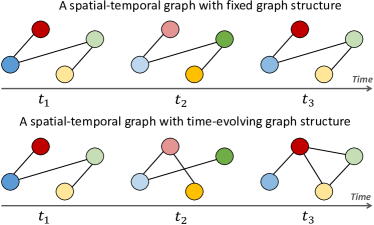
- 다변량 시간 시계열을 속성 그래프의 시퀀스로 표현하기 위해 spatial-temporal 그래프를 정의한다.
- 작업별로 분류하고 공간-시간 모형 선택(스펙트럴 대 공간 GNN, 시간 대 주파수 도메인, 이산 대 연속 아키텍처)에 따라 분류한다.
- 데이터 처리 및 그래프 구성, STGNN 기반 표현 학습, 다운스트림 작업 예측기를 포함하는 통합 파이프라인을 제안한다.
- 휴리스틱 기반 및 학습 기반 그래프 구성 방법(근접성, 연결성, 유사성, 기능적 의존성, 학습된 그래프)을 검토한다.
- 아키텍처 패턴(분해형 vs 결합형 STGNN) 및 시간 모듈(RNN, TCN, Transformer 및 하이브리드)을 설명한다.
- 대표 모델과 그들의 작업별 공식화(예: forecasting 손실, imputation 손실, classification 손실)를 요약한다.
실험 결과
연구 질문
- RQ1GNN 기반 시간 시계열 분석의 주요 작업 범주는 무엇이며 어떻게 모델링되는가?
- RQ2공간-시간 그래프와 STGNN 아키텍처를 어떻게 통합하여 다양한 시간 시계열 작업을 처리할 수 있는가?
- RQ3시간 시계열에 대한 핵심 그래프 구성 전략(휴리스틱 및 학습 기반)은 무엇이며 성능에 어떤 영향을 미치는가?
- RQ4시간 시계열 예측, 이상 탐지, 보간, 분류를 위한 STGNN의 일반적인 아키텍처 패턴(불연속 대 연속, 분해형 대 결합형)은 무엇인가?
- RQ5GNN 기반 시간 시계열 연구의 주요 방향과 개방 과제는 무엇인가?
주요 결과
- 본 고시는 forecasting, classification, anomaly detection, imputation에 걸친 GNN 기반 시간 시계열 분석에 대한 최초의 포괄적이고 최신 리뷰를 제공합니다.
- 작업- 및 방법론 중심의 관점에서 통일되고 체계적인 분류를 제공하고 세 부분으로 구성된 프레임워크(공간 모듈, 시간 모듈, 전체 아키텍처)를 소개한다.
- 응용 도메인의 폭과 GNN4TS가 변수 간 및 시점 간 의존성 모델링에서 가지는 다재다능함을 강조한다.
- 휴리스틱 및 학습 기반 그래프 구성 전략을 논의하고 각 접근 방식이 언제 적합한지 자세히 설명한다.
- 향후 연구 방향과 남은 질문들을 제시하여 GNN4TS의 후속 연구를 이끈다.
이 논문 읽기
누빈트 뷰어에서 원문을 열고, 읽으면서 궁금한 곳을 바로 물어보세요.
누빈트에서 이 논문 읽기이 리뷰는 AI가 논문 원문을 바탕으로 만들었습니다. 인용하기 전에 원문을 확인해 주세요.