
[논문 리뷰] A Survey on the Memory Mechanism of Large Language Model based Agents
이 설문 조사는 LLM 기반 에이전트의 메모리 모듈을 분석하여 메모리를 정의하고, 설계 전략(소스, 형태, 작동), 평가 및 응용을 상세히 설명하며, 향후 방향을 개요한다.
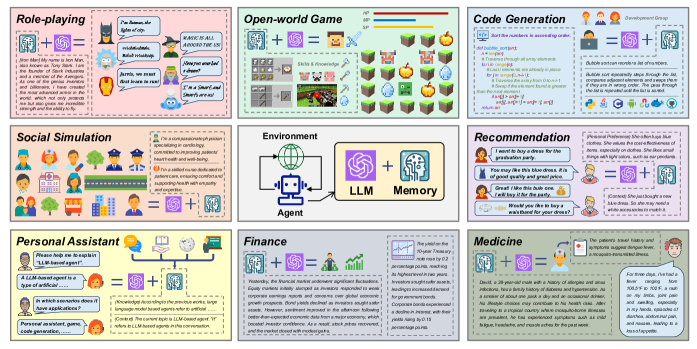
Large language model (LLM) based agents have recently attracted much attention from the research and industry communities. Compared with original LLMs, LLM-based agents are featured in their self-evolving capability, which is the basis for solving real-world problems that need long-term and complex agent-environment interactions. The key component to support agent-environment interactions is the memory of the agents. While previous studies have proposed many promising memory mechanisms, they are scattered in different papers, and there lacks a systematical review to summarize and compare these works from a holistic perspective, failing to abstract common and effective designing patterns for inspiring future studies. To bridge this gap, in this paper, we propose a comprehensive survey on the memory mechanism of LLM-based agents. In specific, we first discuss ''what is'' and ''why do we need'' the memory in LLM-based agents. Then, we systematically review previous studies on how to design and evaluate the memory module. In addition, we also present many agent applications, where the memory module plays an important role. At last, we analyze the limitations of existing work and show important future directions. To keep up with the latest advances in this field, we create a repository at \url{https://github.com/nuster1128/LLM_Agent_Memory_Survey}.
연구 동기 및 목표
- LLM 기반 에이전트에서 메모리를 정의하고 그것의 필요성을 정당화한다.
- 소스, 형태, 작동에 걸쳐 메모리 설계를 체계적으로 분류한다.
- 에이전트 메모리 평가 방법론을 검토하고 모범 사례를 식별한다.
- 메모리가 중요한 에이전트 응용 사례를 조사하고 한계를 분석한다.
- 메모리 기능을 갖춘 에이전트의 미해결 과제와 향후 연구 방향을 강조한다.
제안 방법
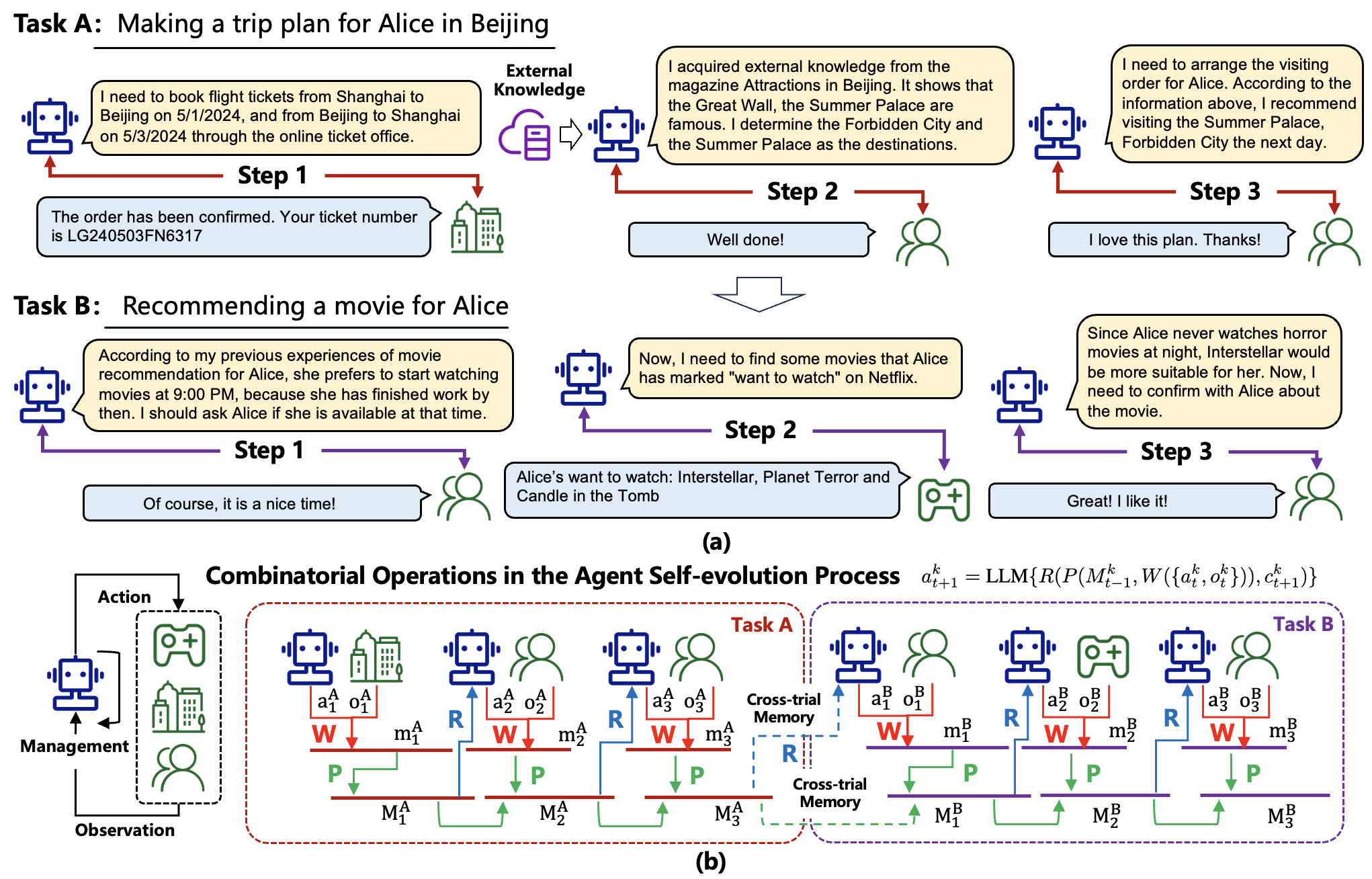
- 에이전트 메모리의 좁은 개념과 넓은 개념을 정의하고 (쓰기, 관리, 읽기)로 구성된 3단계 상호작용 과정을 모델링한다.
- 메모리 소스를 inside-trial, cross-trial, external knowledge로 분류하고 기존 시스템의 예를 제시한다.
- 메모리 형태를 텍스트적 표현 또는 파라메트릭 표현으로 설명하고 장단점을 비교한다.
- 메모리 작동을 쓰기(W), 관리(P), 읽기(R)로 설명하고 LLM과의 통합 진화 함수에 대해 다룬다.
- 직접 및 간접 작업을 포함한 평가 방법과 다양한 응용 시나리오를 조사한다.
실험 결과
연구 질문
- RQ1메모리는 무엇으로 구성되며 왜 에이전트 자율성과 자기 진화에 필요한가?
- RQ2메모리는 어떻게 효과적으로 구현될 수 있으며(소스, 형태, 작동) 과제 전반에 걸쳐 어떻게 평가될 수 있는가?
- RQ3메모리의 중요성을 보여주는 주요 응용 분야는 무엇인가?
- RQ4현 메모리 모듈의 한계와 향후 개선 방향은 무엇인가?
주요 결과
- 메모리는 에이전트-환경 상호작용에 필수적이며, 지각, 처리, 행동을 루프 내에서 가능하게 한다.
- 메모리는 좁게는 (트라이얼 내에서) 또는 넓게는 (트라이얼과 작업 전반에 걸쳐) 외부 지식을 포함한다.
- 메모리 소스에는 inside-trial 정보, cross-trial 정보, 외부 지식이 포함되며, 많은 시스템이 세 가지를 모두 일정 정도 활용한다.
- 메모리 형태에는 텍스트형 및 파라메트릭 표현이 있으며, 각자 설명가능성과 효율성 면에서 트레이드오프를 가진다.
- 메모리 작동은 쓰기, 관리, 읽기로 구성되며, LLM을 통해 에이전트 행동을 안내하는 통합 공식이 있다.
- 본 조사는 한계점을 식별하고 파라메트릭 메모리, 다중 에이전트 메모리, 평생학습 등 향후 방향을 강조한다.
이 논문 읽기
누빈트 뷰어에서 원문을 열고, 읽으면서 궁금한 곳을 바로 물어보세요.
누빈트에서 이 논문 읽기이 리뷰는 AI가 논문 원문을 바탕으로 만들었습니다. 인용하기 전에 원문을 확인해 주세요.