
[논문 리뷰] Adaptive Few-shot Prompting for Machine Translation with Pre-trained Language Models
AFSP는 입력 문장에 대해 혼합 LLM-임베딩 검색 모듈을 사용해 자동으로 적합한 번역 시연을 선택하고, 여러 출력을 생성한 뒤 자기감독 재순위기로 재정렬하여 외교 중국어–영어 및 UN 코퍼스에서 MT를 개선한다.
Recently, Large language models (LLMs) with in-context learning have demonstrated remarkable potential in handling neural machine translation. However, existing evidence shows that LLMs are prompt-sensitive and it is sub-optimal to apply the fixed prompt to any input for downstream machine translation tasks. To address this issue, we propose an adaptive few-shot prompting (AFSP) framework to automatically select suitable translation demonstrations for various source input sentences to further elicit the translation capability of an LLM for better machine translation. First, we build a translation demonstration retrieval module based on LLM's embedding to retrieve top-k semantic-similar translation demonstrations from aligned parallel translation corpus. Rather than using other embedding models for semantic demonstration retrieval, we build a hybrid demonstration retrieval module based on the embedding layer of the deployed LLM to build better input representation for retrieving more semantic-related translation demonstrations. Then, to ensure better semantic consistency between source inputs and target outputs, we force the deployed LLM itself to generate multiple output candidates in the target language with the help of translation demonstrations and rerank these candidates. Besides, to better evaluate the effectiveness of our AFSP framework on the latest language and extend the research boundary of neural machine translation, we construct a high-quality diplomatic Chinese-English parallel dataset that consists of 5,528 parallel Chinese-English sentences. Finally, extensive experiments on the proposed diplomatic Chinese-English parallel dataset and the United Nations Parallel Corpus (Chinese-English part) show the effectiveness and superiority of our proposed AFSP.
연구 동기 및 목표
- 기계 번역에서 인-context 학습의 프롬프트 민감도를 해결하기 위해 각 소스 입력에 대해 고품질 시연을 자동으로 선택한다.
- 배포된 LLM의 임베딩을 사용해 의미적으로 관련된 번역 시연을 검색하는 하이브리드 시연 검색 모듈을 구축한다.
- 의미적으로 일관된 번역을 선택하고 출력 편향을 줄이기 위해 자체 감독 재랭커를 도입한다.
- 효과를 평가하기 위해 고품질의 외교 중국어-영어 병렬 데이터세트와 UN 중국어-영어 부분집합을 만들어 도메인 간 효과를 평가하기 위해 검증한다.
제안 방법
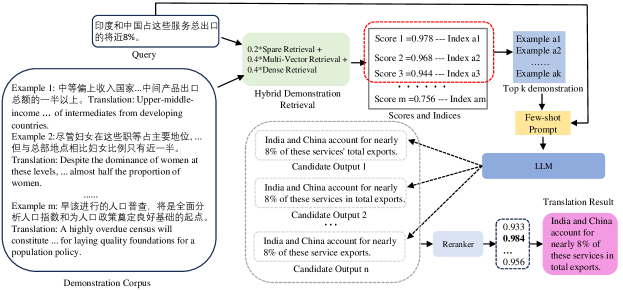
- 배포된 LLM의 임베딩(밀집, 희소, 다중 벡터)을 기반으로 한 하이브드 검색 모듈과 함께 시연 문서를 사용해 하이브드 관련도 점수를 계산하고 상위 k 시연을 검색한다.
- 검색된 시연으로 고정된 프롬프트 템플릿을 채워 LLM용 소수 샷 프롬프트를 형성한다.
- LLM이 다수의 대상 언어 출력을 생성하고, 부정 샘플링으로 자기 지도(Self-supervision) 학습된 소형 언어 모델(SLM) 재랭커로 재랭한다.
- 손상된(target) 텍스트와 이를 통해 파생된 품질 점수 및 변화로부터 자체 감독 재랭커를 학습시켜 대규모 학습 데이터를 생성한다.
- 표준 MT 지표와 인간 평가를 사용해 Diplomatic 및 UN Chinese–English 데이터셋에서 제로샷, 소샷, 및 KNN 기반 기준선과 AFSP를 비교한다.
실험 결과
연구 질문
- RQ1적응형 시연 검색이 입력 간에 고정 프롬프트보다 번역 품질을 향상시킬 수 있는가?
- RQ2하이브리드 임베딩 기반 검색이 단일 모델 임베딩보다 더 의미적으로 관련된 시연을 제공하는가?
- RQ3자체 감독 재랭커가 의미적 일관성을 개선하고 LLM 번역의 출력 편향을 줄일 수 있는가?
- RQ4AFSP가 외교 중국어–영어 및 UN 중국어–영어 데이터에서 기준선 대비 얼마나 성능을 발휘하는가?
주요 결과
- AFSP는 평가된 데이터세트와 언어 방향 전반에 걸쳐 제로샷, 소샷 및 KNN 기반 기준선보다 일관되게 우수하다.
- 배포된 LLM의 임베딩을 이용한 시연 검색(밀집, 희소, 다중 벡터) 및 적응형 프롬프트로 번역 지표를 개선한다.
- 자체 감독 재랭커가 더 높은 품질의 번역을 효과적으로 선택해 자동 지표와 인간 평가 모두를 향상시킨다.
- AFSP는 여러 지표와 시연에서 Diplomatic 코퍼스 및 UN Parallel Corpus (Chinese–English)에서 주목할 만한 개선을 달성한다.
- 인간 평가에서 AFSP가 기준선보다 더 나은 문장 흐름, 정확성 및 스타일 유지력을 보인다.
이 논문 읽기
누빈트 뷰어에서 원문을 열고, 읽으면서 궁금한 곳을 바로 물어보세요.
누빈트에서 이 논문 읽기이 리뷰는 AI가 논문 원문을 바탕으로 만들었습니다. 인용하기 전에 원문을 확인해 주세요.