
[논문 리뷰] Approximating Online Human Evaluation of Social Chatbots with Prompting
이 논문은 사회적 채팅 봇의 온라인 인간 평가를 자동으로 근사하기 위해 대규모 언어 모델(Large Language Models, LLMs)을 활용하는 프롬프팅 기반 프레임워크인 DEP를 제안한다. 특정 사회적 역할을 수행하도록 조건화하고 지시 테이닝 프롬프팅을 적용함으로써 DEP는 최대 0.95의 피어슨 상관계수를 보이며 합성 대화 로그와 평가 점수를 생성한다. 이는 실세계 상호작용 환경에서 확장 가능하고 비용 효율적이며 정확한 채팅 봇 평가를 가능하게 한다.
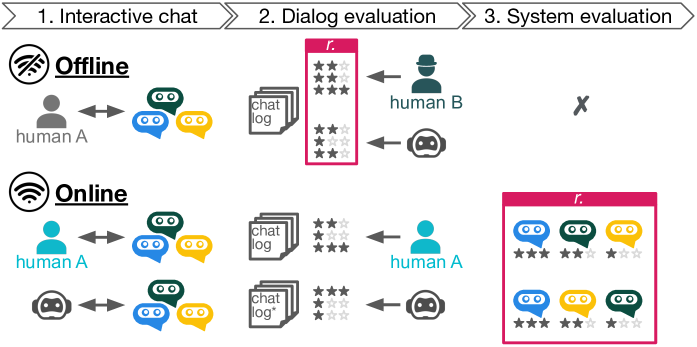
As conversational models become increasingly available to the general public, users are engaging with this technology in social interactions. Such unprecedented interaction experiences may pose considerable social and psychological risks to the users unless the technology is properly controlled. This highlights the need for scalable and robust evaluation metrics for conversational chatbots. Existing evaluation metrics aim to automate offline user evaluation and approximate human judgment of pre-curated dialogs. However, they are limited in their ability to capture subjective perceptions of users who actually interact with the bots and might not generalize to real-world settings. To address this limitation, we propose an approach to approximate online human evaluation leveraging large language models (LLMs) from the GPT family. We introduce a new Dialog system Evaluation framework based on Prompting (DEP), which enables a fully automatic evaluation pipeline that replicates live user studies and achieves an impressive correlation with human judgment (up to Pearson r=0.95 on a system level). The DEP approach involves collecting synthetic chat logs of evaluated bots with an LLM in the other-play setting, where the LLM is carefully conditioned to follow a specific scenario. We further explore different prompting approaches to produce evaluation scores with the same LLM. The best performing prompts, which contain few-shot demonstrations and instructions, show outstanding performance on the tested dataset and demonstrate the ability to generalize to other dialog corpora.
연구 동기 및 목표
- 실제 사용자가 사회적 채팅 봇과 상호작용할 때의 주관적 인식을 반영하지 못하는 기존 평가 지표의 격차를 보완하기 위해.
- 실시간 사용자 연구의 동역학을 재현하는 자동화되고 확장 가능하며 비용 효율적인 온라인 인간 평가의 대안을 개발하기 위해.
- LLMs가 대화 시스템에서 인간처럼 행동하는 사회적 역할과 평가 행동을 효과적으로 프롬프팅할 수 있는지 탐색하기 위해.
- 공감적이고 개방형 도메인 대화 환경에서 자동 평가 점수와 인간 평가 간의 높은 상관관계를 달성하기 위해.
- 기본 품질 지표를 넘어서 다양한 대화 코퍼스와 사회적 현상(예: 공감, 독성)에 대한 평가의 일반화를 가능하게 하기 위해.
제안 방법
- GPT 계열의 LLM을 사용하여 '다른 사람이 말하는 방식' 설정에서 실제적인 대화 로그를 생성하고 평가된 채팅 봇과 상호작용하는 합성 대화 파트너로 활용한다.
- 대화 생성 중 특정 사회적 역할(예: 공감하는 경청자, 정서적인 발언자)을 시뮬레이션하기 위해 역할 기반 프롬프팅을 LLM에 조건화한다.
- 대화 품질 차원 기반으로 세분화된 평가 점수를 할당하도록 지도하는 데 사용하기 위해 애너테이션된 예시를 포함한 소수의 프롬프팅을 적용한다.
- 세분화된 특성(예: 공감, 일관성)을 총합 대화 점수와 명시적으로 연결하는 지시 프롬프팅을 설계하여 인간 평가와의 일치도를 향상시킨다.
- 다양한 대화 세션의 평가 점수를 집계하여 비교 분석을 위한 시스템 수준의 순위를 산출한다.
- 기준 데이터셋(iEval, FED, DSTC9)을 사용하여 프레임워크를 검증하고 인간 애너테이션 기반 참값과의 상관계수를 측정한다.
실험 결과
연구 질문
- RQ1LLMs는 대화 상호작용에서 인간처럼 행동하는 사회적 역할을 효과적으로 프롬프팅할 수 있는가? 이를 통해 현실적인 합성 대화 로그를 생성할 수 있는가?
- RQ2지시 테이닝 프롬프팅은 온라인 평가 환경에서 인간 평가와 상관관계가 높은 평가 점수를 얼마나 잘 생성할 수 있는가?
- RQ3DEP 프레임워크는 다양한 대화 코퍼스와 사회적 상호작용 현상(예: 공감, 독성)에 대해 얼마나 잘 일반화되는가?
- RQ4어떤 프롬프팅 전략(예: 소수의 예시 제시, 상세한 지시)이 인간 평가와 가장 높은 상관관계를 보이는가?
- RQ5이 프레임워크는 기본 응답 품질을 넘어서 정서적 지원이나 유머와 같은 복잡한 사회적 행동을 평가하는 데도 적용될 수 있는가?
주요 결과
- DEP 프레임워크는 iEval 데이터셋에서 시스템 수준에서 인간 평가와 최대 0.95의 피어슨 상관계수를 달성하여 인간 평가와 강력한 일치를 보였다.
- 세부 지침이 포함된 소수의 프롬프팅은 평가 점수 정확도를 크게 향상시켜 제로샷 또는 일반적인 프롬프팅 접근 방식을 능가했다.
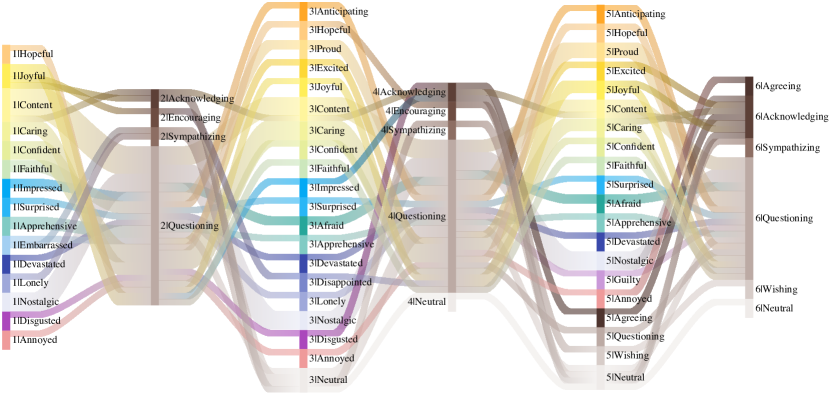
- 합성 대화 로그에서 LLM의 행동은 인간의 대화 패턴, 감정 및 의도 분포와 유사하게 나타났지만, 일부 하위 흐름(예: 감사 표현)에서는 RLHF 훈련으로 인한 모델 성격의 흔적을 보였다.
- 프레임워크는 FED 및 DSTC9를 포함한 다른 대화 코퍼스로도 잘 일반화되어 다양한 평가 맥락에서의 강건성을 보였다.
- 합성 대화 로그와 평가 애너테이션은 공개되어 있어 재현성과 향후 벤치마크 작업을 가능하게 했다.
- 이 프레임워크는 인간 애너테이터 없이도 빠르고 자동으로 채팅 봇을 평가할 수 있게 하여 시간과 비용을 줄였고, 높은 신뢰성을 유지했다.
이 논문 읽기
누빈트 뷰어에서 원문을 열고, 읽으면서 궁금한 곳을 바로 물어보세요.
누빈트에서 이 논문 읽기이 리뷰는 AI가 논문 원문을 바탕으로 만들었습니다. 인용하기 전에 원문을 확인해 주세요.