
[논문 리뷰] Art or Artifice? Large Language Models and the False Promise of Creativity
이 논문은 TTCW를 Torrance에서 영감을 받은, 산물 중심의 창의성 평가로 제시하여, 단편 소설에서 창의성 테스트에서 LLM이 인간 작가보다 3–10배 느리다는 것과 LLM이 창의성을 신뢰성 있게 평가할 수 없다는 것을 보여준다.
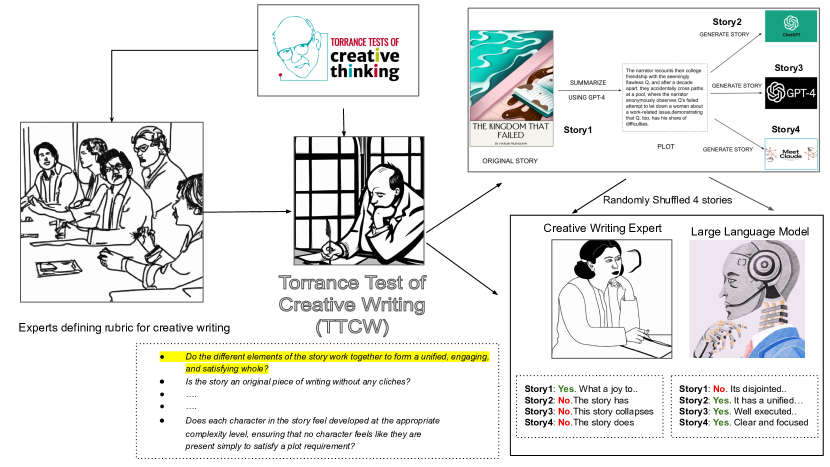
Researchers have argued that large language models (LLMs) exhibit high-quality writing capabilities from blogs to stories. However, evaluating objectively the creativity of a piece of writing is challenging. Inspired by the Torrance Test of Creative Thinking (TTCT), which measures creativity as a process, we use the Consensual Assessment Technique [3] and propose the Torrance Test of Creative Writing (TTCW) to evaluate creativity as a product. TTCW consists of 14 binary tests organized into the original dimensions of Fluency, Flexibility, Originality, and Elaboration. We recruit 10 creative writers and implement a human assessment of 48 stories written either by professional authors or LLMs using TTCW. Our analysis shows that LLM-generated stories pass 3-10X less TTCW tests than stories written by professionals. In addition, we explore the use of LLMs as assessors to automate the TTCW evaluation, revealing that none of the LLMs positively correlate with the expert assessments.
연구 동기 및 목표
- Adapt TTCT into an artifact-centric Torrance Test for Creative Writing (TTCW) to evaluate creativity in short stories.
- Validate TTCW using expert judgments on 48 stories (professionals vs. LLMs) under the Consensual Assessment Technique.
- Investigate whether LLMs can function as autonomous assessors of TTCW tests.
- Compare performance across LLMs to identify dimension-specific strengths and weaknesses.
- Release large-scale TTCW annotations to enable future research in AI-assisted creative writing.
제안 방법
- Grounded TTCW in TTCT dimensions of Fluency, Flexibility, Originality, and Elaboration.
- Develop 14 binary tests (Yes/No) with open-ended rationales to assess each story across TTCW dimensions.
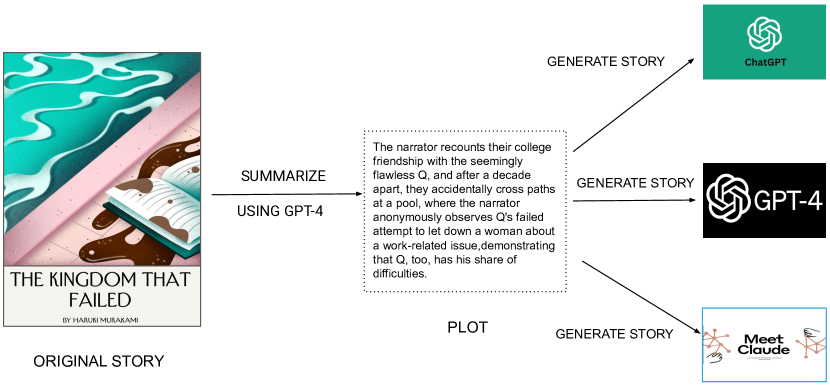
- Use Consensual Assessment Technique with 10 expert raters to evaluate 48 stories (12 professional, 36 LLM-generated).
- Analyze inter-rater agreement (Fleiss Kappa) and aggregate correlations (Pearson) to validate TTCW.
- Compare LLM-generated stories against expert-written ones across tests to quantify pass rates (e.g., 84.7% vs. 9–30%).
- Experiment with LLMs as TTCW assessors to measure correlation with expert judgments.
실험 결과
연구 질문
- RQ1RQ1: Is TTCW-based creativity evaluation consistent and reproducible among experts?
- RQ2RQ2: Do expert-written stories pass TTCW tests more often than LLM-generated stories, and which tests show largest gaps?
- RQ3RQ3: Do different LLMs differ in passing TTCW tests, and are there dimension-specific strengths?
- RQ4RQ4: Can LLMs reliably assess TTCW tests, i.e., do their judgments correlate with expert judgments?
주요 결과
- Experts show moderate agreement on individual TTCW tests (Fleiss Kappa ~0.41) and strong agreement when aggregating all tests (Pearson ~0.69).
- Expert-written stories pass an average of 84.7% of TTCW tests, while ChatGPT-generated stories pass ~9% and Claude-generated stories pass ~30%.
- LLMs exhibit dimension-specific strengths (GPT-4 favors Originality; Claude v1.3 favors Fluency, Flexibility, Elaboration).
- LLMs as TTCW assessors largely fail to correlate with expert judgments (correlations near zero).
- The TTCW framework is additive across tests; higher overall pass counts indicate greater perceived creativity.
이 논문 읽기
누빈트 뷰어에서 원문을 열고, 읽으면서 궁금한 곳을 바로 물어보세요.
누빈트에서 이 논문 읽기이 리뷰는 AI가 논문 원문을 바탕으로 만들었습니다. 인용하기 전에 원문을 확인해 주세요.