
[논문 리뷰] Beyond Adapting SAM: Towards End-to-End Ultrasound Image Segmentation via Auto Prompting
SAMUS는 병렬 CNN 인코더, 어댑터, 그리고 교차 분기 주의를 도입하여 엔드-투-엔드 초음파 분할의 일반화 향상과 배포 비용 감소를 가능하게 하며, US30K에서 시연한다.
End-to-end medical image segmentation is of great value for computer-aided diagnosis dominated by task-specific models, usually suffering from poor generalization. With recent breakthroughs brought by the segment anything model (SAM) for universal image segmentation, extensive efforts have been made to adapt SAM for medical imaging but still encounter two major issues: 1) severe performance degradation and limited generalization without proper adaptation, and 2) semi-automatic segmentation relying on accurate manual prompts for interaction. In this work, we propose SAMUS as a universal model tailored for ultrasound image segmentation and further enable it to work in an end-to-end manner denoted as AutoSAMUS. Specifically, in SAMUS, a parallel CNN branch is introduced to supplement local information through cross-branch attention, and a feature adapter and a position adapter are jointly used to adapt SAM from natural to ultrasound domains while reducing training complexity. AutoSAMUS is realized by introducing an auto prompt generator (APG) to replace the manual prompt encoder of SAMUS to automatically generate prompt embeddings. A comprehensive ultrasound dataset, comprising about 30k images and 69k masks and covering six object categories, is collected for verification. Extensive comparison experiments demonstrate the superiority of SAMUS and AutoSAMUS against the state-of-the-art task-specific and SAM-based foundation models. We believe the auto-prompted SAM-based model has the potential to become a new paradigm for end-to-end medical image segmentation and deserves more exploration. Code and data are available at https://github.com/xianlin7/SAMUS.
연구 동기 및 목표
- 일반적이면서도 임상적으로 친근한 초음파 분할의 동기를 부여한다.
- SAM의 기반을 활용하되 의학 도메인 한계를 해결한다.
- 초음파 대상의 지역 세부 정보 포착 및 경계 구분을 개선한다.
- GPU 요구를 줄이고 입문 수준의 하드웨어에서 배포를 가능하게 한다.
제안 방법
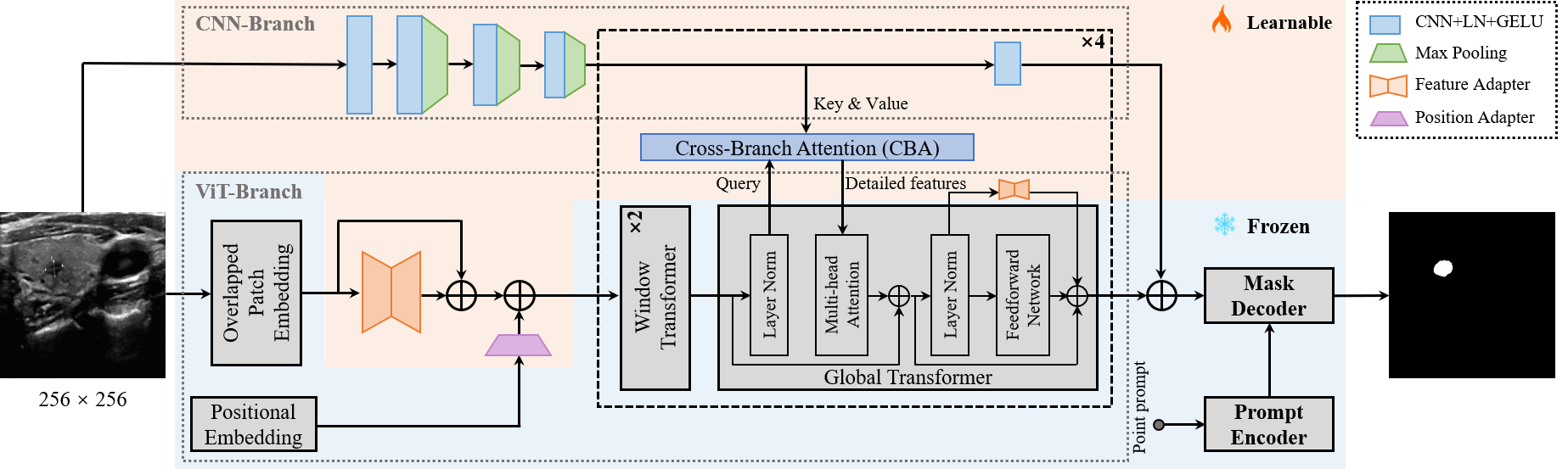
- SAM의 프롬프트 인코더와 마스크 디코더를 유지하되 영상 인코더를 의학용으로 수정한다.
- 교차-분기 주의를 통해 로컬 특징을 주입하기 위해 병렬 CNN 분기를 추가한다.
- 의학 도메인과 작은 입력에 ViT를 적응시키기 위해 위치 어댑터와 다섯 개의 특징 어댑터를 도입한다.
- 경계 정보를 보존하기 위해 중첩 패치 임베딩을 구현한다.
- 핵심 SAM 구성 요소를 고정하고 어댑터, CNN 분기, 교차-분기 주의와 함께 학습하되, 단일 포인트 양성 프롬프트를 사용하는 Dice + BCE 손실을 사용한다.
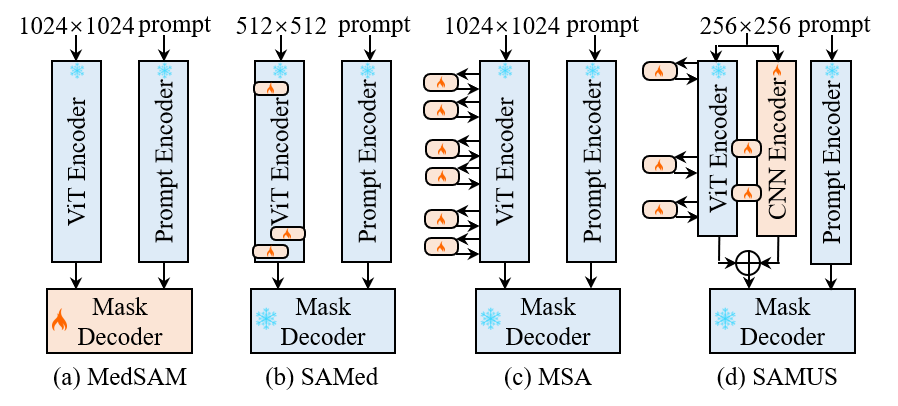
실험 결과
연구 질문
- RQ1SAM을 전체 모델 재학습 없이 초음파 분할에 효과적으로 적응시키는가?
- RQ2로컬 특징 통합과 컴팩트 어댑터가 초음파 이미지의 경계 보존과 작은 객체 분할을 개선하는가?
- RQ3SAMUS가 본 데이터에서와 보지 못한 데이터에서 태스크 특화 모델 및 다른 기반 모델과 비교하여 어떤 성능을 보이는가?
주요 결과
- SAMUS는 TN3K, BUSI, CAMUS-LV, CAMUS-MYO, CAMUS-LA에서 최첨단 태스크 특화 방법보다 더 높은 평균 Dice 점수를 달성한다(평균 Dice: 84.45%, 85.77%, 93.73%, 87.46%, 91.58%).
- 기반 모델과의 비교에서 SAMUS는 시각 가능한 데이터에서 일관되게 우수한 Dice 점수(예: 83.05–93.73 범위)를 제공하고, 보지 못한 데이터에 대한 일반화도 더 좋다(예를 들어 보지 않은 데이터에서 기준 대비 평균 이득).
- 절삭(ablation) 분석은 네 가지 구성요소(CNN 분기, 교차 분기 주의, 특징 어댑터, 위치 어댑터) 모두 성능에 기여하며, 위치 어댑터 하나만으로도 여러 데이터셋에서 Dice를 크게 향상시킨다.
- SAMUS는 전체 SAM 학습의 GPU 메모리 비용을 약 28%로 줄이고 추론 시 약 3배 빠르게 실행되며 분할과 일반화를 유지하거나 향상시킨다.
이 논문 읽기
누빈트 뷰어에서 원문을 열고, 읽으면서 궁금한 곳을 바로 물어보세요.
누빈트에서 이 논문 읽기이 리뷰는 AI가 논문 원문을 바탕으로 만들었습니다. 인용하기 전에 원문을 확인해 주세요.