
[논문 리뷰] Chain of History: Learning and Forecasting with LLMs for Temporal Knowledge Graph Completion
이 논문은 구조 인지 히스토리와 역-논리 프롬프트를 활용하여 시간적 지식 그래프 보완을 수행하는 PEFT-미세조정 LLM 프레임워크를 제시하며, ICEWS 및 YAGO 데이터세트에서 임베딩 기반 및 다른 LLM 접근법과 비교하여 경쟁력 있는 결과를 달성한다.
Temporal Knowledge Graph Completion (TKGC) is a complex task involving the prediction of missing event links at future timestamps by leveraging established temporal structural knowledge. This paper aims to provide a comprehensive perspective on harnessing the advantages of Large Language Models (LLMs) for reasoning in temporal knowledge graphs, presenting an easily transferable pipeline. In terms of graph modality, we underscore the LLMs' prowess in discerning the structural information of pivotal nodes within the historical chain. As for the generation mode of the LLMs utilized for inference, we conduct an exhaustive exploration into the variances induced by a range of inherent factors in LLMs, with particular attention to the challenges in comprehending reverse logic. We adopt a parameter-efficient fine-tuning strategy to harmonize the LLMs with the task requirements, facilitating the learning of the key knowledge highlighted earlier. Comprehensive experiments are undertaken on several widely recognized datasets, revealing that our framework exceeds or parallels existing methods across numerous popular metrics. Additionally, we execute a substantial range of ablation experiments and draw comparisons with several advanced commercial LLMs, to investigate the crucial factors influencing LLMs' performance in structured temporal knowledge inference tasks.
연구 동기 및 목표
- 대형 언어 모델(LLMs)을 사용하여 시간적 지식 그래프(TKGs)에 대한 효과적 추론을 촉진하고 가능하게 한다.
- 역사적 그래프 정보를 TKGC에 통합하는 이전 가능하고 구조 인지 프레임워크를 개발한다.
- 미세조정 중 역-논리 프롬프트를 통해 LLM 기반 구조적 추론의 역전 효과를 완화한다.
- TKGC 작업에 LLM을 맞추기 위한 매개변수 효율적인 미세조정(PEFT)을 입증한다.
- 기존 TKGC 방법 및 상용 LLM과의 포괄적 고찰 및 기존 방법과의 비교를 제공한다.
제안 방법
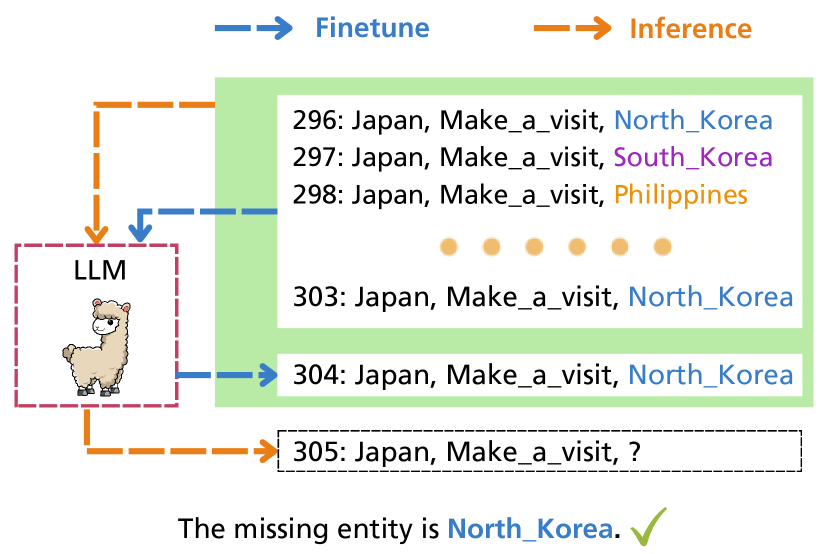
- 스키마 매칭 히스토리, 엔티티 보강 히스토리, 및 관계 보강 히스토리를 결합하여 LLM 추론을 보조하는 구조 보강 히스토리 모델링.
- 세 가지 프롬프트 전략(일반형, 텍스트 인식형, 위치 인식형)을 통해 미세조정 중 역 논리를 도입하여 구조적 추론의 역전 문제를 완화한다.
- LoRA 기반 PEFT를 사용한 지시 미세조정을 통해 기본 모델을 고정한 채 소량의 매개변수만 업데이트한다.
- 빔 탐색 디코딩을 통해 후보 해답 시퀀스를 생성하고 가장 높은 확률 시퀀스를 선택하여 LLM으로 예측한다.
- 맥락 제공을 위한 역사적 체인(L)의 사용 및 다른 데이터세트에 대한 최적의 히스토리 길이에 주의한다.
- ICEWS 및 YAGO 데이터세트에서 임베딩 기반 TKGC 모델과 다양한 오픈 소스/상용 LLM에 대한 비교 평가를 수행한다.
실험 결과
연구 질문
- RQ1구조 인지 히스토리와 역-논리 프롬프트를 갖춘 LLM이 확장 가능한 TKGC에서 효과적인 추론 에이전트로 작동할 수 있는가?
- RQ2PEFT(LoRA) 미세조정이 TKGC 태스크에서 전체 매개변수 미세조정과 비교하여 LLM 성능에 어떤 영향을 미치는가?
- RQ3히스토리 보강, 역 데이터, 프롬프트 전략이 순방향 및 역방향(역) 시간 추론에 어떤 영향을 미치는가?
- RQ4모델 크기와 데이터세트 특성이 LLM 기반 TKGC 성능에 어떤 영향을 주며, 상용 LLM과의 비교에서 어떤 차이가 있는가?
주요 결과
- 제안된 프레임워크는 여러 TKGC 벤치마크에서 최첨단 방법과 경쟁력 있거나 더 우수한 성능을 달성한다.
- 구조 기반 히스토리 보강(스키마, 엔티티, 관계 히스토리)이 TKGC에서 순방향 및 역방향 추론을 모두 향상시킨다.
- 미세조정 중 역 논리를 도입하면 역전 저주를 완화하고 일반적으로 순방향 추론을 개선하거나 보존한다.
- LoRA 기반 지시 미세조정은 상대적으로 작은 매개변수 업데이트로 강력한 결과를 낳으며, 더 큰 모델 크기가 반드시 TKGC 성능을 향상시키지 않는다.
- 상용 LLM은 다양한 성능을 보이며, RLHF가 반영된 일부 채팅 모델은 특정 데이터세트에서 기초 모델에 근접하거나 이를 초과할 수 있지만, 다른 데이터세트에서의 성능은 TKGC 특화 모델보다 떨어지는 경우가 있다.
- 데이터세트 전반에 걸쳐 히스토리 길이와 데이터 보강 전략이 성능에 영향을 주며, 일부 데이터세트에서 히스토리가 너무 길어지면 수익 감소 또는 악화가 나타난다.

이 논문 읽기
누빈트 뷰어에서 원문을 열고, 읽으면서 궁금한 곳을 바로 물어보세요.
누빈트에서 이 논문 읽기이 리뷰는 AI가 논문 원문을 바탕으로 만들었습니다. 인용하기 전에 원문을 확인해 주세요.