
[논문 리뷰] Charge Transfer and Zhang-Rice Singlet Bands in the Nickelate Superconductor $\mathrm{La_3Ni_2O_7}$ under Pressure
저자들은 압력 하에서 La3Ni2O7에 대한 11-band Hubbard 모델을 determinant quantum Monte Carlo 및 cellular dynamical mean-field theory를 사용해 연구하여 서로 다른 구멍 분포를 가진 두 개의 스핀-싱귤렛 밴드를 밝히고, 저에너지 물리를 위한 네-band t-J 모델을 제안한다.
Recently, a bulk nickelate superconductor $\mathrm{La_3Ni_2O_7}$ is discovered at pressures with a remarkable high transition temperature $T_c \sim 80K$. Here, we study a Hubbard model with tight-binding parameters derived from extit{ab initio} calculations of $\mathrm{La_3Ni_2O_7}$, by employing large scale determinant quantum Monte Carlo and cellular dynamical mean-field theory. Our result suggests that the superexchange couplings in this system are comparable to that of cuprates. The system is a charge transfer insulator as hole concentration becomes four per site at large Hubbard $U$. Upon hole doping, two low-energy spin-singlet bands emerge in the system exhibiting distinct correlation properties: while the one composed of the out-of-plane Ni-$d_{3z^2-r^2}$ and O-$p_z$ orbitals demonstrates strong antiferromagnetic correlations and narrow effective bandwidth, the in-plane singlet band consisting of the Ni-$d_{x^2-y^2}$ and O-$p_x / p_y$ orbitals is in general more itinerant. Over a broad range of hole doping, the doped holes occupy primarily the $d_{x^2-y^2}$ and $p_x / p_y$ orbitals, whereas the $d_{3z^2-r^2}$ and $p_z$ orbitals retain underdoped. We propose an effective $ t-J$ model to capture the relevant physics and discuss the implications of our result for comprehending the $\mathrm{La_3Ni_2O_7}$ superconductivity.
연구 동기 및 목표
- 압력 하에서 La3Ni2O7의 자기 교환과 구멍 분포를 조사하여 고온 초전도 현상의 이해를 동력화한다.
- 초교환 결합을 결정하고 이를 구파트와의 유사성으로 평가한다.
- 반강성 채움에서의 궤도 해석 구멍 분포와 절연성의 성격을 특징짓는다.
- 저에너지에서의 스핀-싱귤렛 밴드와 그 상관 특성을 식별한다.
- 압력 하에서 La3Ni2O7에 대한 유효한 저에너지 네-밴드 t-J 모델을 제안한다.
제안 방법
- Ni 3d 및 O 2p 궤도를 포함하는 ab initio 다운폴딩 파라미터를 갖는 11-band Hubbard 모델을 활용한다.
- 스핀 상관관계와 구멍 농도를 계산하기 위해 determinant quantum Monte Carlo (DQMC)를 사용한다.
- 자체에너지와 스펙트ral 정보를 얻기 위해 cellular dynamical mean-field theory (CDMFT)를 적용한다.
- 층 간 및 층 내 초교환 결합의 상대 강도를 추출하기 위해 스핀 상관관계를 분석한다.
- Zhang-Rice 유사 밴드의 출현을 추적하고 국부 상태 밀도를 계산한다.
- 주도하는 교환 상호작용을 포착하는 유효한 네-밴드 t-J 모델을 제안한다.
실험 결과
연구 질문
- RQ1압력 하에서 La3Ni2O7의 지배적 자기 교환 결합은 무엇이며 그것들이 구파트와 어떻게 비교되는가?
- RQ2Half-filling에서와 멀어졌을 때 Ni d 및 O p 궤도 간의 구멍 분포는 어떻게 변하며 저에너지 밴드의 성격은 무엇인가?
- RQ3ZRS 유사 밴드가 나타나는가, 그리고 평면 및 비평면 궤도 간의 특성은 어떻게 다른가?
- RQ4저에너지에서의 유효한 t-J 모델이 시스템의 주요 물리 현상을 포착할 수 있는가?
주요 결과
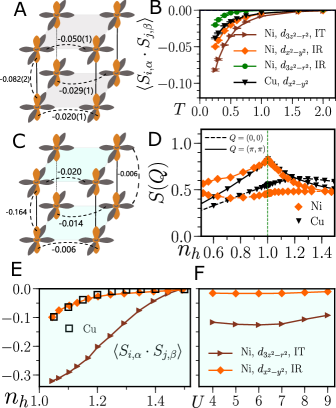
- 층 간 d3z^2-r^2–d3z^2-r^2 반강체(antiferromagnetic) 교환이 차수에서 우세하며, 평면 d_x^2−y^2–d_x^2−y^2 교환은 상당하나 약하다.
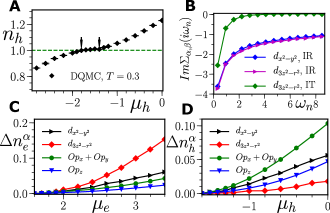
- 구멍 도핑 시 두 개의 스핀-싱귤렛 밴드가 나타나며 서로 다른 상관 특성을 보인다: 바람직하게 좁고 강하게 상관된 비평면(out-of-plane) 밴드(d3z^2−r^2, pz)와 더 많이 이동하는 평면(in-plane) 싱글렛 밴드(d_x^2−y^2, px/py).
- 구멍 도핑은 평면 궤도(d_x^2−y^2 및 px/py)에 집중되는 반면 비평면 궤도(d3z^2−r^2 및 pz)은 저도핑 상태로 남아 궤도 차별화가 강함.
- 시스템은 한가득에서 전하-전이 절연체로 행동하며(사이트당 네 개의 구멍), 구멍은 주로 O 2p 궤도에 들어가 ZAanen-Sawatzky-Allen 전하-전이 물리와 일치한다.
- 평면의 ZRS-유사 밴드는 비평면 싱귤렛 밴드보다 더 이동성이 있어 두 밴드가 잠재적 초전도성에서 서로 다른 수송 및 상관 역할을 한다는 것을 시사한다.
- 저에너지 물리를 포착하기 위해 La3Ni2O7의 압력 하에서 주요 교환 상호작용과 저에너지 물리를 포괄하는 유효한 네-밴드 t-J 모델을 제안한다.
더 나은 연구,지금 바로 시작하세요
연구 설계부터 논문 작성까지, 연구 시간을 획기적으로 줄여보세요.
카드 등록 없음 · 무료 플랜 제공
이 리뷰는 AI가 만들고, 인간 에디터가 검토했습니다.