
[논문 리뷰] Circumstellar interaction signatures in the low luminosity type II SN 2021gmj
이 연구는 저광도 Type II 초신성 SN 2021gmj의 다중 파장 관측을 통해 초기 광도곡선의 이질성과 고이온화 방출선을 통한 원형성물질 상호작용을 규명한다. 유체역학적 모델링과 스펙트로스코픽 분석 결과, 원형성물질 질량은 0.025 M☉이며, 원형성물질의 기원은 약 10 M☉의 질량을 지닌 중간 에너지 폭발로 추정되며, 이는 저광도 SNe II에서 이러한 상호작용 서식이 흔할 수 있음을 시사한다.
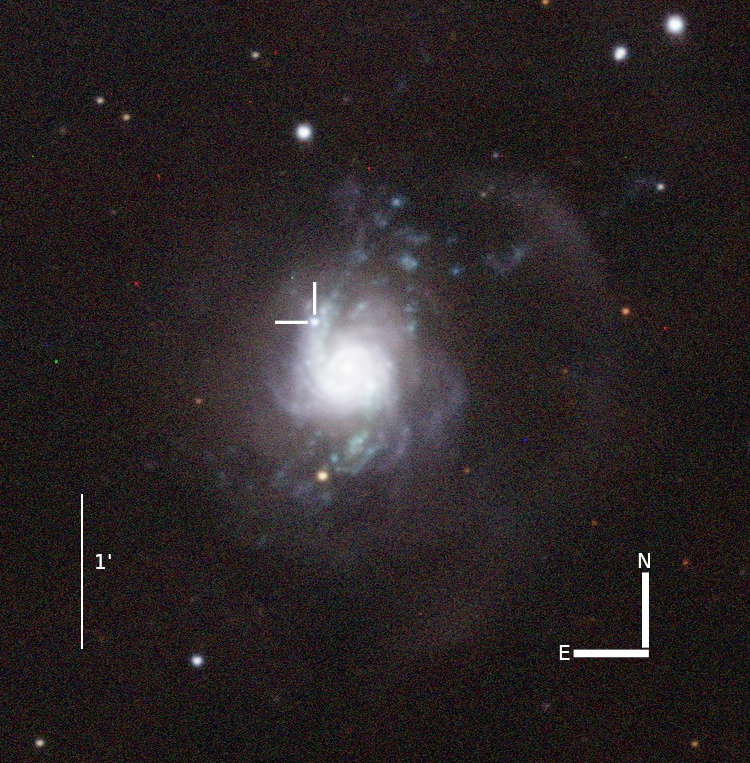
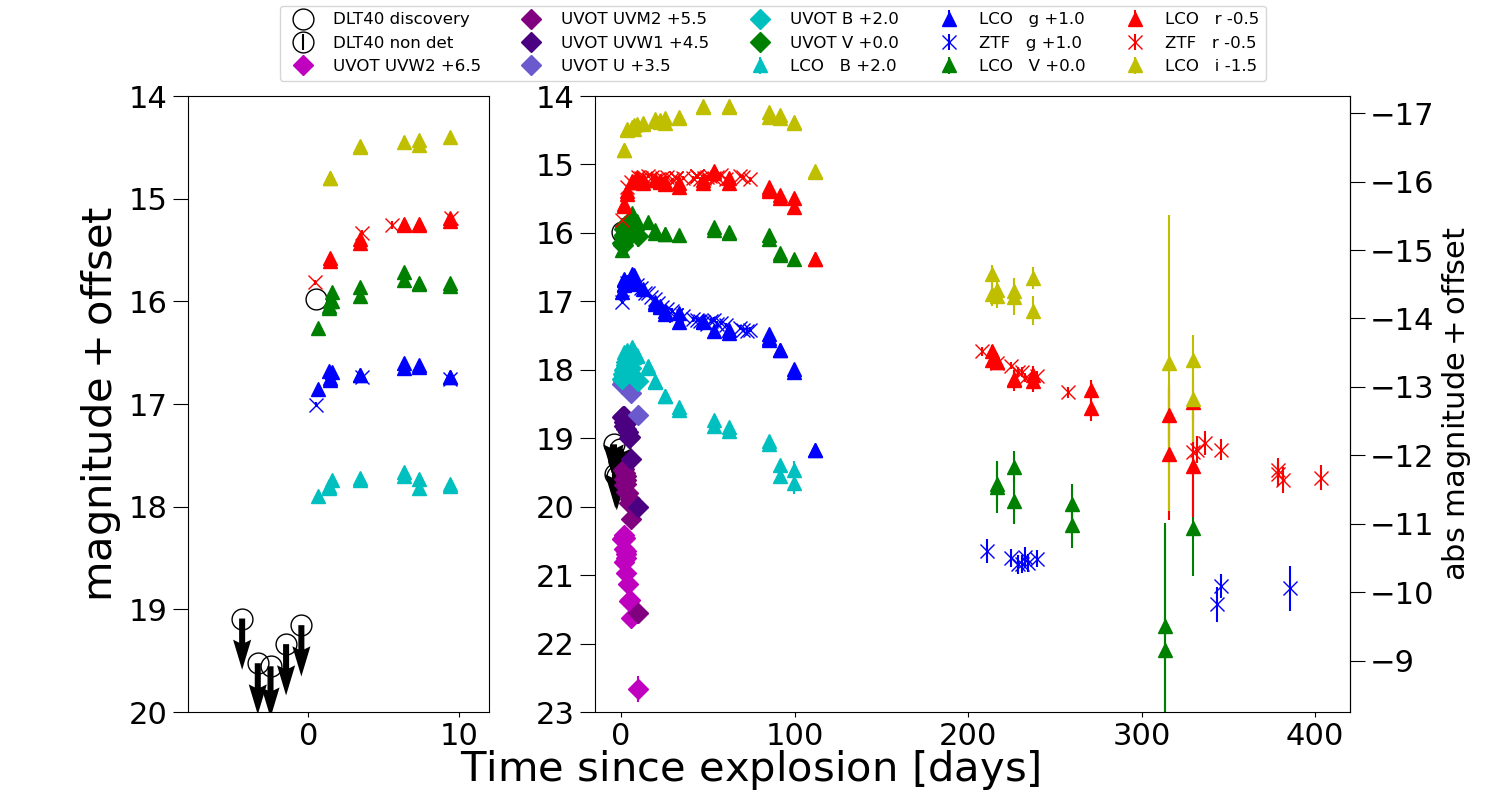
We present comprehensive optical observations of SN~2021gmj, a Type II supernova (SN~II) discovered within a day of explosion by the Distance Less Than 40~Mpc (DLT40) survey. Follow-up observations show that SN~2021gmj is a low-luminosity SN~II (LL~SN~II), with a peak magnitude $M_V = -15.45$ and Fe~II velocity of $\sim 1800 \ \mathrm{km} \ \mathrm{s}^{-1}$ at 50 days past explosion. Using the expanding photosphere method, we derive a distance of $17.8^{+0.6}_{-0.4}$~Mpc. From the tail of the light curve we obtain a radioactive nickel mass of $0.014 \pm 0.001$ M$_{\odot}$. The presence of circumstellar material (CSM) is suggested by the early-time light curve, early spectra, and high-velocity H$α$ in absorption. Analytical shock-cooling models of the light curve cannot reproduce the fast rise, supporting the idea that the early-time emission is partially powered by the interaction of the SN ejecta and CSM. The inferred low CSM mass of 0.025 M$_{\odot}$ in our hydrodynamic-modeling light curve analysis is also consistent with our spectroscopy. We observe a broad feature near 4600 Å, which may be high-ionization lines of C, N, or/and He~II. This feature is reproduced by radiation-hydrodynamic simulations of red supergiants with extended atmospheres. Several LL~SNe~II show similar spectral features, implying that high-density material around the progenitor may be common among them.
연구 동기 및 목표
- 저광도 Type II 초신성 SN 2021gmj의 광도 및 스펙트럼적 변화를 규명하기 위해.
- 광도곡선 및 스펙트럼 분석을 통해 원형성물질 기원 성운의 존재와 특성을 조사하기 위해.
- 유체역학적 모델링과 확장된 표면 온도 방법을 통해 기원 성운 질량, 폭발 에너지, 56Ni 질량을 결정하기 위해.
- 스펙트럼에서 관측된 고이온화 방출 특징이 저광도 SNe II에서 광범위한 원형성물질 상호작용을 나타내는지 탐색하기 위해.
제안 방법
- DLT40, Keck, MMT, Las Cumbres Observatory 등 여러 관측소에서 확보한 광도곡선 데이터를 활용하여 초기 충격 냉각 및 평탄기 단계를 모델링하기 위해.
- LRIS, DEIMOS, Binospec, FLOYDS 기구에서 확보한 스펙트로스코픽 데이터를 사용하여 고이온화 선을 식별하고 속도 이동을 측정하기 위해.
- 확장된 표면 온도 방법을 적용하여 V-대역 magnitude와 표면 온도를 기반으로 거리 17.8⁺⁰.⁶₋₀.⁴ Mpc를 유도하기 위해.
- 광도곡선 尾부에서 방사성 ⁵⁶Ni 질량을 추정하여 M₅₆Ni = 0.014 ± 0.001 M☉를 산출하기 위해.
- SNEC를 사용한 유체역학적 모델링을 통해 일정한 풍성 원형성물질 CSM를 가정하여 광도곡선에 적합시키고, CSM 질량과 폭발 에너지를 추론하기 위해.
- 확장된 대기층을 가진 빨간 초거성의 복사 유체역학적 시뮬레이션을 4600 Å의 넓은 특징과 비교하여 그 기원을 해석하기 위해.
실험 결과
연구 질문
- RQ1SN 2021gmj의 기원 성운 주변 원형성물질(CSM)의 성격과 질량은 무엇인가요?
- RQ2SN 2021gmj의 초기 광도곡선은 표준 충격 냉각 모델과 어떻게 다를까요? 이는 에너지원에 대해 어떤 시사점을 제공합니까?
- RQ34600 Å 근처의 넓은 방출 특징은 무엇으로 인해 발생하며, C, N 또는 He II의 고이온화 선 블렌드와 일치합니까?
- RQ4저광도 Type II 초신성에서 원형성물질 상호작용 서식이 흔한가요?
- RQ5SN 2021gmj의 기원 성운 질량과 폭발 에너지는 무엇이며, 기존 모델과 비교해 봤을 때 어떻게 다릅니까?
주요 결과
- SN 2021gmj는 V-대역 최대 등급이 MV = -15.45로, 저광도 Type II 초신성로 분류된다.
- 폭발 과정에서 생성된 56Ni 질량은 0.014 ± 0.001 M☉로, 저에너지 및 중간 질량 기원 성운 모델과 일치한다.
- SN 2021gmj까지의 거리는 확장된 표면 온도 방법을 통해 17.8⁺⁰.⁶₋₀.⁴ Mpc로 유도되었다.
- 초기 광도곡선 모델링 결과, 표준 충격 냉각 모델과 일치하지 않는 빠른 상승이 관측되어 원형성물질 상호작용에 의한 에너지 공급을 지지한다.
- 유체역학적 모델링 결과, 10 M☉ 기원 성운에 대해 CSM 질량은 0.025 M☉, 폭발 에너지는 0.294 foe로 산출되었다.
- 4600 Å 근처의 넓은 특징은 고이온화 선(C, N, He II)의 가능성이 높은 블렌드로 식별되었으며, 원형성물질이 존재하는 확장된 빨간 초거성의 복사 유체역학적 시뮬레이션과 일치한다.
이 논문 읽기
누빈트 뷰어에서 원문을 열고, 읽으면서 궁금한 곳을 바로 물어보세요.
누빈트에서 이 논문 읽기이 리뷰는 AI가 논문 원문을 바탕으로 만들었습니다. 인용하기 전에 원문을 확인해 주세요.