
[논문 리뷰] CRIRES$^+$ transmission spectroscopy of WASP-127b. Detection of the resolved signatures of a supersonic equatorial jet and cool poles in a hot planet
이 연구는 핫 젠더 WASP-127b의 고해상도 CRIRES+ K밴드 투과 스펙트로스코피를 사용하여 공간적으로 분리된 대기 비균일성을 탐지하고, 초음속 적도 바람과 냉각된 극지역을 규명한다. 교차상관 신호에 2차원 베이지안 추정 모델을 적용함으로써 오전과 저녁 퇴적선에서 별개의 속도 이동을 식별하여, 적도 바람 속도는 9.3 ± 0.2 km s⁻¹이며, 퇴적선 간의 온도 차이는 175 K이다. 극지역의 신호가 둔한 것은 온도가 낮거나 고층 구름층이 있음을 시사한다.
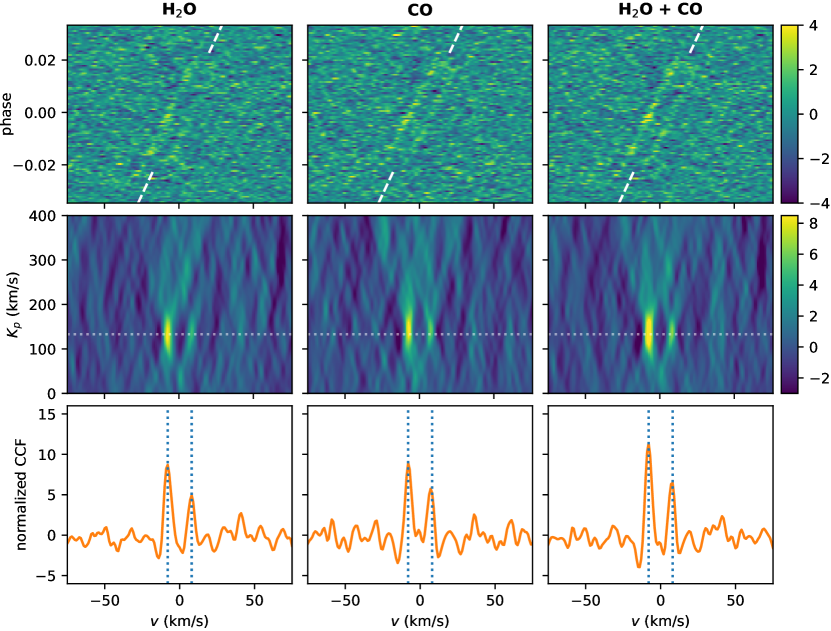
General circulation models of gas giant exoplanets predict equatorial jets that drive inhomogeneities in the atmospheric physical parameters across the planetary surface. We studied the transmission spectrum of the hot Jupiter WASP-127\,b during one transit in the K band with CRIRES$^+$. Telluric and stellar signals were removed from the data using SYSREM. The planetary signal was investigated using the cross-correlation technique. After detecting a spectral signal indicative of atmospheric inhomogeneities, we employed a Bayesian retrieval framework with a 2D modelling approach tailored to address this scenario. We detected strong signals of H$_2$O and CO, which exhibited not one but two distinct cross-correlation peaks. The double-peaked signal can be explained by a supersonic equatorial jet and muted signals at the planetary poles, with the two peaks representing the signals from the planet's morning and evening terminators. We calculated a jet velocity of $7.7\pm0.2$ km~s$^{-1}$ and derive distinct atmospheric properties for the two terminators as well as the polar region. Our retrieval yields a solar C/O ratio and metallicity and challenges previous studies of WASP-127b's atmosphere. It provides tentative evidence for the morning terminator to be cooler than the evening terminator by $-175^{+133}_{-117}$K and shows that the muted signals from the poles can be explained by either significantly lower temperatures or a high cloud deck. The presence of a clear double-peaked signal highlights the importance of taking planetary 3D structure into account during interpretation of atmospheric signals. The supersonic jet velocity and lack of signal from the polar regions, representing a detection of latitudinal inhomogeneity in a spatially unresolved target, showcases the power of high-resolution transmission spectroscopy for the characterisation of global circulation in exoplanet atmospheres.
연구 동기 및 목표
- 고해상도 투과 스펙트로스코피를 활용하여 핫 젠더 WASP-127b의 대기 비균일성을 조사한다.
- 적도 바람과 행성 위도에 따른 온도 변화와 같은 전역 대기 순환 특징을 탐지하고 특성화한다.
- 속도 해상도를 갖춘 스펙트럼 신호를 통해 오전 및 저녁 퇴적선, 극지역과 같은 다양한 대기 영역의 기여를 해명한다.
- 수소/산소 비율 및 금속성 농도와 같은 회수된 대기 파라미터가 태양 값과 일치하는지 테스트한다.
- 관측적 제약 조건을 제공함으로써 3차원 일반 대기순환모델(GCMs)을 검증한다.
제안 방법
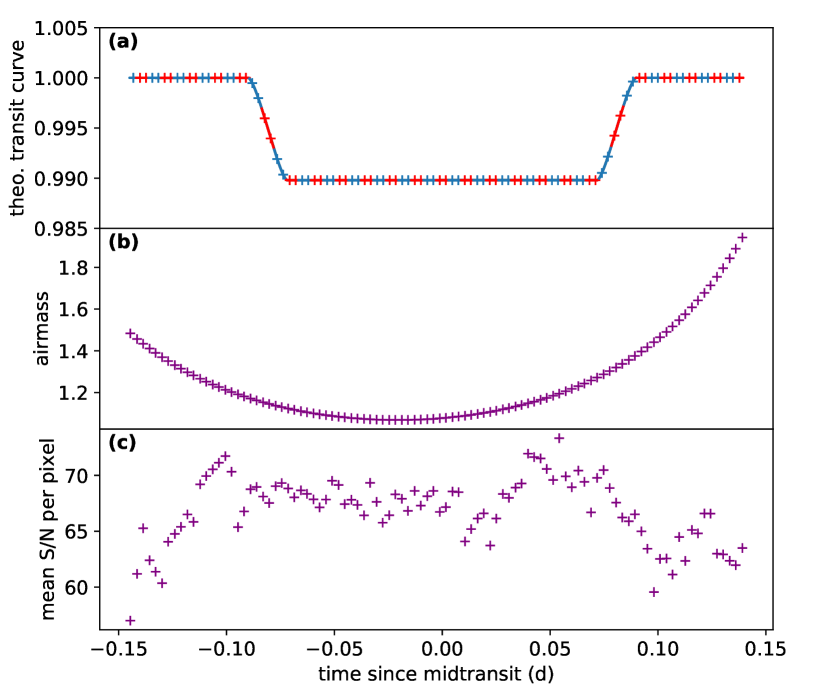
- WASP-127b의 단일 전행을 대상으로 VLT의 CRIRES+ 기구를 사용하여 고해상도 K밴드 투과 스펙트로스코피를 확보하였다.
- 지구 대기 및 항성 오염을 제거하기 위해 SYSREM 알고리즘을 사용하여 행성 대기 신호를 고립시켰다.
- 분자 종류(H₂O 및 CO)를 도플러 시프트 속도 프로파일을 통해 탐지하기 위해 교차상관 기법을 적용하였다.
- 오전 퇴적선, 저녁 퇴적선, 극지역 각각에 대해 별개의 대기 특성을 모델링하기 위해 2차원 베이지안 추정 프레임워크를 개발하였다.
- 속도에 의존하는 신호 커널을 고려함으로써 다양한 행성 경도 및 위도에서 기인한 별개의 대기 기여를 해명할 수 있었다.
- 파ipel린 검출 불확실성의 체계적 과대평가를 교정하기 위해 오차 스케일링을 β 계수 0.6089 ± 0.0004로 校정하였다.
실험 결과
연구 질문
- RQ1고해상도 투과 스펙트로스코피는 조우된 외계행성의 서로 다른 경도(오전 vs. 저녁 퇴적선)에서 기인한 별개의 대기 신호를 해명할 수 있는가?
- RQ2WASP-127b 대기 중 적도 바람의 속도와 구조는 어떠한가, 그리고 이는 행성의 자전 속도보다 초음속인가?
- RQ3오전 퇴적선, 저녁 퇴적선, 극지역 간의 온도와 화학 농도는 어떻게 다를까?
- RQ4행성 극지역의 둔한 스펙트럼 신호의 원인은 무엇이며, 저온 또는 고고도 구름층에 의해 설명될 수 있는가?
- RQ5수소/산소 비율 및 금속성 농도와 같은 회수된 대기 파라미터는 태양 값과 일치하는가, 이는 이 행성에서 CO의 이전 비검출을 도전하는가?
주요 결과
- 이 연구는 WASP-127b 대기 중에서 CO를 처음으로 확실하게 탐지하여 이전 비검출과의 오랜 모순을 해결한다.
- 0 km s⁻¹에서의 신호 없이 ±8 km s⁻¹에서 두 개의 별개의 교차상관 피크가 관측되어, 9.3 ± 0.2 km s⁻¹의 회수된 적도 바람 속도를 가진 초음속 적도 바람이 존재함을 시사한다.
- 적도 바람 속도는 예상되는 조우된 자전 속도보다 약 6배 빠른 초음속 유동임을 시사한다.
- 저녁 퇴적선은 오전 퇴적선보다 175⁺¹¹⁶₋₁₃₃ K 높은 온도를 보이며, 강한 경도 온도 비대칭성을 나타낸다.
- 극지역은 둔한 스펙트럼 신호를 보이며, 이는 상당히 낮은 온도 또는 고고도 구름층이 투과를 차단하기 때문으로 가장 잘 설명된다.
- 회수된 C/O 비율과 금속성 농도는 태양 값과 일치하며, 이는 행성 대기 화학을 설명하기 위해 특수한 형성 역사를 요구하지 않음을 시사한다.
이 논문 읽기
누빈트 뷰어에서 원문을 열고, 읽으면서 궁금한 곳을 바로 물어보세요.
누빈트에서 이 논문 읽기이 리뷰는 AI가 논문 원문을 바탕으로 만들었습니다. 인용하기 전에 원문을 확인해 주세요.