
[논문 리뷰] DEDGAT: Dual Embedding of Directed Graph Attention Networks for Detecting Financial Risk
이 논문은 금융 리스크 탐지에 적합한 방향성 그래프에서 진입도 및 진출도 표현을 명시적으로 모델링하는 이중 임bedding 그래프 신경망인 DEDGAT을 제안한다. 들어오는 간선과 나가는 간선에 대한 주의 계산을 분리함으로써 표준 GAT의 방향성 편향을 완화하고, GNNExplainer 시각화를 통해 해석 가능성까지 향상시켜 금융 리스크 데이터셋에서 최고 성능을 달성한다.
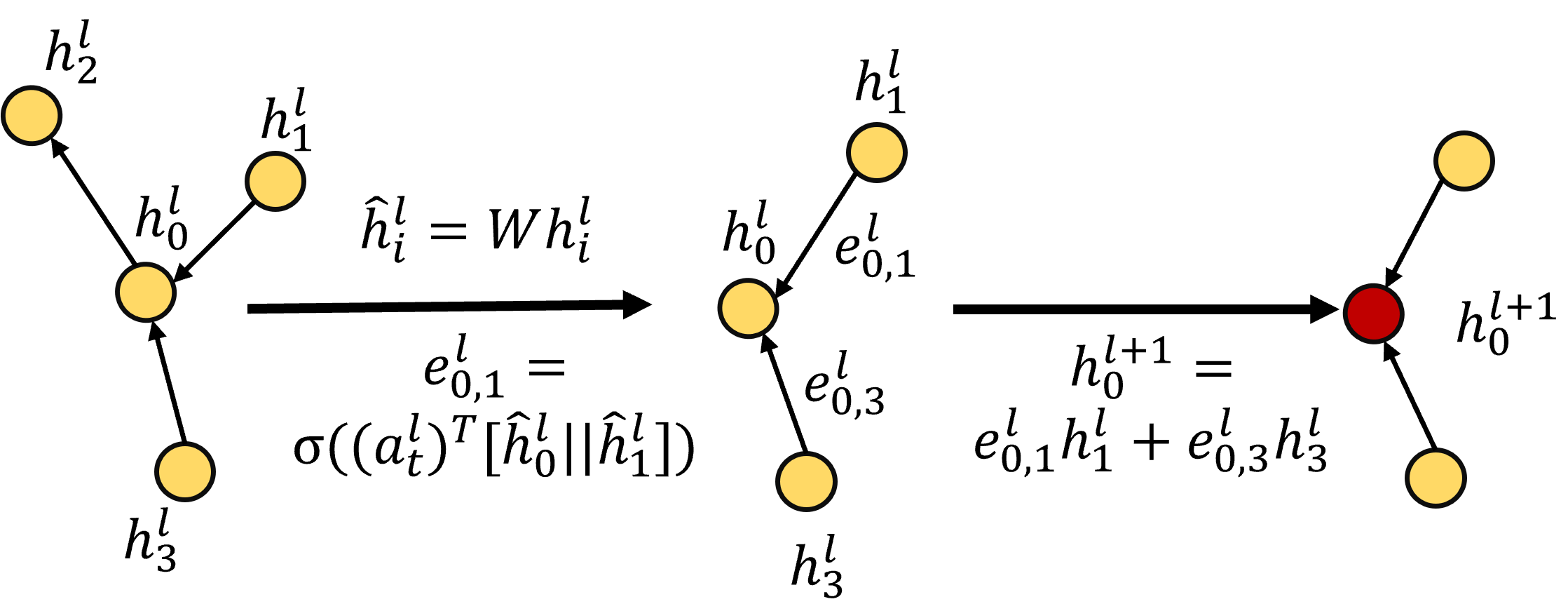
Graph representation plays an important role in the field of financial risk control, where the relationship among users can be constructed in a graph manner. In practical scenarios, the relationships between nodes in risk control tasks are bidirectional, e.g., merchants having both revenue and expense behaviors. Graph neural networks designed for undirected graphs usually aggregate discriminative node or edge representations with an attention strategy, but cannot fully exploit the out-degree information when used for the tasks built on directed graph, which leads to the problem of a directional bias. To tackle this problem, we propose a Directed Graph ATtention network called DGAT, which explicitly takes out-degree into attention calculation. In addition to having directional requirements, the same node might have different representations of its input and output, and thus we further propose a dual embedding of DGAT, referred to as DEDGAT. Specifically, DEDGAT assigns in-degree and out-degree representations to each node and uses these two embeddings to calculate the attention weights of in-degree and out-degree nodes, respectively. Experiments performed on the benchmark datasets show that DGAT and DEDGAT obtain better classification performance compared to undirected GAT. Also,the visualization results demonstrate that our methods can fully use both in-degree and out-degree information.
연구 동기 및 목표
- 방향성 그래프에 적용된 그래프 주의망(GAT)에서 발생하는 방향성 편향 문제를 해결하기 위해.
- 진입도 및 진출도 정보를 명시적으로 구분함으로써 방향성 그래프 구조의 표현을 향상시키기 위해.
- 이중 임베딩 기반 기법을 활용해 금융 리스크 탐지 작업에서 모델 성능과 설명 가능성을 향상시키기 위해.
제안 방법
- 진입도 및 진출도 간선에 대한 주의 가중치를 별도로 계산하는 방향성 그래프 주의망(DGAT)을 제안한다.
- 각 노드의 들어오는 연결과 나가는 연결에 대해 별도로 학습하는 이중 노드 임베딩을 도입한다.
- 진입도 및 진출도 이웃에 대해 별개의 주의 메커니즘을 사용함으로써 방향성 정보의 균형 잡힌 집합을 가능하게 한다.
- 핵심 간선에서의 주의 분포를 시각화하고 검증하기 위해 GNNExplainer를 적용한다.
- 중요도 점수를 비교하기 위해 임계값 기반 통계 분석(λ = 0.5)을 사용한다.
- 성능 검증과 편향 완화를 위해 세 가지 벤치마크 금융 리스크 제어 데이터셋에서 학습 및 평가를 수행한다.
실험 결과
연구 질문
- RQ1표준 GAT은 방향성 금융 거래 그래프에서 어떻게 작동하며, 주의 메커니즘에서 어떤 방향성 편향이 나타나는가?
- RQ2진입도 및 진출도 주의 계산을 분리하면 그래프 신경망의 리스크 탐지에 있어 방향성 편향을 줄일 수 있는가?
- RQ3이중 임베딩 기법이 방향성 그래프에서 노드 표현 학습 및 후속 분류 성능 향상에 얼마나 기여하는가?
- RQ4실제 금융 리스크 데이터셋에서 DGAT 및 DEDGAT은 GAT에 비해 주의 분포와 특징 중요도 측면에서 어떻게 비교되는가?
- RQ5제안된 모델은 간선 중요도 시각화를 통해 더 나은 설명 가능성과 강건성을 확보할 수 있는가?
주요 결과
- DEDGAT은 세 가지 금융 리스크 제어 벤치마크 데이터셋에서 표준 GAT 및 DGAT을 능가하는 최고 성능을 달성한다.
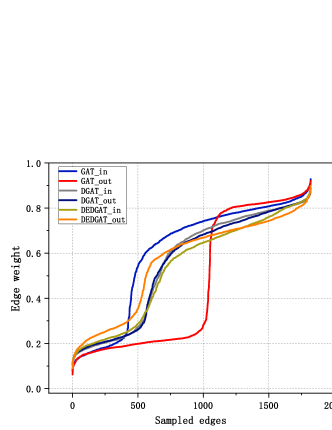
- 간선 가중치 중요도 점수 분포 분석 결과, GAT는 진입도 간선을 1.73배 더 선호하는 편향을 보이며, DEDGAT은 진입도 및 진출도 주의를 균형 있게 유지한다.
- GNNExplainer 시각화 결과, DEDGAT은 GAT가 간과한 네 개의 핵심 진출도 간선을 모두 활용함을 확인하여 모델의 설명 가능성을 향상시켰다.
- DGAT 및 DEDGAT은 진입도 및 진출도 간선 가중치 중 0.5 임계값 이상의 비율이 거의 동일하게 유지되어 균형 잡힌 주의를 보였다.
- DEDGAT의 이중 임베딩 기법은 들어오는 연결과 나가는 연결의 표현을 효과적으로 분리하고 강화함으로써 방향성 편향을 감소시켰다.
- 시각화 및 통계 분석 결과, DEDGAT은 GAT가 진출도 간선을 부족하게 활용하는 것과 달리, 진입도 및 진출도 정보를 모두 효율적으로 활용함을 확인했다.
이 논문 읽기
누빈트 뷰어에서 원문을 열고, 읽으면서 궁금한 곳을 바로 물어보세요.
누빈트에서 이 논문 읽기이 리뷰는 AI가 논문 원문을 바탕으로 만들었습니다. 인용하기 전에 원문을 확인해 주세요.