
[논문 리뷰] Deep Reinforcement Learning for Traffic Light Control in Intelligent Transportation Systems
요약: 이 논문은 단일 교차로와 격자 네트워크에서 DRL 기반 교통 신호 제어를 연구하며, DQN이 단일 교차로에서 최적 제어를 산출하는 반면 DDPG는 격자에서 emergent greenwave 행동을 유도하고, 지정된 모델 하에서 확장성과 정책 최적화를 보인다.
Smart traffic lights in intelligent transportation systems (ITSs) are envisioned to greatly increase traffic efficiency and reduce congestion. Deep reinforcement learning (DRL) is a promising approach to adaptively control traffic lights based on the real-time traffic situation in a road network. However, conventional methods may suffer from poor scalability. In this paper, we investigate deep reinforcement learning to control traffic lights, and both theoretical analysis and numerical experiments show that the intelligent behavior ``greenwave" (i.e., a vehicle will see a progressive cascade of green lights, and not have to brake at any intersection) emerges naturally a grid road network, which is proved to be the optimal policy in an avenue with multiple cross streets. As a first step, we use two DRL algorithms for the traffic light control problems in two scenarios. In a single road intersection, we verify that the deep Q-network (DQN) algorithm delivers a thresholding policy; and in a grid road network, we adopt the deep deterministic policy gradient (DDPG) algorithm. Secondly, numerical experiments show that the DQN algorithm delivers the optimal control, and the DDPG algorithm with passive observations has the capability to produce on its own a high-level intelligent behavior in a grid road network, namely, the ``greenwave" policy emerges. We also verify the ``greenwave" patterns in a $5 imes 10$ grid road network. Thirdly, the ``greenwave" patterns demonstrate that DRL algorithms produce favorable solutions since the ``greenwave" policy shown in experiment results is proved to be optimal in a specified traffic model (an avenue with multiple cross streets). The delivered policies both in a single road intersection and a grid road network demonstrate the scalability of DRL algorithms.
연구 동기 및 목표
- ITS에서 효율성을 개선하고 혼잡을 줄이기 위한 적응형 교통 신호 제어를 위한 DRL의 사용을 동기화한다.
- 하나의 교차로와 그리드 도로 네트워크의 두 가지 시나리오에서 DRL 방법을 평가한다.
- 더 큰 네트워크로의 DRL 방법의 확장성을 보여준다.
- 정의된 모델 하에서 격자 네트워크에서 greenwave와 유사한 지능적 행동이 DRL에서 발생함을 보인다.
제안 방법
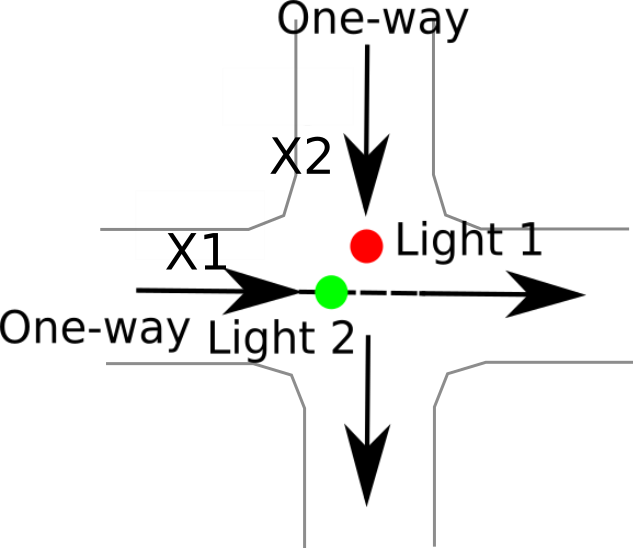
- 대기줄 역학과 이산 시간 스텝을 갖는 MDP로 교통 신호 제어를 모델링한다.
- 단일 교차로에 DQN을 적용하여 최적 일반적 MDP 결과와 일치하는 임계제어를 시연한다.
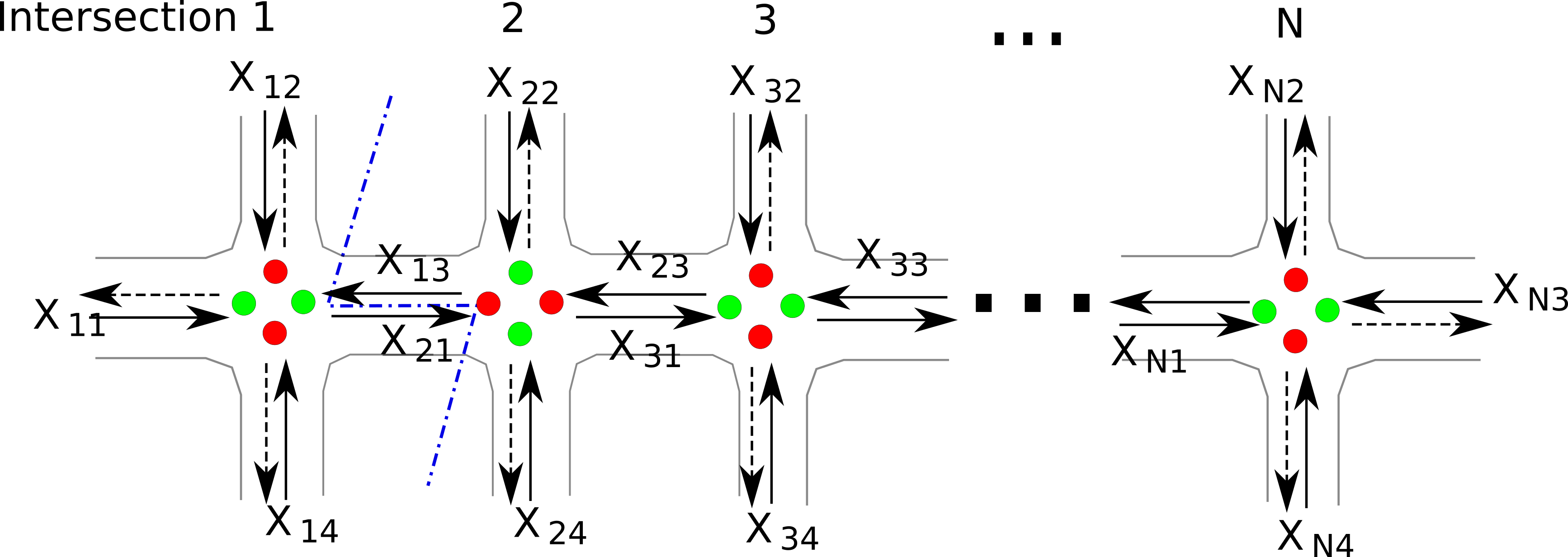
- 격자 네트워크에 DDPG를 적용하여 연속에 가까운 제어를 처리하고 교통 신호에 대한 출력을 이산화한다.
- 정책을 최적화하기 위해 에피소드 장기 혼잡 비용 Z(X)와 할인 인자를 사용한다.
- 제한된 시그모이드 활성화 수정으로 이산적 행동을 생성하는 이산화된 DDPG 변형을 도입한다.
- 지정된 모델 하에서 격자 설정에서 greenwave 패턴이 최적 정책으로 등장함을 시연한다.
실험 결과
연구 질문
- RQ1DRL(DQN)이 전통적 MDP 방법과 비교할 때 단일 교차로에서 최적 또는 근최적 신호 제어를 달성할 수 있는가?
- RQ2DRL(DDPG)가 그리드 도로 네트워크에서 greenwave와 같은 고수준의 지능적 행동을 생성할 수 있는가?
- RQ3정책 품질과 계산 가능성 면에서 단일 교차로에서 격자 네트워크로 DRL 접근법이 어떻게 확장되는가?
- RQ4연구의 교통 모델에서 다수의 교차로가 있는 도로에 대해 greenwave 정책이 최적인가?
주요 결과
- DQN은 단일 도로 교차로에 대한 최적 제어를 제공하며, 결과는 기존의 MDP 최적 정책과 일치한다.
- 격자 도로 네트워크에서 DDPG는 emergent greenwave 패턴을 생성하여 명시적 프로그래밍 없이 고수준의 지능적 행동을 보여준다.
- 5×10 격자에서 greenwave 패턴이 나타나며, DRL이 더 큰 네트워크에서도 확장 가능하고 바람직한 해를 생성할 수 있음을 시사한다.
- greenwave 정책이 다중 교차로가 있는 도로의 지정된 교통 모델 내에서 최적임이 입증된다.
- 연구는 단일 교차로에서 격자 네트워크로 DRL 알고리즘의 확장 가능성과 바람직한 교통 결과 달성을 보여준다.
이 논문 읽기
누빈트 뷰어에서 원문을 열고, 읽으면서 궁금한 곳을 바로 물어보세요.
누빈트에서 이 논문 읽기이 리뷰는 AI가 논문 원문을 바탕으로 만들었습니다. 인용하기 전에 원문을 확인해 주세요.