
[논문 리뷰] Deep Rib Fracture Instance Segmentation and Classification from CT on the RibFrac Challenge
이 논문은 RibFrac 챌린지 데이터셋을 사용하여 CT 스캔에서 갈비뼈 골절의 3D 인스턴스 세그멘테이션 및 분류를 위한 딥러닝 프레임워크인 FracNet+를 제시한다. 포인트 기반 갈비뼈 세그멘테이션과 대규모 사전 훈련된 3D 네트워크를 통합함으로써 골절 탐지에서 최신 기술 수준의 성능을 달성하였으며, 일부 경우에서는 인간 전문가를 뛰어넘는 성능을 보였지만, 복잡한 유형의 골절, 예를 들어 굽은 골절의 분류는 여전히 과제로 남아 있다.
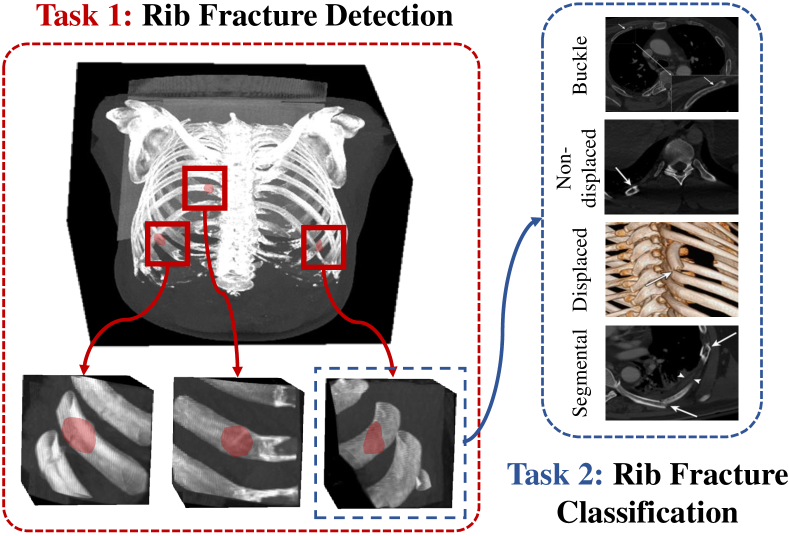
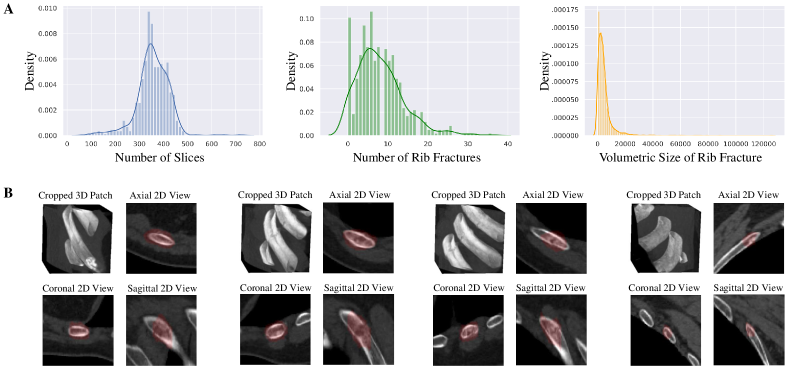
Rib fractures are a common and potentially severe injury that can be challenging and labor-intensive to detect in CT scans. While there have been efforts to address this field, the lack of large-scale annotated datasets and evaluation benchmarks has hindered the development and validation of deep learning algorithms. To address this issue, the RibFrac Challenge was introduced, providing a benchmark dataset of over 5,000 rib fractures from 660 CT scans, with voxel-level instance mask annotations and diagnosis labels for four clinical categories (buckle, nondisplaced, displaced, or segmental). The challenge includes two tracks: a detection (instance segmentation) track evaluated by an FROC-style metric and a classification track evaluated by an F1-style metric. During the MICCAI 2020 challenge period, 243 results were evaluated, and seven teams were invited to participate in the challenge summary. The analysis revealed that several top rib fracture detection solutions achieved performance comparable or even better than human experts. Nevertheless, the current rib fracture classification solutions are hardly clinically applicable, which can be an interesting area in the future. As an active benchmark and research resource, the data and online evaluation of the RibFrac Challenge are available at the challenge website. As an independent contribution, we have also extended our previous internal baseline by incorporating recent advancements in large-scale pretrained networks and point-based rib segmentation techniques. The resulting FracNet+ demonstrates competitive performance in rib fracture detection, which lays a foundation for further research and development in AI-assisted rib fracture detection and diagnosis.
연구 동기 및 목표
- 복잡한 갈비뼈 해부학적 구조와 미세한 골절 유형으로 인해 CT 스캔에서 갈비뼈 골절이 놓치는 임상적 문제를 해결하기 위해.
- 부피적 CT 데이터에서 갈비뼈 골절의 3D 인스턴스 세그멘테이션 및 분류를 위한 강력한 딥러닝 프레임워크를 개발하기 위해.
- 볼륨 기반 CT 데이터에서의 AI 보조 갈비뼈 골절 진단을 위한 벤치마크를 설정하기 위해, 볼륨 수준 마스크와 임상 레이블을 포함한 대규모, 주석 처리된 데이터셋을 제공하기 위해.
- 특히 복잡하거나 간과된 골절 유형에 대해 수동 독해에 비해 정확도를 높이고 해석 시간을 단축하기 위해.
- 기하학적 복잡성과 클래스 불균형과 같은 핵심 기술적 과제를 규명하고 향후 방법론적 개선을 이끌기 위해.
제안 방법
- 해부학적 구조를 추출하고 후속 골절 탐지에 안내하기 위해 포인트 기반 갈비뼈 세그멘테이션 기법을 사용한다.
- RibFrac 데이터셋에 맞춰 미세조정된 대규모 사전 훈련된 3D 컨volution 신경망(예: MONAI 기반 아키텍처)을 통합하여 기능 학습을 향상시킨다.
- 볼륨 수준 정밀도로 다수의 CT 슬라이스에 걸쳐 개별 갈비뼈 골절을 국소화하고 세그멘테이션하기 위해 3D 인스턴스 세그멘테이션 헤드를 사용한다.
- 분류 헤드는 네 가지 임상 유형인 굽은 골절(BK), 이완성 골절(ND), 이완 골절(DP), 세그멘탈 골절(SG)을 예측한다.
- 다중 작업 손실을 사용하여 탐지 및 분류 목표를 통합하고, 정확도 향상을 위해 데이터 증강 기법을 적용하여 프레임워크를 종합적으로 훈련한다.
- 챌린지 이후 개선 사항으로 클래스 불균형과 기하학적 변동성을 해결하기 위해 개선된 데이터 샘플링 및 손실 가중치 조정을 시행한다.
실험 결과
연구 질문
- RQ1딥러닝 모델이 다양한 CT 스캔 볼륨에서 인간 수준 또는 그 이상의 성능을 달성할 수 있는가?
- RQ2기하학적 복잡성과 변동하는 갈비뼈 방향이 3D CNN의 갈비뼈 골절 탐지 성능에 어떤 영향을 미치는가?
- RQ3강력한 탐지 성능에도 불구하고 현재 모델들이 굽은 골절과 세그멘탈 골절과 같은 미세한 골절 유형의 분류에 어려움을 겪는 이유는 무엇인가?
- RQ4포인트 기반 갈비뼈 세그멘테이션을 통합함으로써 골절 탐지의 정확도와 내성은 어느 정도 향상되는가?
- RQ5갈비뼈 레이블링, 중심선 추출 및 골절 진단을 통합한 통합 프레임워크가 전용 파이프라인을 능가할 수 있는가?
주요 결과
- RibFrac 챌린지에서 상위 성능을 보인 여러 모델들이 복잡하거나 간과된 골절을 탐지하는 데서 인간 방사선 전문가의 성능과 유사하거나 이를 초월하는 성능을 보였다.
- 굽은 골절에 대한 예측 인식 기반 F1 스코어가 크게 향상되어 가짜 음성 수가 감소했지만, 미세한 외관으로 인해 여전히 분류가 어려운 것으로 나타났다.
- 세그멘탈 골절은 국소 패치에 의존하고 장거리 구조적 맥락이 부족하여 빈약하게 탐지되었으며, 이는 현재 방법의 핵심 한계를 드러냈다.
- 데이터셋에서 골절 유형의 분포는 불균형적이며, 세그멘탈 골절과 굽은 골절의 수가 적어 모델 일반화에 어려움을 겪고 오류율이 증가한다.
- 제안된 FracNet+ 프레임워크는 사전 훈련된 3D 네트워크와 포인트 기반 갈비뼈 세그멘테이션을 활용하여 탐지 성능에서 경쟁력을 보였으며, 향후 연구를 위한 강력한 기준을 설정했다.
더 나은 연구,지금 바로 시작하세요
논문 읽기부터 검토까지, 연구 시간을 획기적으로 줄여보세요.
카드 등록 없음 · 무료 플랜 제공
이 리뷰는 AI가 만들고, 인간 에디터가 검토했습니다.