
[논문 리뷰] DeepDISC photo-z catalog for JADES DR2 GOODS-S
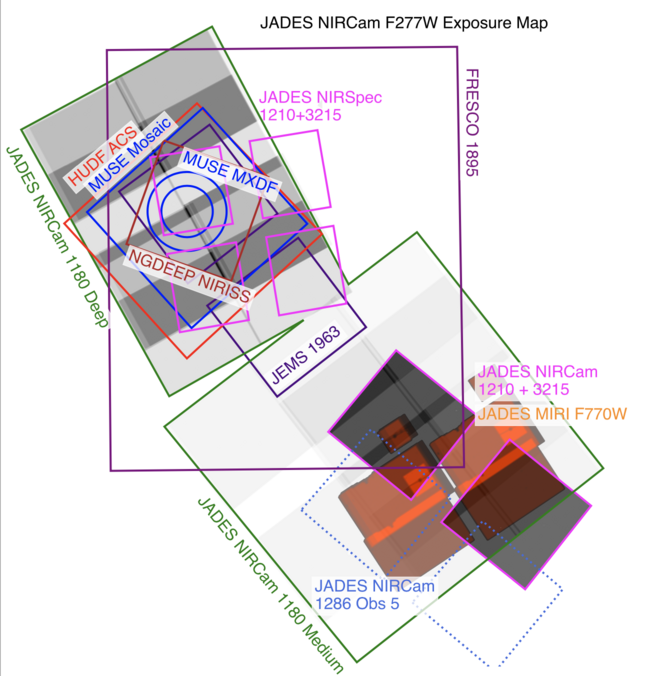
이 논문은 JADES Origins Field (JOF) Cycle 2/3 관측 계획과 초기 JOF 데이터 릴리스를 제시하며, 15개의 필터를 포함한 심층 JWST NIRCam 이미징(중간 대역 포함)과 고z 은 탐색을 가능하게 하고 사진적 적합(z) 카탈로그를 위한 계획된 NIRSpec/NIRCam 분광을 자세히 다룹니다.
README This file contains a photometric redshift catalog for all objects in the JADES DR2 GOODS-S sample. Photo-zs were derived using deep learning framework DeepDISC. Associated paper here. Abstract: Photo-z algorithms that utilize SED template fitting have matured, and are widely adopted for use on high-redshift near-infrared data that provides a unique window into the early universe. Alternative photo-z methods have been developed, largely within the context of low-redshift optical surveys. Machine learning based approaches have gained footing in this regime, including those that utilize raw pixel information instead of aperture photometry. However, the efficacy of image-based algorithms on high-redshift, near-infrared data remains underexplored. Here, we test the performance of Detection, Instance Segmentation and Classification with Deep Learning (DeepDISC) on photometric redshift estimation with NIRCam images from the JWST Advanced Deep Extragalactic Survey (JADES) program. DeepDISC is designed to produce probabilistic photometric redshift estimates directly from images, after detecting and deblending sources in a scene. Using NIRCam-only images and a compiled catalog of spectroscopic redshifts, we show that DeepDISC produces reliable photo-zs and uncertainties comparable to those estimated from template fitting using HST+JWST filters; DeepDISC even outperforms template fitting (lower scatter/fewer outliers) when the input photometric filters are matched. Compared with template fitting, DeepDISC does not require measured photometry from images, and can produce a catalog of 94000 photo-zs in ~4 minutes on a single NVIDIA A40 GPU. While current spectroscopic training samples are small and incomplete in color-magnitude space, this work demonstrates the potential of DeepDISC for increasingly larger image volumes and spectroscopic samples from ongoing and future programs. We discuss the impact of the training data on applications to broader samples and produce a catalog of photo-zs for all JADES DR2 photometric sources in the GOOD-S field, with quality flags indicating caveats. Catalog description Columns ID: JADES DR2 ID matching that from Eisenstein et al 2023 z_phot_mode: mode point estimate from the photo-z PDF l68: lower bound of the 68th percentile confidence interval from the photo-z PDF u68: upper bound of the 68th percentile confidence interval from the photo-z PDF l95: lower bound of the 95th percentile confidence interval from the photo-z PDF u95: upper bound of the 95th percentile confidence interval from the photo-z PDF l99: lower bound of the 99th percentile confidence interval from the photo-z PDF u99: upper bound of the 99th percentile confidence interval from the photo-z PDF forced: whether or not forced photometry mode was used, i.e, DeepDISC did not initially detect the object spec-rep: The number of training sample spectroscopic objects in the corresponding SOM cell based on the object's magnitude/colors. See paper for details. Higher = better and more trustworthy photo-z SOM The SOM is used to identify regions of color-space that are underrepresented by the training sample. It can be loaded with with open('som_trained.p' ,'rb') as f: som = pickle.load(f)
연구 동기 및 목표
- Describe the scientific design and implementation of JWST Cycle 2 and Cycle 3 observations targeting the JADES Origins Field (JOF).
- Deliver an initial data release of deep NIRCam imaging and catalogs for the JOF, connecting to prior HUDF/GOODS-S data.
- Explain the motivation for deep medium-band imaging to improve identification of z>15 galaxy candidates.
- Highlight the planned ultra-deep NIRSpec spectroscopy to study high-redshift galaxies and their physical properties.
제안 방법
- Use JWST NIRCam to obtain very deep imaging in 15 filters, including medium-band filters F162M, F182M, F210M, F250M, F300M, and F335M.
- Combine wide-band and medium-band photometry to improve dropout selection and distinguish high-z galaxies from mid-redshift interlopers (e.g., via Prospector-like SED fitting).
- Plan ultra-deep NIRSpec spectroscopy (G395M, Prism, G140M) to obtain redshifts and emission-line diagnostics for z>3.5 to z>10 sources.
- Publish an initial data release with imaging and catalogs from Year 1 JOF observations, and describe exposure time budgets and depths.
- Discuss how the Cycle 2/3 strategy enhances the search for z>15 galaxies by deep 2 μm-band imaging and spectral sampling.]
- research_questions:[
실험 결과
연구 질문
- RQ1How can deep, multi-band (especially medium-band) NIRCam imaging optimize the identification of z>15 galaxy candidates and rule out mid-redshift interlopers?
- RQ2What are the expected depths and redshift coverages achievable with Cycle 2/3 NIRCam/NIRSpec observations in the JOF field?
- RQ3What is the impact of combining NIRCam imaging with ultra-deep NIRSpec spectroscopy on constraining the high-z galaxy population and their physical properties?
- RQ4How will the JOF data release integrate with existing HUDF/GOODS-S datasets to enhance high-redshift galaxy studies?
주요 결과
- The Cycle 2 program 3215 adopts very deep imaging in F182M, F210M, and F250M to robustly identify z>15 dropouts and distinguish them from interlopers.
- The exposure plan yields up to ~91 hours in key medium bands per filter, enabling high S/N dropout measurements and continuum characterization.
- Cycle 3 NIRSpec observations will provide ultra-deep spectra (G395M, Prism, G140M) to map rest-frame optical lines and enable metallicity diagnostics for high-redshift galaxies.
- The joint Cycle 2/3 strategy will deliver 380 open-shutter hours of NIRCam imaging across 15 filters and substantial MIRI coverage for the JOF, making it exceptionally deep for JWST imaging.
- The initial data release includes NIRCam imaging and catalogs linking to the Year 1 JOF observations and the deeper HUDF-related datasets.

이 논문 읽기
누빈트 뷰어에서 원문을 열고, 읽으면서 궁금한 곳을 바로 물어보세요.
누빈트에서 이 논문 읽기이 리뷰는 AI가 논문 원문을 바탕으로 만들었습니다. 인용하기 전에 원문을 확인해 주세요.