
[논문 리뷰] Depression detection in social media posts using affective and social norm features
이 논문은 BERT 기반 텍스트 표현과 사전 훈련된 정서 분류기에서 유도한 정서적 특징, 그리고 능동적 규범 특징(불결함 및 도덕성)을 후기 융합을 통해 통합한 딥러닝 모델을 제안한다. 이 모델은 최신 기술 수준의 성능을 달성하였으며, 사용자 수준 및 게시물 수준의 우울증 탐지 작업에서 각각 F1 점수를 6.73%, 2.65% 향상시켰다.
We propose a deep architecture for depression detection from social media posts. The proposed architecture builds upon BERT to extract language representations from social media posts and combines these representations using an attentive bidirectional GRU network. We incorporate affective information, by augmenting the text representations with features extracted from a pretrained emotion classifier. Motivated by psychological literature we propose to incorporate profanity and morality features of posts and words in our architecture using a late fusion scheme. Our analysis indicates that morality and profanity can be important features for depression detection. We apply our model for depression detection on Reddit posts on the Pirina dataset, and further consider the setting of detecting depressed users, given multiple posts per user, proposed in the Reddit RSDD dataset. The inclusion of the proposed features yields state-of-the-art results in both settings, namely 2.65% and 6.73% absolute improvement in F1 score respectively. Index Terms: Depression detection, BERT, Feature fusion, Emotion recognition, profanity, morality
연구 동기 및 목표
- 우울증에서 언어 사용에 대한 심리학적 통찰을 통합하여 사회 미디어 내 우울증 탐지 성능을 향상시키기 위해.
- 정서(정서) 및 사회적 규범(불결함, 도덕성) 특징이 우울증 탐지 모델에 기여하는 정도를 조사하기 위해.
- 게시물 수준 및 사용자 수준 분류를 위한 BERT, 정서, 사회적 규범 특징을 융합하는 계층적 딥러닝 아키텍처를 개발하기 위해.
- 소규모(Pirina) 및 대규모(RSDD) 사회 미디어 게시물 컬렉션을 포함한 다양한 데이터셋에서 모델의 성능을 평가하기 위해.
- 특히 자원이 제한된 환경에서, 사회적 규범 특징이 성능 향상에 기여함을 입증하기 위해.
제안 방법
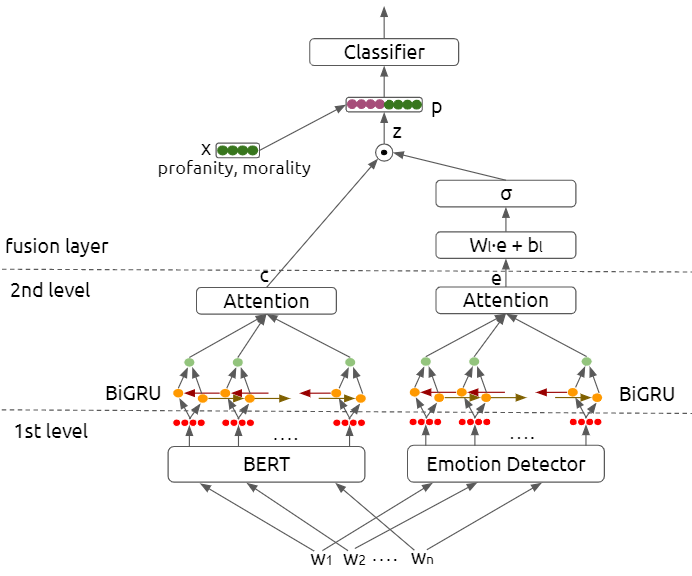
- 모델은 사회 미디어 게시물에서 문맥 기반 단어 표현을 추출하기 위해 BERT(bert-base-uncased)를 사용한다.
- 사전 훈련된 정서 분류기를 사용하여 정서적 특징을 추출하고, 이를 주목적 기반 양방향 GRU(BiGRU) 네트워크를 통해 BERT 표현과 융합한다.
- 불결함 및 도덕성 점수는 사전 정의된 어휘 기반 방법을 사용하여 게시물 및 사용자 수준에서 계산되며, BERT 및 정서 특징과 후기 융합을 통해 통합된다.
- 아키텍처는 이중 수준 설계를 취한다: 첫 번째로 BERT 및 정서 특징은 BiGRU를 통해 처리되고, 두 번째로 표현은 불결함 및 도덕성 특징과 융합 레이어에서 융합된다.
- 최종 분류기는 교차 엔트로피 손실과 클래스 가중치(1:7)를 사용하며, 기초 학습률 1e-3로 Adam을 사용해 10 에포크 동안 훈련된다.
- 게시물 수준 분류에는 10겹 교차 검증을 사용하고, 사용자 수준 분류에서는 사용자당 여러 게시물을 평균화한 후 BiGRU에 입력한다.
실험 결과
연구 질문
- RQ1사전 훈련된 정서 분류기에서 유도한 정서적 특징이 사회 미디어 게시물의 우울증 탐지에 기여하는가?
- RQ2특히 불결함 및 도덕성과 같은 사회적 규범 특징이 우울증 탐지 모델에 의미 있는 기여를 하는가?
- RQ3정서적 및 사회적 규범 특징의 통합이 다양한 데이터셋 크기와 분류 수준(게시물 대 사용자)에서 성능에 어떤 영향을 미치는가?
- RQ4이러한 특징의 성능 향상 효과가 자원이 제한된 환경을 포함한 다양한 사회 미디어 데이터셋에서 일관되게 유지되는가?
- RQ5후기 융합 전략이 BERT, 정서, 사회적 규범 특징을 효과적으로 융합하면서 성능 저하 없이 작동하는가?
주요 결과
- 정서 특징(B+E)을 포함시킨 결과, BERT 전용 기준 대비 재현율이 24% 향상되어 우울증이 의심되는 사용자를 더 잘 탐지함을 시사한다.
- 불결함 특징(P)을 추가한 B+E+P 모델은 RSDD 데이터셋에서 F1 점수 62.73을 기록하여 기존 최고 성능 모델 대비 6.73%p의 절대적 향상을 달성했다.
- Pirina 데이터셋에서는 B+E+P 모델이 F1 점수 95.65를 기록하여 BERT 전용 기준 대비 2.65%p의 절대적 향상을 달성했다.
- 모든 특징(B+E+P+M)을 통합한 결과는 성능 향상이 추가로 이루어지지 않았으며, 이는 상호 간의 중복성 또는 융합의 비효율성을 시사한다.
- 소규모 Pirina 데이터셋(2,000건 미만)에서도 사회적 규범 특징이 성능 향상에 기여함을 확인하여 자원이 제한된 환경에서도 뛰어난 안정성을 입증했다.
- 모델은 RSDD(사용자 수준) 및 Pirina(게시물 수준) 데이터셋 모두에서 최신 기술 수준의 성능을 달성하여 다양한 작업 및 데이터 스케일에 걸쳐 일반화 능력을 입증했다.

이 논문 읽기
누빈트 뷰어에서 원문을 열고, 읽으면서 궁금한 곳을 바로 물어보세요.
누빈트에서 이 논문 읽기이 리뷰는 AI가 논문 원문을 바탕으로 만들었습니다. 인용하기 전에 원문을 확인해 주세요.